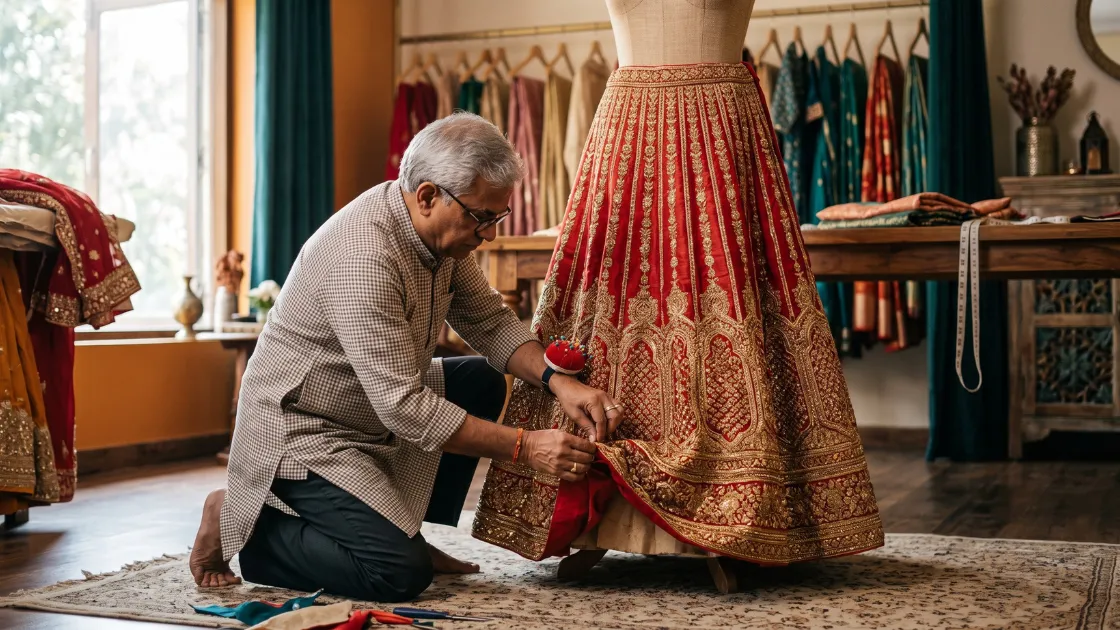
A standard kurti delivered two days late earns you a minor customer complaint. A grand bridal lehenga delivered two days late ends up permanently embedded in a family's wedding story forever—told poorly, to every relative and friend, for decades. That is the implicit operational agreement you accept when you run a luxury bridal boutique: you command the largest ticket sizes and highest billing margins in the entire custom apparel industry, attached firmly to the one calendar date in India that never, ever moves.
Managing a high-stakes bridal studio is about much more than aesthetic talent. Every system, checklist, and scheduling habit in your atelier must be built around one absolute rule: protecting the wedding date at all costs.
Bridal Custom Work Is a Completely Different Business
The financial and operational metrics of bridal custom tailoring diverge completely from everyday alteration or casual wear setups:
- Higher Order Value: A bridal request is almost never a single garment. It encompasses a complete wedding trousseau—the main wedding lehenga or silk saree-gown alongside two or three heavy outfits for the Sangeet, Mehendi, and Reception. Order totals regularly range from ₹25,000 to ₹1.5 Lakhs or more.
- Extended Production Lead Times: Executing intricate hand-embroidered aari, zardosi, and specialized dyeing work requires long lead cycles spanning 45 to 90 days.
- Multi-Stakeholder Dynamics: You are rarely managing a single customer's opinion. You are balancing the emotional expectations of the bride, her mother, opinionated aunts, and frequently an external wedding planner—all at once.
High billing value, long lead times, multiple decision-makers, and one unyielding deadline—a bridal studio demands tighter, bulletproof operational systems than any standard stitching shop. There are no second chances when the wedding mandap is waiting.
The 8-Stage Enquiry-to-Trousseau Workflow
To keep complex multi-garment orders organized without dropping details, route every incoming bridal client through eight written, standardized production stages:
- 1. Initial Enquiry: Capture the exact wedding date, the schedule of independent functions, target budget parameters, and referral channels.
- 2. Design Consultation: Evaluate raw fabric options, design references, Instagram lookbooks, and prepare an initial estimate quote.
- 3. Design Lock & Advance Payment: Secure written sign-off on sketches or sample photos, collect the initial advance deposit, and establish strict delivery dates per outfit.
- 4. Material Sourcing & Hand-Off: Procure silk base fabrics, arrange custom dyeing, and assign specialized embroidery karigars with strict individual deadline cards.
- 5. First Fitting (Base Structure): Conduct a trial on the unadorned base canvas to verify overall structural drape, armhole curves, and body silhouette.
- 6. Second Fitting (Post-Embroidery): Assess the garment after full surface needlework, zardosi embellishments, and structural linings are assembled.
- 7. Final Trial (Full Outfit Ensemble): Test the complete look—including finished blouse closures, dupatta draping, latkan drops, and can-can underskirts.
- 8. Inspection & Handover: Steam-press, complete final quality checks, photograph for boutique lookbooks, and obtain client sign-off upon full balance clearance.
The real power of this workflow lies in transparency: every single stage carries an explicit target date visible to your whole team via a central register or live order tracking system.
Schedule Fitting Dates Backwards from the Wedding Day
Never schedule bridal production forward from today's date. Always map deadlines backward from the event date to build essential safety buffers:
- • Final Garment Handover: At least 7 days before the first wedding function.
- • Final Outfit Trial: 12 to 14 days before the wedding.
- • Second Fitting (Post-Embroidery): Approximately 3 weeks before the event.
- • First Structural Fitting: 5 to 6 weeks before the wedding.
- • Embroidery Master Hand-off: Immediately following design lock and measurement confirmation.
These built-in gaps act as your operational insurance. If a specialized zardosi workshop runs a few days behind schedule, your final handover remains completely protected. A bride who receives her finished trousseau a week early becomes your strongest brand advocate; one who receives it the night before her ceremony shares her anxiety with everyone.
Bridal Body Measurements Change—Plan for Fluctuations
Brides frequently experience weight changes during the hectic months leading up to their wedding. Pre-wedding stress, exercise regimes, and diet shifts commonly alter waist and bust measurements by several centimeters.
Measure at least twice: first at design lock and again during the first structural fitting. Record every measurement set alongside its exact date rather than overwriting previous entries. Always cut with generous internal seam margins to allow for easy last-minute adjustments. Having a dated, chronological measurement history also resolves fitting discussions gracefully—you can refer to exact numbers to show what changed and when. Managing digital measurement records per client makes this historical tracking seamless and permanent.
Enforce Clear Payment Milestones
Bridal boutique finances should be structured around clear payment milestones established at consultation and printed on invoices:
- • 50% Advance Deposit: Collected at design lock to fund raw silk purchases, custom dyeing, and artisan advance fees.
- • 30% Mid-Stage Payment: Due at the first structural fitting before heavy embroidery or finishing work proceeds.
- • 20% Final Balance: Cleared at the final trial prior to garment handover.
Milestones protect both parties. Your material and labor costs remain fully covered, while the client family avoids a single intimidating lump-sum payment during an already expensive period. Record every transaction immediately against the order—uncollected bridal balances are a primary source of seasonal margin leaks.
Managing Family WhatsApp Communication
Most bridal orders rely heavily on family WhatsApp groups for quick communication. Participate actively, but maintain two strict guidelines:
- 1. Identify One Primary Decision-Maker: Establish during consultation whose final approval counts—typically the bride herself—to avoid conflicting design requests from extended family.
- 2. Send Written Meeting Summaries: Follow every in-person consultation or trial with a single written summary message outlining what was approved, any cost adjustments, next steps, and the upcoming fitting date.
Verbal agreements and informal voice notes fade quickly. Clear written recaps keep everyone aligned and protect client relationships as the wedding date approaches.
Streamlining NRI & Destination Bridal Orders
Orders from Non-Resident Indian (NRI) brides represent high-value opportunities featuring larger budgets and streamlined requirements. Because in-person fittings may be limited, manage these orders with a dedicated remote process:
- • High-Definition Video Consultations: Review design references, fabric drape options, and color swatches virtually.
- • Standardized Self-Measurement Guides: Provide a clear measurement form for the bride to take to a local tailor in her city, capturing dated measurements accurately.
- • Dress Form Video Fitting: Conduct a mid-stage video review using a custom-adjusted mannequin matching her exact dimensions.
- • Early International Courier Shipping: Dispatch the finished trousseau at least three weeks prior to international travel dates to allow a comfortable window for local try-ons.
The Pre-Handover Quality Checklist
Before conducting the final trial or packing the trousseau, verify every detail using an outfit-specific checklist:
- • Blouse fastenings, hooks, and internal padding secured firmly.
- • Saree fall and pico edging finished completely.
- • Dupatta borders, tassels, and latkans double-checked.
- • Lehenga lining and can-can structure inspected for comfort.
- • Matching petticoat or underskirt verified.
- • All individual ensemble pieces accounted for.
- • Professional steam-pressing completed.
- • Final invoice and balance details updated.
Maintain a separate checklist for each individual outfit rather than the overall order to ensure no single blouse or accessory is overlooked.
Frequently Asked Questions (FAQ)
How many fittings does a custom bridal lehenga typically require?
A standard bridal lehenga requires two fittings plus a final trial: a first fitting at 5–6 weeks out for base structure, a second fitting at 3 weeks out following embroidery, and a full final trial 12–14 days before the wedding.
What advance deposit should a bridal boutique collect?
A 50% advance deposit at design lock is industry standard, followed by 30% at the first fitting and the remaining 20% balance at the final trial prior to handover.
Can a boutique successfully handle NRI bridal orders remotely?
Yes. By combining video consultations, standardized measurement templates, dated measurement logs, virtual mannequin fittings, and early courier delivery, boutiques can deliver flawless fits for overseas clients.
Elevate Your Bridal Operations with Juvee
Managing high-value bridal orders requires systems designed specifically for complex timelines and custom workflows. The Juvee platform brings order tracking, dated measurement histories, payment milestone alerts, and fitting schedules into a single synchronized system built for fashion designers and bridal studios.
Explore how software for bridal boutiques and designers can transform your boutique floor. Schedule a personalized walkthrough, or start your free Basic plan with the Juvee tailor app on Google Play today. Full access is priced flat at ₹10,190/year—a modest investment that pays for itself with your very first bridal trousseau.
👉 Book Your Free Juvee Platform Walkthrough Today
🔗 Related Resources & Quick Links