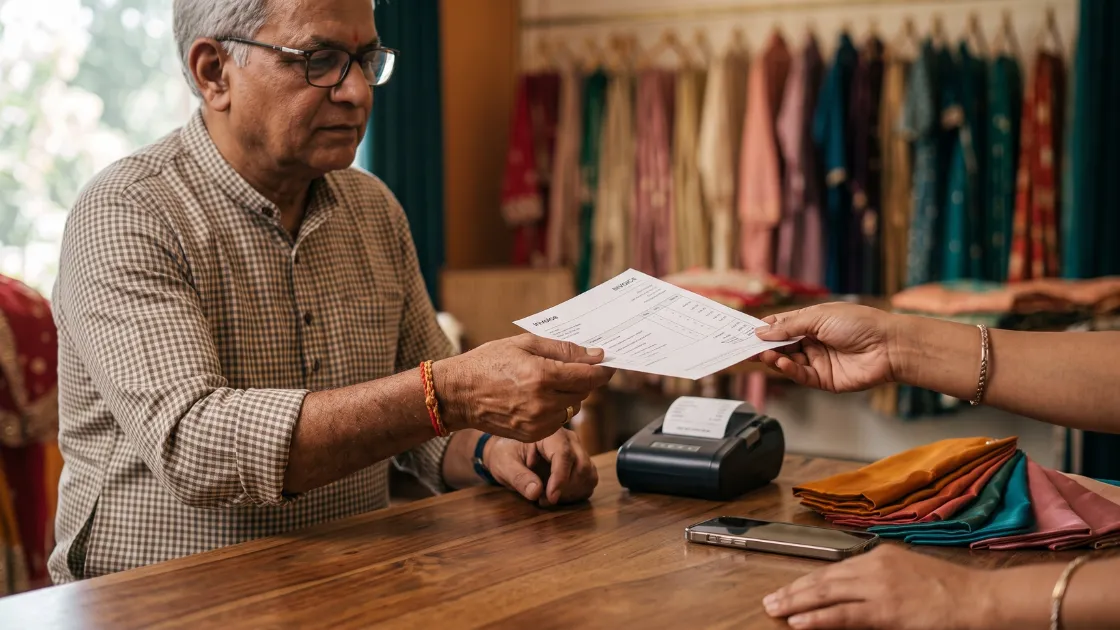
Open your order register right now and count the half-paid orders. In most active Indian boutiques, you will find eight or ten sitting on the pages at any given moment—a ₹2,000 advance taken back in March against a ₹4,800 final bill, the completed garment delivered to the client, and the remaining ₹2,800 balance never collected because nobody remembered it existed.
Multiply that single pattern across twelve months, and custom tailoring shops quietly lose ₹30,000 to ₹50,000 every single year to forgotten balances alone. This is precisely why generic supermarket or retail POS tools fail custom stitching businesses, and why dedicated boutique billing software represents its own specialized category: your invoices are not simple one-time retail sales—they are multi-week stories with instalments.
Why Boutique Billing Breaks Normal POS Software
A standard grocery or retail POS assumes a single, instant point of transaction: item selected, money taken in full, receipt printed, done. A custom boutique bill lives for weeks and flexes in ways standard retail software simply cannot accommodate:
- Multi-Stage Advance Payments: Advances arrive at initial booking, sometimes again during preliminary trials, weeks before the final invoice is completed.
- Irregular Part-Payment Modes: Payments land in odd split amounts—for example, ₹500 in cash today at intake, and ₹1,300 via UPI at pickup.
- Mixed Item Categories on One Bill: A single customer bill combines raw fabric sales (goods), stitching charges (service), and specialized finishing like fall-pico.
- Post-Delivery Alterations: Line items like 'take in the waist' get added after trial or initial delivery, either billed separately or offered free, but requiring explicit record tracking.
- Delivery Date Driven Cashflow: Completion dates, rather than initial booking dates, dictate when balance money actually materializes.
Forcing these dynamic steps through a standard retail app obliges you to maintain a parallel notebook for advances—creating two unlinked systems, double data entry, and the exact same forgotten balances as before.
The Anatomy of a Professional Boutique Invoice
An invoice is your most frequently handled brand asset. A complete, professional boutique bill must carry eight key elements:
- 1. Boutique name, official address, contact number, and GSTIN (if registered).
- 2. Unique serial bill number and creation date.
- 3. Customer name and verified mobile phone number.
- 4. Clear line-item splits: stitching fees, fabric/materials sold, alteration costs, and express charges.
- 5. Detailed advance log with payment dates and payment modes (Cash / UPI).
- 6. Balance due displayed in prominent bold typography—the single number the client should remember upon leaving.
- 7. Prompromised delivery date and a concise one-line alteration policy statement.
- 8. Dynamic UPI QR Code, allowing immediate balance payment the moment the digital invoice is viewed.
A handwritten paper slip accomplishes none of this. A printed or WhatsApp-delivered digital invoice containing these eight elements makes a ₹3,000 custom blouse feel like a true ₹3,000 designer piece.
GST on Boutique Bills: The Short Version
If your boutique is GST-registered, maintain the core distinction: custom stitching is categorized as a service, whereas raw fabric sales are classified as goods. Each carries its own distinct tax rate and code structure on the tax invoice.
Work performed for external commercial brands (job-work) follows separate textile GST guidelines. If your annual turnover remains below the statutory registration threshold, you can bill cleanly without GST, though voluntary registration builds trust when pitching for corporate or school uniform contracts.
Advances and Balances: A Worked Example
Here is how an order ledger should track dynamically across its lifecycle:
| Date | Entry Details | Amount Paid | Running Balance |
|---|
3 Aug | Order Booking: Blouse stitching + Fabric + Fall-Pico | ₹4,800 Total | ₹4,800 |
3 Aug | Initial Advance Deposit (UPI) | ₹2,000 | ₹2,800 |
14 Aug | Paid during Trial (Cash) | ₹1,000 | ₹1,800 |
21 Aug | Final Balance at Delivery (UPI) | ₹1,800 | ₹0 |
Every payment is recorded the moment it arrives, tied directly to the order, with the running balance updated in real time. The logic is simple, yet manual setups fail when entries are deferred to 'later tonight'. Dedicated boutique billing software handles this ledger automatically—updating the invoice, updating customer history, and balancing daily cash logs simultaneously.
Collecting Balances Without the Awkwardness
Boutique owners often hesitate to ask for outstanding balances from long-time clients. Let your billing system handle payment communications naturally:
- At Intake / Billing: "Total is ₹4,800 — ₹2,000 advance today, and I've noted the ₹2,800 balance right on the printed bill so it's ready at pickup."
- Ready Notification: "Your blouse is ready for trial! Outstanding balance is ₹1,800 — UPI or cash, whichever you prefer. See you before 8 PM!"
- Gentle Follow-Up (Day 7): "Friendly reminder from your boutique: ₹1,800 pending on Bill #214. You can use the QR code on your invoice to clear it anytime."
When numbers are clearly documented and reminders follow a standard routine, payment collection becomes seamless and professional.
Let the Software Do the Remembering
Managing advances, part-payments, and balance tracking manually consumes 30 to 45 minutes every day—and still leads to missed collections. Modern boutique billing software automates the process entirely: booking an order generates the invoice, every advance updates the remaining balance, GST rates apply automatically per line item, ready-notifications include exact balances, and a single dashboard highlights every pending rupee across your shop.
Frequently Asked Questions (FAQ)
Which is the best boutique billing software in India?
Choose software built specifically for custom tailoring workflows—capable of handling advance deposits, part-payments, GST splits for combined stitching and fabric sales, and real-time balance tracking. Juvee is purpose-built for Indian boutiques, offering a free Basic plan to test with live orders.
How do boutiques bill stitching and fabric together on one invoice?
List them as distinct line items: custom stitching as a service and fabric as goods, applying appropriate GST rates and codes to each where registered, with all advance payments and running balances clearly detailed below.
What advance deposit percentage should a boutique require?
A 50% advance deposit is standard for regular stitching orders, while structured milestone payments work best for bridal trousseaus. Always document advances directly on the invoice alongside the date and payment method.
Recover Pending Balances and Streamline Your Counter
Add your existing pending balances to Juvee this week and see how quickly outstanding payments clear once automated reminders are enabled. The free Basic plan requires no credit card, the Juvee tailor app is available on Google Play, and full access costs ₹10,190/year—an investment that quickly pays for itself by recovering uncollected balances.
🔗 Related Resources & Quick Links