A customer cannot judge a seam but she can judge a crease. Why pressing and finishing decide what she thinks of the whole garment, what the last twenty minutes should contain, and why it is the first thing dropped.
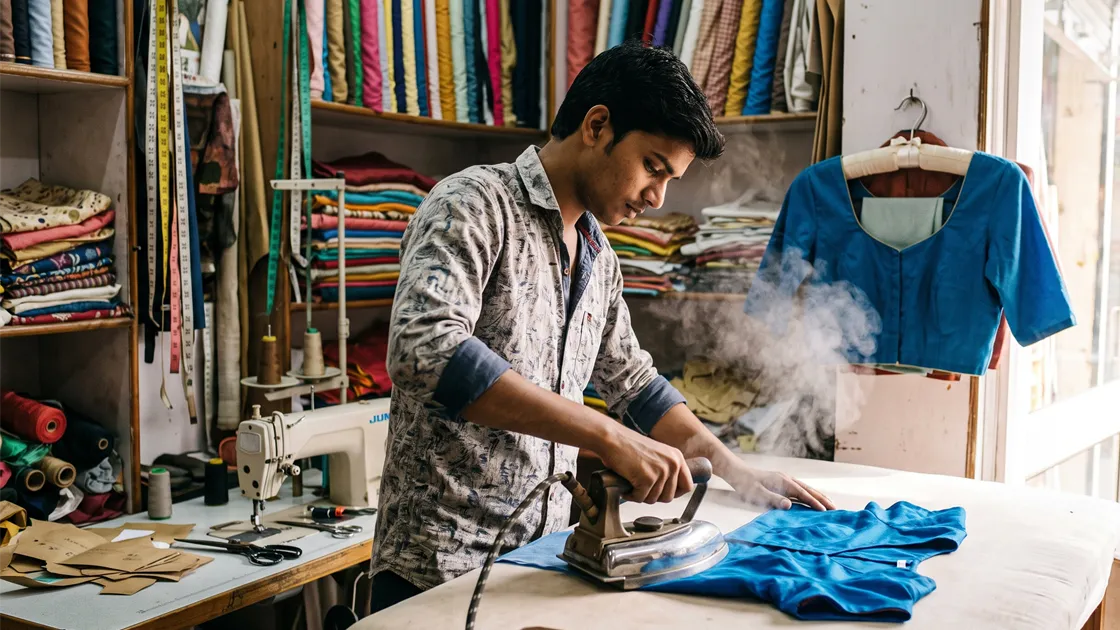
What She Is Actually Looking At
A customer picks up a finished blouse and forms an opinion in about four seconds. She is not examining the seam allowance or the stitch density, because she cannot. She is looking at whether it is crisp, whether the edges lie flat, whether there are thread ends, and whether it is folded like something from a shop or something from a back room.
All four of those are finishing. None of them is stitching. A garment constructed beautifully and handed over creased will be judged worse than an ordinary one that was pressed properly.
This is unfair and it is also completely reliable, which makes it the cheapest quality improvement available to a tailoring shop. Twenty minutes at the end of a garment that took four hours changes what the customer thinks of the four hours.
Pressing Is Not Ironing
The two words are used as though they mean the same thing and the actions are different, which is why so much pressing damages cloth.
Ironing is sliding a hot plate across fabric to remove creases. Pressing is lifting the iron, setting it down on one area, holding, and lifting it off again. You press a seam; you iron a shirt before wearing it.
The difference matters because sliding stretches. A seam ironed along its length comes out longer than it was cut, which is how a neckline goes wavy and a hem ripples. Pressed — down, hold, lift — it stays the length it was.
Three things make pressing work. Steam, which relaxes the fibre so the shape sets. Pressure, which is the weight of the iron and not your arm. And a moment of cooling before the garment is moved — cloth takes its shape as it cools, so a seam lifted while warm goes back to where it was.
Pressing as You Go
The largest single difference between a shop whose garments look finished and one whose garments look homemade is when the pressing happens.
The weak version presses once, at the end. By then the seams are enclosed, the lining is in and the sleeve is set, and the iron cannot reach half of what needs flattening. Whatever was not pressed before it was closed will never be pressed.
The strong version presses at every stage. Each seam is pressed open the moment it is stitched, before the next one crosses it. Darts are pressed towards the centre. The facing is pressed before the lining goes in. By the time the garment is complete, the final press is a tidy-up rather than a rescue.
It feels slower and is not. A garment pressed as it is built goes together more accurately, because flat pieces align and bulky ones do not, and the final press takes five minutes instead of twenty-five.
What the Last Twenty Minutes Contains
Cut every thread end
Inside and out. This is the single most common complaint about an otherwise good garment, and it takes three minutes. A garment with threads hanging reads as unfinished however well it is made.
Check the hardware works
Open and close the zip twice. Fasten every hook. Pull gently on each button. The failure you find now costs four minutes; the one she finds at home costs the garment coming back.
Press in order — inside, then details, then outside
Seams and linings first, then collar, cuffs and plackets, then the body. Done the other way round you will crease what you already pressed.
Use a cloth on anything that shines
Silk, synthetics, dark colours. A pressing cloth between the iron and the garment prevents the shine mark that cannot be removed. On a bridal blouse this is not optional.
Look at it in daylight
Carry it to the door. Shop lighting hides a colour mismatch in the thread, a puckered seam and a mark on pale cloth, and daylight shows all three in two seconds.
Fold and bag it
Folded the same way every time, in a bag or cover. A garment handed over loose arrives home creased and she will remember that, not the fitting.
Why It Is the First Thing Dropped
Finishing disappears in a busy week, and always for the same reason: it is the only stage with nobody waiting on the other side of it.
If cutting is late, stitching stops. If stitching is late, the karigar has nothing. If finishing is late, nothing happens at all — the garment simply goes out less finished, and the shop finds out two days later when somebody brings it back.
That is also why folding it into "stitching" on the job sheet is a mistake. A stage that is not tracked is a stage that can be skipped invisibly. Given its own place in the order’s progress, a garment that reached finishing and did not leave it is visible on the same day.
The other half of the answer is equipment. A shop pressing on a folded blanket on the cutting table, with a dry iron, will drop pressing because it is genuinely difficult. A proper padded board, a steam iron with a full tank and a sleeve board turn twenty minutes of struggle into eight minutes of work, and that is the difference between a step that survives Monday and one that does not.
Frequently Asked Questions
What is the difference between pressing and ironing?
Ironing slides the iron across cloth; pressing sets it down, holds, and lifts it off. Sliding stretches a seam and makes a neckline go wavy. Seams are pressed, never ironed along their length.
Should a garment be pressed during stitching or only at the end?
At every stage. A seam pressed open the moment it is stitched, before the next crosses it, cannot be reached once the garment is closed. Pressing as you go also makes the pieces align better, and the final press then takes five minutes instead of twenty-five.
How do I stop the iron leaving shine marks?
Use a pressing cloth between the iron and the garment on silk, synthetics and dark colours. The mark is the fibre flattening under direct heat, and it cannot be removed afterwards.
Why does finishing get skipped when the shop is busy?
Because nothing waits on it. Late cutting stops stitching; late finishing just means the garment leaves less finished, and nobody finds out until it comes back. Tracking it as its own stage is what makes a skipped finish visible the same day.
Where Juvee Helps
Finishing is skipped because it is invisible. Given its own stage, a garment that reached it and did not leave shows up the same day rather than at the counter — that is what order tracking is for. Juvee’s Basic plan is free with no time limit, and paid plans start at ₹10,190 a year including GST; the pricing page lists them. The stage list this belongs in is set out in order status stages every tailoring shop needs.