Hand work is quoted by feel and almost always under-quoted. How to work out the embroidery cost on a garment so the price survives the hours it really takes, and why the outworker is the part of the shop nobody tracks.
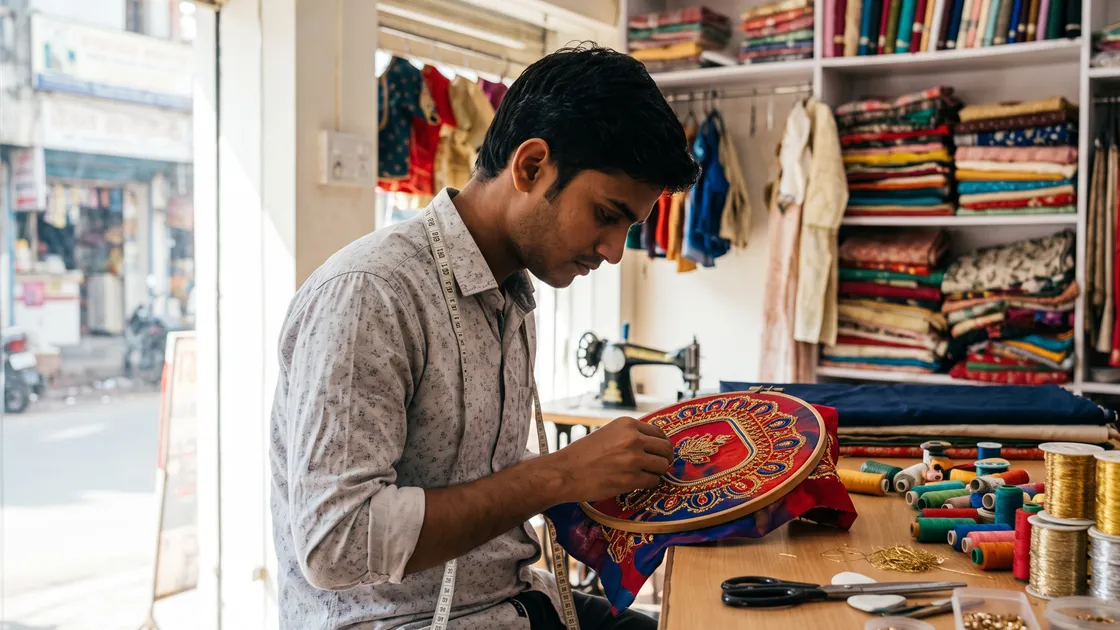
The Quote Given Before Anyone Has Counted
A customer shows a photograph of a blouse with work on the yoke and sleeves and asks what it will cost. An answer is given in about four seconds, from memory of something that looked similar.
Three weeks later the garment has taken eleven hours of hand work instead of the five that were imagined, the embroiderer has been paid for eleven, and the quote covered five. The order was finished at a loss and nobody noticed, because there was never a figure to compare against.
This happens because hand work does not scale the way stitching does. Doubling the area does not double the time — it often triples it, because density, thread changes and the fiddly edges all grow faster than the surface. A quote built on "that looks like twice the last one" is wrong before it leaves your mouth.
What Actually Drives the Hours
Density, not area
A sparse motif across a whole yoke can take less time than a dense one the size of a hand. Ask yourself how much of the surface is actually covered, not how big the design is.
Number of colours
Every colour change is a thread cut, re-thread and restart. A five-colour design is not five times a one-colour design, but it is a great deal more than one.
Type of work
Running stitch and simple chain are fast. Zardozi, aari, mirror work, bead and sequin work are slow and are paid by the hour or by the piece at rates that have nothing to do with ordinary stitching.
The cloth it sits on
Work on chiffon or net takes longer than the same work on cotton, because the ground moves, needs backing, and punishes a mistake. Add a third for anything sheer.
Whether it has to match
Two sleeves that must be identical take more than twice one sleeve. So does a design that must align across a seam.
The finishing afterwards
Beaded and sequinned work cannot be pressed normally, cannot be handled roughly, and often needs a lining added over the back of the work. That is time too, and it belongs in the same quote.
Costing It in Four Numbers
A usable quote needs four figures and ten minutes, and the ten minutes is the only reason shops do not do it.
First, <b>hours</b>. Not a guess — ask the person who will actually do the work, describe the design, and get a number from them. If they cannot say, ask them to do a tenth of it and time that.
Second, the <b>rate</b> for those hours. What you pay the embroiderer, per hour or per piece. If they work by the piece, divide by the hours to get a comparable figure, because that is what tells you whether a job is worth taking.
Third, <b>materials</b>. Thread, beads, sequins, stones, backing cloth, the frame if it is consumed. On heavy work this is not trivial and it is the line most often left out entirely.
Fourth, <b>your margin</b>, on top of both. Hand work ties up a garment for days, carries the risk of being redone and often cannot be rushed. It should carry a higher margin than plain stitching, not the same one.
Write the four down for every hand-work job for two months and you will have something better than any rule of thumb: your own figures for the kinds of work you actually get asked for.
The Outworker Is Where Jobs Disappear
Most hand work in a small shop leaves the building. It goes to an embroiderer who works from home, for you and for four other shops, and from the moment it leaves you have no idea where it is.
This is the single largest source of missed delivery dates in a shop that does decorative work. A garment at an embroiderer looks exactly like a garment being stitched, right up until the day it was promised.
Four things make it manageable, and none of them require trusting anybody less. Give a <b>collection date, not a deadline</b> — "I will come on Thursday morning" is a different arrangement from "I need it by Friday". Give <b>one bundle at a time</b> where you can; an outworker holding six of your garments will finish them in the order that suits him. <b>Write down what went out</b>, with the date, the piece and the agreed rate, because a dispute about which blouse was which three weeks later cannot be settled from memory. And <b>track it as its own stage</b>, so the order shows as being at the embroiderer rather than vaguely in progress.
The shops that deliver hand-work orders on time are not the ones with better embroiderers. They are the ones that know on Tuesday what is still outside the building.
What to Tell the Customer
Hand work is the category where customer expectation and reality separate most easily, and three sentences at the counter prevent most of it.
Give a date that includes the outwork, and add slack. If the embroiderer needs five days, promise on the basis of eight. Hand work is the stage that overruns, and it sits at the end where there is nothing left to absorb it.
Say that hand work is hand work. Two sleeves will be very close and will not be identical, and a machine-perfect match is not what she is buying. Said at the counter this is craftsmanship; said at delivery it is an excuse.
And quote the work separately on the bill — stitching on one line, hand work on another. A customer who sees eleven hundred rupees of embroidery as its own line understands what she paid for. The same amount folded into a single stitching charge just looks expensive.
Frequently Asked Questions
How do you price embroidery work on a garment?
Four numbers: the hours, taken from the person who will do the work rather than guessed; the rate for those hours; materials including thread, beads and backing; and a margin higher than plain stitching, because hand work ties up the garment and carries redo risk.
Why does hand work always run late?
Because it usually leaves the building. A garment at an outworker is invisible and looks exactly like one being stitched until the delivery date. Tracking it as its own stage is what makes it visible on a Tuesday instead of a Friday.
Should embroidery be a separate line on the bill?
Yes. Eleven hundred rupees of hand work shown on its own line is understood; the same amount folded into one stitching charge just reads as expensive, and invites a comparison with a shop that did no hand work at all.
How much slack should I add for outwork?
Promise on roughly half as long again as the embroiderer quotes. Hand work sits at the end of the process where there is no remaining slack to absorb an overrun, so the slack has to be in the promise.
Where Juvee Helps
Hand work is a job within a job: its own hours, its own rate, its own worker and often its own location. Juvee tracks it that way rather than as part of stitching — see production and jobs. The Basic plan is free with no time limit, and paid plans start at ₹10,190 a year including GST; the pricing page lists every plan. For paying the people who do it, read piece rate or monthly.