The three kinds of bill a tailoring shop can issue, what each must carry, and the details that get a bill rejected by a school or a company.
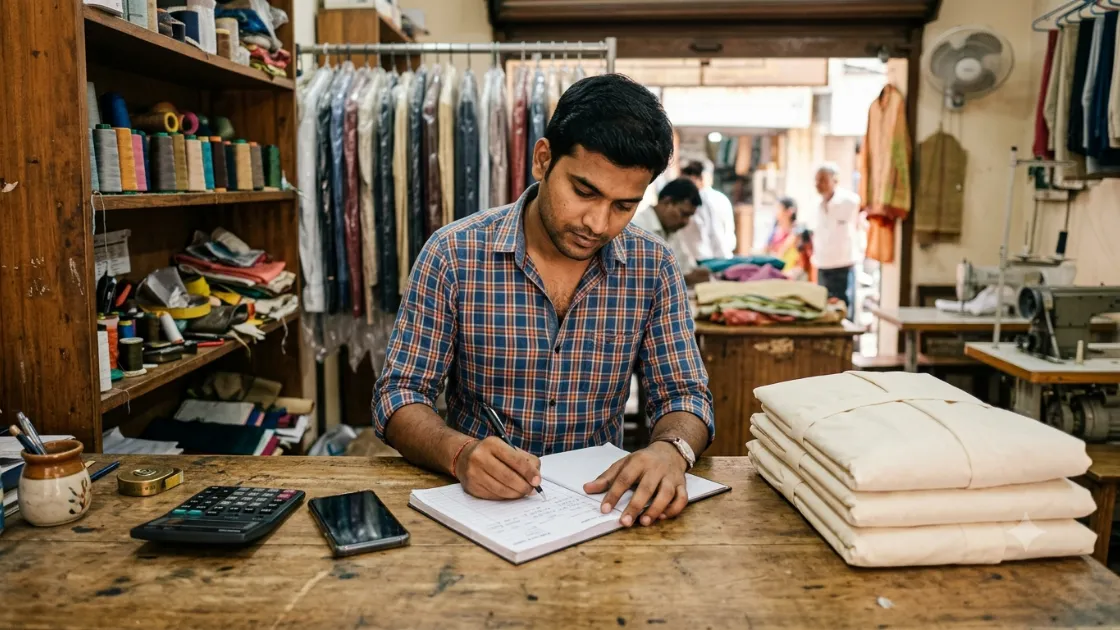
Most days a tailoring shop writes a bill nobody will ever question. Then a school placing a uniform order asks for a proper invoice, or a company wants one for its accounts, and the slip from the receipt book is sent back.
This guide sets out what a tailoring bill has to carry, which of the three kinds applies to your shop, and the details shops most often get wrong.
In this guide:
- The three kinds of bill, and which one you should be issuing
- Every field a tax invoice must carry
- The details that get a bill rejected
- What a shop that is not registered should do
- When the bill has to be issued by
One thing said at the start and again at the end: this explains what a bill must show. It does not advise on whether you should register, what rate applies to your work, or which code to use. Those depend on your turnover and your business, and they are a question for a CA.
Which Bill Does Your Shop Issue?
There are three, and shops routinely issue the wrong one because nobody explained the difference.
| Kind of bill | Who issues it | Shows GST? |
|---|
A plain shop bill | A shop that is not registered for GST | No — and it must not |
Bill of supply | A registered shop under the composition scheme, or supplying exempt items | No |
Tax invoice | A registered shop charging GST normally | Yes, with the rate and amount broken out |
If You Are Not Registered
You issue an ordinary bill. It carries your shop name, the customer, what was stitched, and the amount. It must not show a GST amount or a GSTIN, because you do not have one, and showing tax you are not entitled to collect is a serious matter rather than a paperwork slip.
There is nothing wrong with this. Most small tailoring shops are here.
If You Are Registered Under Composition
You issue a bill of supply. It looks like a tax invoice but shows no GST amount, because under composition you are not collecting it from the customer. Your customer cannot claim input credit against it.
If You Are Registered Normally
You issue a tax invoice, and it has to carry every field in the next section. This is the one a school or a company will ask for.
What a Tax Invoice Must Carry
The GST rules set out the fields. Missing them is not a formatting preference — an invoice with details missing can cost your customer their input credit.
| Field | What it means | Commonly wrong? |
|---|
Your name, address, GSTIN | The shop’s legal name, not just the board name | Yes |
Invoice number | A consecutive serial, unique within the financial year, up to 16 characters | Yes — see below |
Date of issue | The date the invoice is raised | No |
Customer name and address | And their GSTIN if they are registered | Yes |
SAC or HSN code | The code for the service or goods supplied | Yes |
Description | What was stitched or supplied | No |
Quantity and unit | Number of pieces | No |
Total value | Before tax | No |
Taxable value | After any discount | Sometimes |
Tax rate and amount | CGST and SGST separately, or IGST | Yes |
Place of supply | The state | Yes |
Reverse charge | Whether it applies | Yes |
Signature | Of the supplier or an authorised person | Sometimes |
The Invoice Number Is Where Shops Slip
It has to be a consecutive series, unique within the financial year, and no longer than sixteen characters. That rules out three habits that are common in shops:
- Starting the numbers again from 1 in the middle of the year
- Using the same number twice because two people were writing bills
- A long number built from the date, the customer and the order that runs past sixteen characters
A simple series that carries the financial year and runs unbroken is enough, and it is what an auditor looks at first.
When the Bill Has to Be Issued
For a service, the invoice has to be issued within thirty days of the supply. Tailoring work is a service, so the clock starts when the garment is delivered, not when the customer eventually pays.
A bill written three months later, when the customer finally settles, is not late paperwork. It is a late invoice, and the date on it is supposed to be the date of supply.
This is one of the strongest arguments for raising the bill at delivery rather than at payment, quite apart from the fact that a shop which bills at delivery collects more of what it is owed.
The Details That Get a Bill Rejected
When a school or a company sends a bill back, it is almost always one of these.
No GSTIN, or the Wrong One
Yours has to be on it, and theirs does too if they are registered. A company cannot claim its input credit without its own GSTIN on the document.
No SAC or HSN Code
The code identifying what was supplied has to be there. Which code applies to your work is a question for your CA — it depends on what you actually do, and getting it wrong on hundreds of invoices is worse than asking once.
Tax Shown as One Lump
CGST and SGST have to appear separately with their rates, or IGST where the supply is inter-state. A single "GST" line is not enough.
Place of Supply Missing
Usually the state. It decides whether the supply is intra-state or inter-state, and therefore which taxes apply at all.
The Customer Details on a Large Cash Bill
Where the customer is not registered and the invoice is above ₹50,000, their name and address have to be recorded. A large order billed with just a first name will not stand up.
What a Good Tailoring Bill Also Does
Beyond what the rules require, a bill in a tailoring shop is doing a second job the rules say nothing about: it is the record of what was promised.
- The order number, so the bill can be matched to the job
- What was stitched, in the words the customer used
- The advance already taken, and the balance still due
- The delivery date that was agreed
A shop that puts the balance on the bill collects it more often than a shop that keeps it in a diary. That is not a tax point. It is just what happens when the number is in front of the customer.
Frequently Asked Questions
Do tailoring shops need GST registration?
It depends on turnover and on the kind of work you take. Shops handling contracts that require tax invoices may need to consider it regardless. Consult a CA for the requirements that apply to your business.
Can I show GST on the bill if I am not registered?
No. A shop that is not registered must not show a GST amount or a GSTIN. Issue a plain bill instead.
What is the difference between a tax invoice and a bill of supply?
A tax invoice shows GST charged and lets a registered buyer claim input credit. A bill of supply shows no GST — it is issued under the composition scheme or for exempt supplies — and carries no input credit for the buyer.
How should I number my bills?
A consecutive series, unique within the financial year, no more than sixteen characters. Do not restart mid-year and do not let two people issue the same number.
When must the bill be raised?
For services, within thirty days of the supply. For a tailoring shop that means from delivery, not from payment.
Which SAC code applies to tailoring?
That depends on exactly what your shop supplies, and it is worth asking a CA once rather than guessing on every invoice. It is one of the few fields where the wrong answer repeats itself across a whole year of bills.
Bills That Write Themselves
Every field above is the same on every bill except the customer, the work and the amount. Juvee fills the rest in:
- GST-compliant invoices with the rate and amount broken out
- Invoice numbers issued in one unbroken series, so two people cannot duplicate one
- Your shop details and codes set once, not written out each time
- The advance and the balance carried onto the bill from the order
- The bill raised at delivery, sent to the customer on WhatsApp
A bill that comes off the order also matches it, which is the other half of why school and company orders come back.
For the tax side specifically, see our GST billing guide for tailors.
For billing and invoicing generally, see tailor billing software.
For advances and pending balances, see tailor shop accounts.
Try It on This Week’s Bills
Raise the next ten bills properly, at delivery, with the balance on them, and see how many of those balances are still outstanding at the end of the month.
You can explore the free Basic plan.
The Basic plan is free permanently for up to 10 customers and 20 orders a month. Paid plans start at ₹10,190 per year.
This guide explains what a bill must show. It is not tax advice, and whether you should register, what rate applies and which code to use depend on your own business. Consult a CA for the requirements applicable to you.