The two minutes after she says it decide whether she comes back. Here is how to handle the complaint, the alteration and the money.
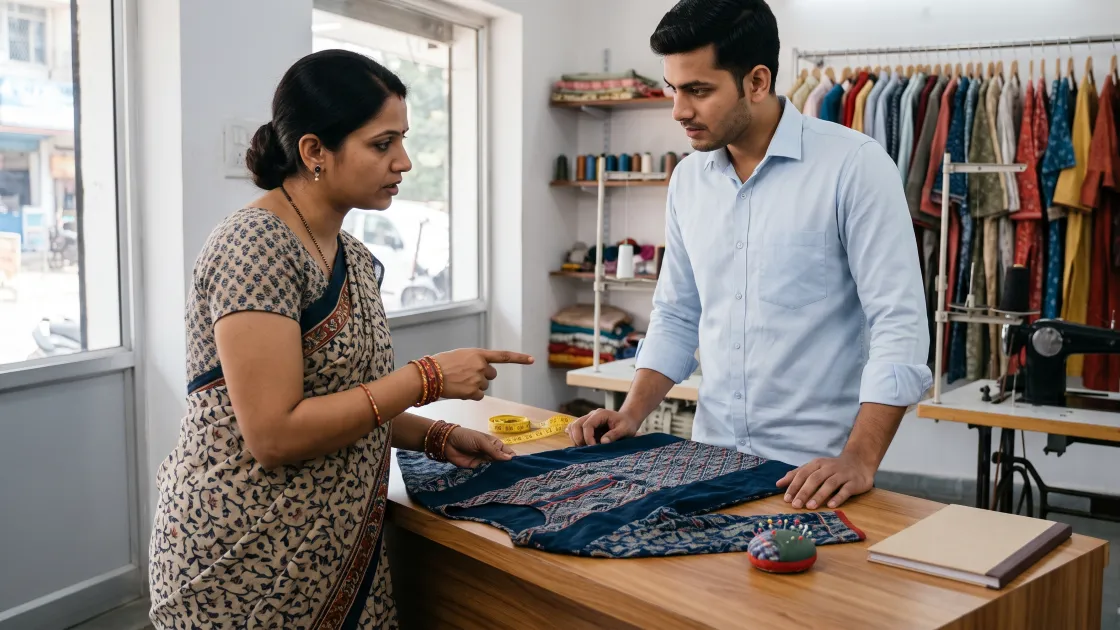
The First Thirty Seconds
She is not enjoying this either. Most customers find it difficult to complain, and by the time she says the words she has usually rehearsed them on the way to the shop.
So the first thing out of your mouth decides the rest of it. Not "it was stitched to your measurement". Not "you must have gained weight". Those may even be true, and they will still cost you the customer and everybody she talks to.
Say instead: "Show me where it is troubling you." Then be quiet and look.
Every fit complaint is really a question: will this shop stand behind its work? Answer that first, and the garment is easy.
Find Out Which of the Three It Is
Almost every fit complaint is one of these, and they need completely different answers. Deciding which one you are looking at is the whole job.
| What it is | How you can tell |
|---|
A stitching fault | The garment does not match the measurements taken | Measure the garment. The numbers are simply wrong |
A fit preference | It matches the measurements but she wants it different | The numbers are right and she says "too loose here" |
A body change | The measurements were right when taken | Old order, and the garment matches the old record |
Measure the garment in front of her. Not to prove anything - to find out. A tape on the counter turns an argument into a shared problem, and most customers relax the moment they see you checking rather than defending.
What to Do About Each
A stitching fault
Fix it free, quickly, and without being asked twice. Do not explain why it happened, do not name the karigar who did it, and do not charge for the cloth. Give her a date and keep it.
A fault fixed well is not a lost customer. It is often the thing that convinces her the shop is honest, which no amount of good stitching can demonstrate on its own.
A fit preference
The measurements were right and she wants it different. This is legitimate and it is not free work, but how you say that matters more than what you charge.
"The stitching is to the measurement we took, and I can absolutely take it in for you - it will be a small charge for the alteration." Said plainly, at the counter, before the work is done. Almost nobody objects to a price they were told in advance.
Then write the new preference against her name, so the next garment is right the first time. This is the part shops forget, and it is the part that stops the complaint repeating.
On keeping preferences with the measurements, see measurement management for tailors.
A body change
An old order, or measurements taken months ago. Say so gently and without making it about her: "These were taken in March - let me measure you again today and adjust it." No comment on the change itself, ever.
Charge for the alteration, and take fresh measurements while she is standing there. You have just gained an up-to-date record, which is worth more than the alteration.
The Rule That Prevents Most of This
A trial before finishing. Not for everything - for anything fitted, anything expensive, anything for a function, and anything for a customer who is new to the shop.
Five minutes at trial stage saves an argument at delivery, and a garment that is adjusted before the finishing is adjusted properly rather than rescued.
- Fix the trial date at the order, and write it on the bill
- At trial, ask her to sit down and raise both arms. Most fit problems appear then and not standing still
- Mark adjustments with pins and chalk while she is wearing it, never from memory afterwards
On taking the order properly in the first place, see how to take measurements for stitching.
When She Never Comes Back for It
The complaint that never gets made is the expensive one. She tried it, it needed altering, she said she would come back, and she did not. That garment is now sitting on your rack, part paid, and she has quietly gone to another shop.
If a garment has been waiting for an alteration for two weeks, that is not a busy customer. Call her. Often the alteration is small and she thought it would be a fuss.
On part-paid orders left waiting, see tailor shop accounts.
Say Your Policy Out Loud
Most shops have a policy in their head - free if it is our mistake, charged if it is a change of mind - and never say it to anybody. Then every complaint becomes a negotiation.
Say it at the order, in one sentence: "If anything is not right with the stitching, I will correct it free. If you want a change afterwards, that is a small alteration charge." Print it on the bill and nobody has to argue at the counter.
Frequently Asked Questions
What should I do when a customer says the garment does not fit?
Ask her to show you exactly where, measure the garment in front of her, and work out whether it is a stitching fault, a preference or a body change. Fix a fault free, charge for the other two, and say the price before doing the work.
Should alterations be free?
Free when the garment does not match the measurements you took. Charged when the measurements were right and something else changed. The important part is that the customer is told which it is, and told before the work is done.
How do I avoid fit complaints?
A trial before finishing on anything fitted, expensive, for a function, or for a new customer. Ask her to sit and raise her arms at the trial. Most problems only appear when the body moves.
A customer says she never gave those measurements. What now?
This is why measurements should be written against the customer with a date, not in a loose book. With a dated record the conversation is thirty seconds and nobody has to be wrong. Without one, assume good faith and fix it.
Should I refuse a customer who complains every time?
Look at your record first. A customer who complains about every garment from every shop is rare; a customer whose preference nobody wrote down is common. If the preference is recorded and she is still unhappy, price her work to include the alteration you know is coming.
For alterations as a line of business, see starting an alteration business.
And alteration shop management software.
For keeping customers coming back, see repeat customers for tailors.
Plans and what each includes are on the pricing page.
Write the Preference Down This Week
The next customer who asks for something a little different: write it against her name before she leaves. That one line is what turns a complaint into a customer who tells people your shop listens.
You can start free on the Basic plan - ten customers, twenty orders a month, no card.