The rent is not the real cost of a location. Here are five things to check before you sign, and one thing everybody worries about that does not matter.
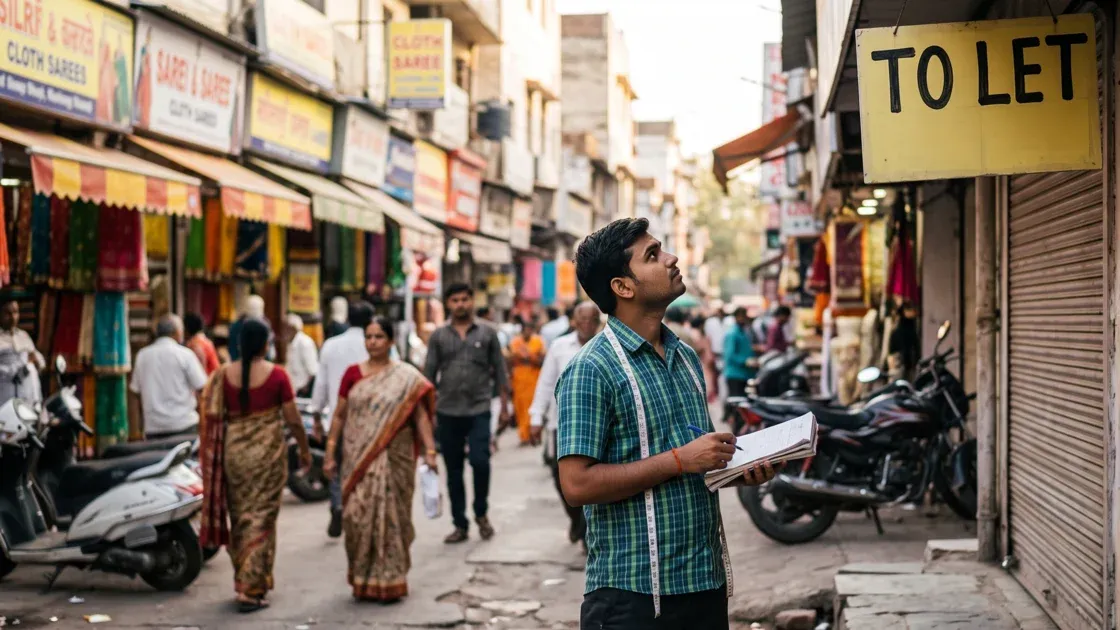
Most people choosing a tailoring shop compare rents. Two units, one is three thousand cheaper, take the cheaper one. A year later the cheaper one is empty and nobody can say exactly why.
Rent is the only number you can see, which is why it gets all the attention. The things that decide whether a tailoring shop works are harder to read off a board.
What a Tailoring Shop Actually Needs From a Location
A tailoring shop is not a general store. It does not live on people walking past who suddenly want something. Almost nobody decides to get a blouse stitched because they saw a shop.
It lives on two things: people who already need stitching done and are looking for somewhere, and people who came once and came back. That changes what a good location means.
Five Things to Check Before You Sign
1. Who walks past, not how many
Stand outside the unit for two hours on a weekday evening and two hours on a Saturday. Count, and look. A hundred office workers hurrying to a bus is worse for you than twenty women with shopping bags.
The cloth shops nearby matter more than the footfall number. Somebody buying material is somebody who needs it stitched, and they usually want that decided the same day.
2. What is already there
Three tailors on one street is not automatically bad. People go to a street to get stitching done, the way they go to a street for gold. What matters is whether those three are busy, and what they do not do.
If all three are gents tailors, a ladies tailor has a street full of customers and no competition. If all three do exactly what you plan to do and two of them look empty, that is your answer.
3. Whether she can stop
This is the one nobody checks. Can a customer park a two-wheeler outside for four minutes without arguing with anybody? Can she stand at your counter without being in the way of the road?
A shop on a main road with nowhere to stop loses to a shop in a lane with space outside. Every single time.
4. Light, and the room behind
You need daylight at the counter, because colour matching in tube light is how disputes start. You need space behind for the machines, a rack for finished work, and somewhere the cloth can sit without being walked on.
A wide shallow shop looks better and works worse than a narrow deep one. The counter needs the front; the work needs the back; they should not be the same space.
5. The total, not the rent
Rent, advance, current, water, any maintenance, and the cost of making the place usable. A cheaper unit that needs wiring, a counter and a shutter can cost more in year one than the expensive one next door.
Our post on what it costs to open a tailoring shop has the full list of what comes at you in the first month.
The Thing That Matters Less Than You Think
Being on the main road.
Main-road rent is often double, and for a tailoring shop it buys visibility to people who were never going to stop. A tailoring customer finds you by asking somebody, by seeing your work on somebody, or by searching on a phone. All three of those work identically in a lane.
What main-road frontage does buy is the first six months, while nobody knows you exist yet. If your budget is thin, that is an expensive way to buy a reputation you could build another way.
Before You Sign
- Ask why it is empty. Shops go empty for reasons. Ask the neighbours, not the owner.
- Check the agreement length and the increase. A rent that rises sharply in year two has ended more shops than a rent that started high.
- Find out what the last business was and how long it lasted. Three failed businesses in four years is the location telling you something.
- Confirm the power. Machines, lights, an iron and a fan on a connection sized for a tea stall is a problem you discover in month two.
If You Cannot Afford the Right Place Yet
Start from home. It is not a lesser beginning; it is how a large number of good shops began, and it removes the one cost that kills new shops before they find their feet.
Our post on running a tailoring business from home covers how to do it properly, and getting your first customers matters more at that stage than any address.
Frequently Asked Questions
Is a main road necessary for a tailoring shop?
No. Tailoring customers arrive by recommendation, by search, or by seeing your work, and all of those reach a lane as easily as a main road. Main-road rent mainly buys early visibility while nobody knows you yet.
Is it bad to open near other tailors?
Not by itself. People go to a known street to get stitching done. What matters is whether the existing shops are busy and whether they already do what you plan to do.
How much space does a tailoring shop need?
Enough for a counter at the front with daylight, machines behind, and a rack for finished work that is not in anybody’s way. Depth is more useful than width.
Should I take a cheaper shop in a worse location?
Compare the total first year, not the rent: advance, wiring, counter, shutter, and the months of quiet while people find you. Cheap units are often cheap for a reason the board does not mention.
How long before a new tailoring shop is busy?
Longer than most people plan for. Keep enough to pay rent through the quiet months, and read whether a tailoring shop is profitable in India before committing to a rent you have to earn immediately.
Spend Two Saturdays Before You Spend the Advance
Stand outside both shortlisted units on two Saturdays and watch. Who walks past, who stops, where they park, where they came from. Two afternoons is nothing against a year of rent.
When the shop is open, the thing that decides whether it grows is whether you know your own numbers. Juvee’s free Basic plan costs nothing and keeps your orders, measurements and dues in one place from day one, which is the habit that is hard to start later.