The churidar is the one piece customers send back most, and almost always for the same two reasons. This chart lists every measurement a churidar needs, where tailors go wrong, and how much ease to leave.
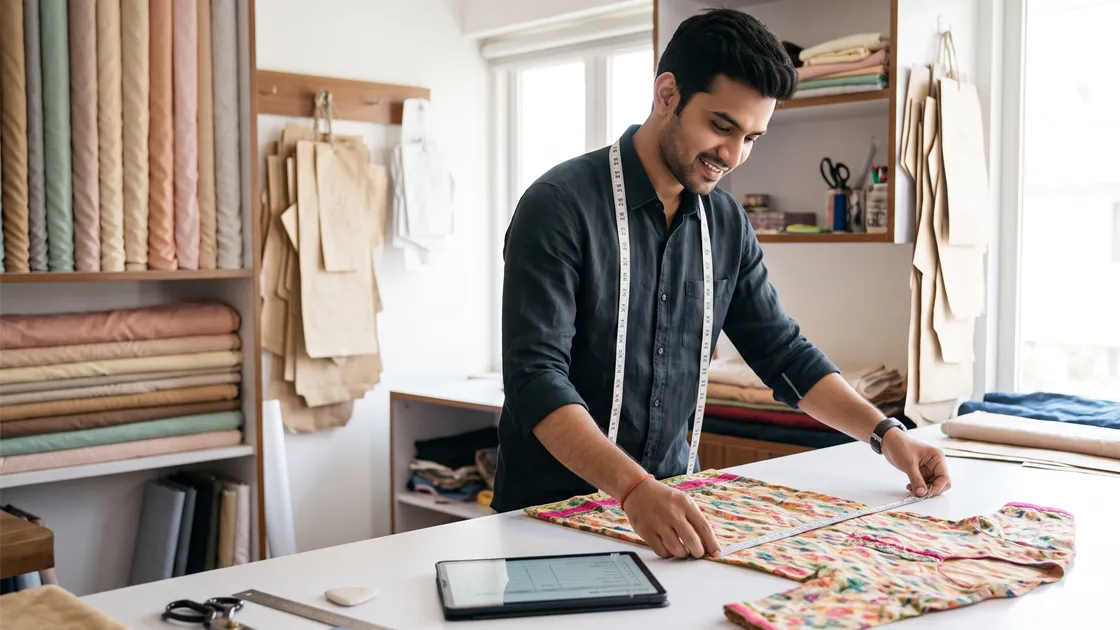
Why the Churidar Is Sent Back More Than Anything Else
A kameez that is slightly loose still looks fine. A churidar that is slightly loose does not — it loses the gathers at the ankle, which is the whole point of the garment. That is why a churidar has less room for error than almost anything else on your cutting table.
Two faults account for most returns. The first is length: the churidar needs extra length above the ankle so it gathers into those bangles of cloth, and a tailor who cuts to the plain ankle measurement produces a straight-legged pyjama. The second is the thigh and knee: too tight and she cannot sit, too loose and the gathers ride up the calf and never settle.
Both are measurement problems, not stitching problems. Get the numbers right and the rest follows.
The Ten Measurements a Churidar Needs
Take every one of these, even for a repeat customer. Bodies change, and a churidar shows it before anything else does.
- Waist — around the natural waist, where she actually ties it, not where a chart says the waist is
- Hip — at the fullest point, usually 20 to 22 cm below the waist
- Thigh — around the fullest part of the upper thigh
- Knee — around the knee, standing straight
- Calf — around the widest point of the calf
- Ankle — snug around the ankle bone, no ease at all
- Full length — from the waist down to the floor, over the ankle bone
- Churidar length — full length plus the gathering allowance, explained below
- Crotch depth — sitting on a hard chair, from the waist down to the seat
- Crotch length — front waist, through the legs, to the back waist
Write them down at the counter, not afterwards. A measurement carried in the head to the back of the shop is the one that goes wrong, which is why a digital measurement record beats a notebook for anything you will stitch again.
The Gathering Allowance — the Number Most Tailors Guess
This is the measurement that separates a churidar from a pyjama, and it is the one most often guessed at.
The extra length below the knee is what forms the gathers. As a working rule, add 15 to 22 cm to the full length. Use the lower end for a slim leg and a soft fabric, the higher end for cotton, which holds its shape and needs more cloth to fold properly.
Customers differ on how many gathers they want. Some ask for four or five tight bangles; others want two soft folds. Ask, and write the answer next to the measurement — it is the sort of preference she will expect you to remember next time.
How Much Ease to Leave
Ease is the room you add to the body measurement so the garment moves. A churidar takes less of it than any other bottom.
- Waist — add 2 cm, or 0 if it takes a drawstring
- Hip — add 4 to 5 cm
- Thigh — add 4 cm, no more; this is the one that gets over-eased
- Knee — add 3 cm
- Calf — add 2 to 3 cm
- Ankle — add nothing, or 1 cm at most
Stretch fabric changes all of this. On a cotton lycra mix, take the ease down by half — the fabric supplies the rest, and a churidar cut with woven ease in stretch cloth bags at the knee within a week.
Three Mistakes That Cost You a Remake
Measuring over a thick salwar
Always measure over close-fitting clothes, or ask her to hold the tape against the skin at the waist and hip. A bulky salwar adds two or three centimetres at the hip and the churidar is loose before you have cut a thing.
Taking the ankle too generously
The instinct is to leave room so the foot goes through. It does not need it — the gathers give enough stretch, and a loose ankle is the single most common complaint on a returned churidar. If she cannot get her foot through, the answer is a short side opening, not a wider ankle.
Forgetting the crotch depth on a seated customer
Crotch depth is taken sitting. Taken standing, it comes out short, and the churidar pulls every time she sits down. It takes ten seconds and prevents the complaint that is hardest to fix after cutting.
A Ready Reference by Size
Use these as a starting point when a customer orders for someone who is not present. They are not a substitute for measuring — they are for the order you would otherwise refuse.
- Small — waist 66 to 71 cm, hip 86 to 91, thigh 51, knee 34, ankle 23, length 96
- Medium — waist 71 to 76 cm, hip 91 to 97, thigh 55, knee 36, ankle 24, length 98
- Large — waist 76 to 84 cm, hip 97 to 104, thigh 59, knee 38, ankle 25, length 99
- Extra large — waist 84 to 94 cm, hip 104 to 112, thigh 64, knee 41, ankle 26, length 101
Add the gathering allowance to the length in every case. And note on the bill that the garment was cut to a standard size, so there is no argument later about a fit nobody measured for.
Keeping the Chart So You Can Use It Again
A churidar customer is a repeat customer. She will come back for the next set, and the next, and the value of the first measurement is that you never have to take it again.
That only works if the numbers are where you can find them. A notebook works until the notebook is full, or at home, or the page is the one with tea on it. Recording measurements against the customer's name — with the gather preference and the fabric noted beside them — means the second order takes two minutes instead of fifteen, and it is the whole argument for a tailor app on the phone rather than a register under the counter.
Frequently Asked Questions
How much extra length does a churidar need?
Between 15 and 22 cm above the full ankle length. Use the lower figure for slim legs and soft fabrics, the higher for cotton and for customers who want more gathers. Ask how many bangles she wants and write it down.
What is the difference between a churidar and a salwar measurement?
A salwar is loose and needs waist, hip, length and ankle. A churidar is fitted from the waist to the calf, so it also needs thigh, knee, calf and both crotch measurements. Our salwar kameez measurement guide covers the looser cut in full.
How tight should the ankle be on a churidar?
Snug against the ankle bone, with no ease or at most one centimetre. The gathers provide the give. If the foot will not pass through, add a short side opening rather than widening the ankle.
Do stretch fabrics need different measurements?
The body measurements are the same. The ease is roughly halved, because the fabric supplies it. A churidar cut with woven ease in a lycra mix will bag at the knee within a few wears.
Where Juvee Helps
Every measurement above, saved against the customer's name and on your phone at the counter, so the second churidar takes two minutes. Juvee's Basic plan is free with no time limit, and paid plans start at ₹10,190 a year including GST — the pricing page lists every plan.