Every tailoring shop has three or four months when the orders thin out. The shops that struggle are not the ones with a bad season — they are the ones that did not plan for it.
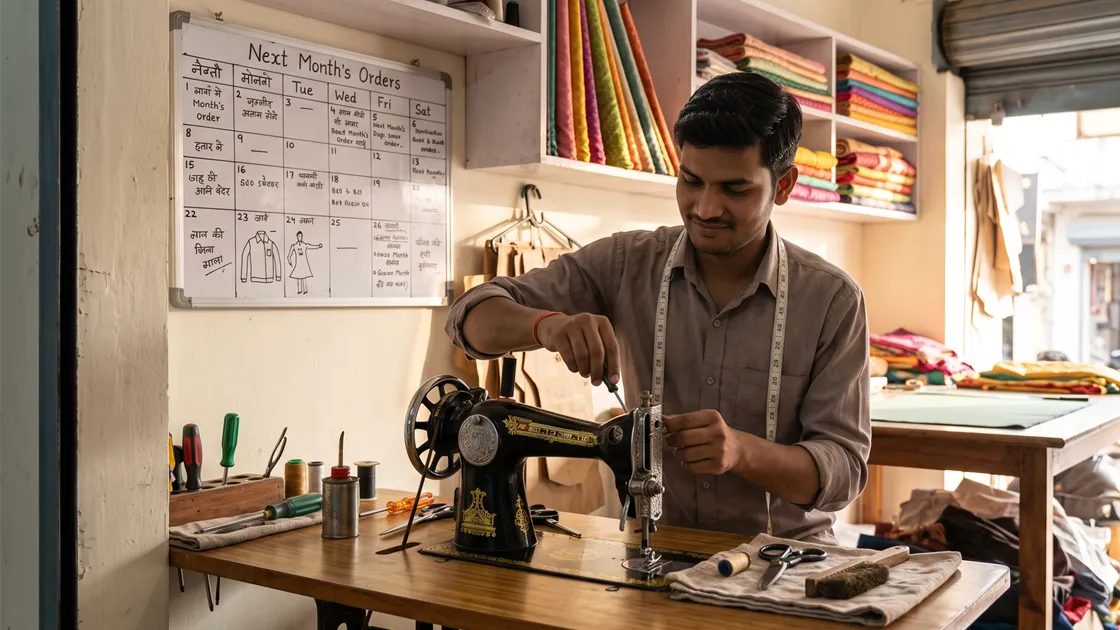
The Shape of a Tailoring Year
Tailoring income is not spread evenly and never has been. In most of India the pattern runs something like this.
- Peak — the festival run from Onam and Ganesh Chaturthi through Navratri and Diwali, and the wedding months that follow
- Strong — the spring wedding season, and the school reopening weeks for uniform work
- Thin — the weeks after the festival season ends, when everyone has just spent
- Thin — the deep monsoon in most regions, and the inauspicious months in the local calendar when weddings do not happen
The exact months differ by state, and the only calendar that matters is your own. But the shape is the same everywhere: four or five very good months, four ordinary ones, and three or four that do not cover the rent. Our note on a tailoring shop year season by season goes through the calendar in detail.
The Mistake Is Made in the Good Months
An off-season cash problem is not created in the off season. It is created in October, when the money is coming in faster than it ever does and the shop treats it as income rather than as the year's income arriving early.
That is when the new machine is bought outright, the extra karigar is taken on permanently, and the family expenses expand to match the takings. In February the machine payment, the karigar's salary and the higher household costs are all still there and the orders are not.
The discipline that fixes it is unglamorous: work out your monthly fixed cost, and put that many months of it aside during the peak before spending anything on expansion. Rent, electricity, salaries, EMIs, your own household minimum — add them, multiply by four, and treat that as untouchable. Everything above it is genuinely available.
Most shops cannot do this because they do not know their monthly fixed cost. That is worth an evening to work out once, and our note on keeping tailor shop accounts covers how to get at it.
Work That Fills a Thin Month
The off season is not empty of demand. It is empty of the demand you are used to. These are the things that are there when new stitching is not.
Alterations and repairs
The most reliable off-season work there is, because it does not follow the festival calendar — people lose weight, gain weight and tear things all year. Margins per garment are small and the turnaround is fast, which is exactly the right shape when the machines are idle. Many shops treat alterations as a nuisance during peak and then have no reputation for them in February. Our note on what to charge for alterations covers the pricing, and there is a dedicated page on running that side properly.
Uniform and institutional work
School and college uniforms, hospital and hotel staff wear, and shop uniforms all run on a different calendar from weddings, and the orders are placed months ahead. A single school contract can carry a shop through two thin months. The approach is worth starting well before you need it — see school uniform manufacturing.
Woollens and off-season garments
In the north and the hill regions, jacket, coat and woollen work fills the winter weeks. In the south, the equivalent is the quieter categories — nighties, kaftans, daily-wear kurtis, petticoats and blouse stock — the everyday items nobody orders in a rush but everybody needs.
Stock, not orders
If you have idle machine hours and the cloth, stitching ready pieces in standard sizes to sell from the shop turns dead time into inventory. It ties up cash, so it is for shops that already have the reserve, not shops trying to create one.
Use the Quiet Weeks for What You Cannot Do in October
The off season is the only time a shop has for the work that improves the shop, and most of it costs nothing but the hours you already have.
- Train the newer karigars. There is no time in season, and a hand you trained in February is worth double in October. Our note on training a new karigar sets out a plan.
- Service the machines. All of them, properly. A breakdown in peak week costs more than a year of servicing.
- Clear the uncollected-garment shelf. Chase, sell or dispose of it, and get the space back before season.
- Get the measurements onto something you can search. Copying a notebook into a system is a February job, and it pays back on the first repeat order in October.
- Photograph your best work. You have the time and no pressure. This is the stock of pictures that carries your Instagram through the next nine months — see Instagram marketing.
- Call your regulars. Not to sell anything. A shop that contacts a customer only when it wants money is remembered differently from one that does not.
Bring the Customers to You
The off season is when a customer list stops being a nice idea and starts being the difference between a thin month and an empty one.
A shop with five hundred past customers and their numbers has something to work with. A pre-season offer in the first week of a quiet month, a reminder to the customers who ordered a blouse last October, a discount on alterations for anyone who ordered in the past year — none of these are sophisticated, and all of them are impossible if the numbers are in a register nobody can search.
This is the practical argument for keeping customer records you can filter: not for the peak, when work arrives anyway, but for the months when you have to go and find it. Our note on getting repeat customers covers the messaging.
Karigars in the Thin Months
This is the hardest decision in the off season and the one that decides the following peak.
A karigar let go in January will be working somewhere else in September, and the good ones do not come back. A shop that keeps its team through a thin quarter starts the season at full strength while its competitors are training replacements.
The choices that avoid the sack: shift piece-rate hands onto alteration and uniform work rather than sending them home; agree reduced hours openly for a fixed number of weeks; move some of the annual leave into the quiet months by arrangement. What does not work is saying nothing and simply paying late — that costs you the karigar anyway, and your reputation with the next one. Our note on piece rate or monthly pay covers how the pay structure changes this.
Frequently Asked Questions
How much money should a tailoring shop keep aside for the off season?
Work out your monthly fixed cost — rent, power, salaries, EMIs and your own household minimum — and aim for about four months of it, set aside during the peak before spending anything on expansion.
What work is available in the off season?
Alterations and repairs, which run all year; uniform and institutional contracts, which are placed months ahead on a different calendar; and the everyday categories nobody orders in a rush — nighties, kurtis, petticoats, blouses.
Should I let karigars go in the off season?
Only as a last resort. A karigar let go in January is working elsewhere in September. Move them onto alteration and uniform work, or agree reduced hours openly for a fixed period, rather than losing the team before the season.
When is the off season for a tailoring shop in India?
Usually the weeks just after the festival run ends, the deep monsoon, and the months the local calendar treats as inauspicious for weddings. The exact months vary by region — the only calendar worth planning against is your own shop's last two years.
Where Juvee Helps
The off season runs on two things you cannot build in a hurry: a customer list you can actually search, and a year's figures that tell you which months are really thin. Juvee keeps both as you go. The Basic plan is free with no time limit, and paid plans start at ₹10,190 a year including GST — every plan is on the pricing page.