A blazer has more measurements than any other garment in the shop, and the fit is judged on three of them. This chart lists all of them and says which three decide the job.
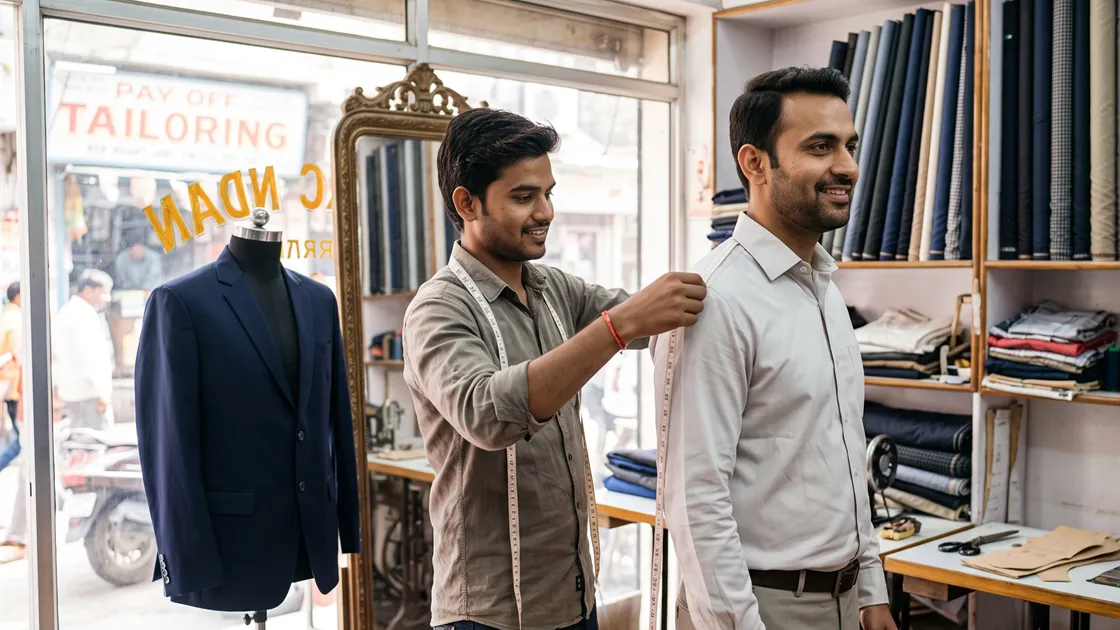
Why a Blazer Is Judged Differently
Most garments are judged on whether they are comfortable. A blazer is judged on how it looks from behind when the customer is standing still, and that is a much harder test.
Three things decide it. The shoulder, because a shoulder seam that sits wrong cannot be corrected after cutting. The chest, because too little room makes the front buttons pull into an X. And the sleeve length, because a cuff that covers the wrist is the first thing anybody notices in a photograph.
Everything else on the list below matters, but those three are the ones that decide whether the customer wears the jacket or leaves it in the cupboard.
Every Measurement a Suit Needs
Take the jacket and the trouser separately, and write them in two blocks. A single long column of eighteen figures is where mistakes hide.
For the jacket
- Shoulder — across the back, from the point of one shoulder to the other
- Chest — around the fullest part, tape level, arms down
- Waist — around the natural waist, at the narrowest point of the torso
- Seat — around the hips, where the jacket hem will fall
- Jacket length — from the base of the collar down the back to where the hem should sit
- Sleeve length — from the shoulder point, over a slightly bent elbow, to the wrist bone
- Bicep — around the fullest part of the upper arm, arm relaxed
- Cuff — around the wrist, plus the allowance below
- Back width — across the back between the armhole creases
- Front chest width — across the front between the armhole creases
- Neck — around the base of the neck, two fingers of ease
- Armhole depth — from the shoulder point down to the level of the armpit
For the trouser
- Waist — where he actually wears the trouser, not where the jacket waist was taken
- Seat — around the fullest part of the hips
- Thigh — around the fullest part of the upper thigh
- Knee — around the knee
- Bottom — the finished opening at the hem
- Outseam — from the waistband down the side to the floor
- Inseam — from the crotch down to the ankle bone
- Crotch — sitting, from the waist to the seat
Twenty figures is a lot to carry to the cutting table on memory, and a suit is too expensive a garment to re-cut. Keeping them against the customer's name in a measurement record is worth more here than on any other order you take.
The Shoulder — Get This Wrong and Nothing Saves It
Ask him to stand straight, facing away from you, arms hanging loose. Find the bony point at the outer end of each shoulder. Measure straight across the back between the two, following the curve of the body rather than pulling the tape flat.
One thing worth knowing: most people have one shoulder lower than the other, usually the writing hand's side. Look for it. If it is obvious, note which side and by how much, and cut the two sides differently. A customer who has never had a jacket fit properly across the back has usually been getting symmetrical jackets on an asymmetrical body.
Shoulder measurement is the one that cannot be altered afterwards. A tight chest can be let out if you kept the seam allowance. A long sleeve can be shortened. A wrong shoulder means a new jacket.
How Much Ease a Jacket Needs
A jacket goes over a shirt, so every measurement needs more room than the body. This is where tailors new to suiting lose confidence, because the numbers feel large.
- Chest — add 10 to 12 cm for a regular fit, 7 to 8 cm for a slim fit
- Waist — add 8 to 10 cm, and never less than the chest ease minus 4
- Seat — add 8 cm
- Bicep — add 8 to 10 cm; a tight bicep is a common complaint and an awkward alteration
- Cuff — add 4 cm to the wrist
- Neck — add 2 cm
- Shoulder — add nothing; the measurement is the measurement
Trousers take much less. Add 2 cm at the waist, 4 cm at the seat, 4 cm at the thigh, 2 cm at the knee. The bottom is a finished figure, not a body figure — ask him, or work to 40 to 42 cm for a regular leg and 36 to 38 for a slim one.
Sleeve Length, and the Half Inch of Shirt Cuff
The convention is that about a centimetre of shirt cuff shows below the jacket sleeve. That is what makes a suit look tailored rather than borrowed.
To get it, measure the sleeve with the elbow slightly bent — not locked straight, which gives a figure that is short every time he reaches for anything. End at the wrist bone. Then, if he has told you the shirts he will wear it with, take a centimetre off so the shirt shows.
If he is buying the suit for a wedding and does not know what shirt he will wear, cut to the wrist bone and tell him the sleeve can come up by a centimetre in twenty minutes. That is an honest thing to promise and it is a cheap alteration to make.
Jacket Length, by Height
Jacket length is the measurement customers have the strongest opinions about and the least accurate instinct for. The traditional rule is that the hem covers the seat and the sleeve ends where the jacket ends. Use these as a starting point and then ask.
- Up to 165 cm tall — jacket length 70 to 72 cm
- 165 to 172 cm — 73 to 75 cm
- 172 to 180 cm — 76 to 78 cm
- Above 180 cm — 79 to 81 cm
A younger customer will usually ask for shorter than this. An older one will usually want it longer. Neither is wrong — but write down what he chose, because he will not remember having chosen it when he comes back for the second suit.
Five Things That Go Wrong
- Measuring over a thick sweater or a bulky shirt. Measure over a normal shirt. Everything else is guesswork on top of guesswork.
- Taking the jacket waist where the trouser sits. They are different places on most men. Two separate figures.
- Pulling the chest tape tight. Snug and level. A tape pulled tight produces a jacket that cannot be buttoned sitting down.
- Forgetting the bicep. It is often skipped, and a tight upper sleeve is one of the hardest alterations in the shop.
- Not asking about the lining and the vent. Single vent, double vent or none, and full or half lining — these change the cut, not just the finish.
Frequently Asked Questions
How much ease should a blazer have at the chest?
Ten to twelve centimetres over the body measurement for a regular fit, seven to eight for a slim fit. Less than seven and the front buttons will pull into an X the first time he sits down.
Which blazer measurement cannot be altered later?
The shoulder. Chest and waist can be let out if you kept the allowance, sleeves can be shortened or lengthened, the hem can come up. A wrong shoulder seam means cutting again.
How do I measure the sleeve so the shirt cuff shows?
Measure with the elbow slightly bent, ending at the wrist bone, then take off about a centimetre. That leaves the shirt cuff visible, which is the point of the convention.
Should the jacket waist and the trouser waist be the same number?
No. The jacket waist is the narrowest part of the torso; the trouser waist is wherever he actually wears his trousers, usually lower. Measure both and record both.
Where Juvee Helps
Twenty measurements against one name, on your phone at the counter, with the vent and lining choices noted beside them — so the second suit does not start from nothing. If you also want the delivery date worked out from the work in hand, the order tracking side handles that. Juvee's Basic plan is free with no time limit; paid plans start at ₹10,190 a year including GST, listed on the pricing page. The shirt and pant chart covers the simpler menswear.