Operational Clarity, Live Production Tracking, and Rapid Rollout for 10–100 Machine Facilities
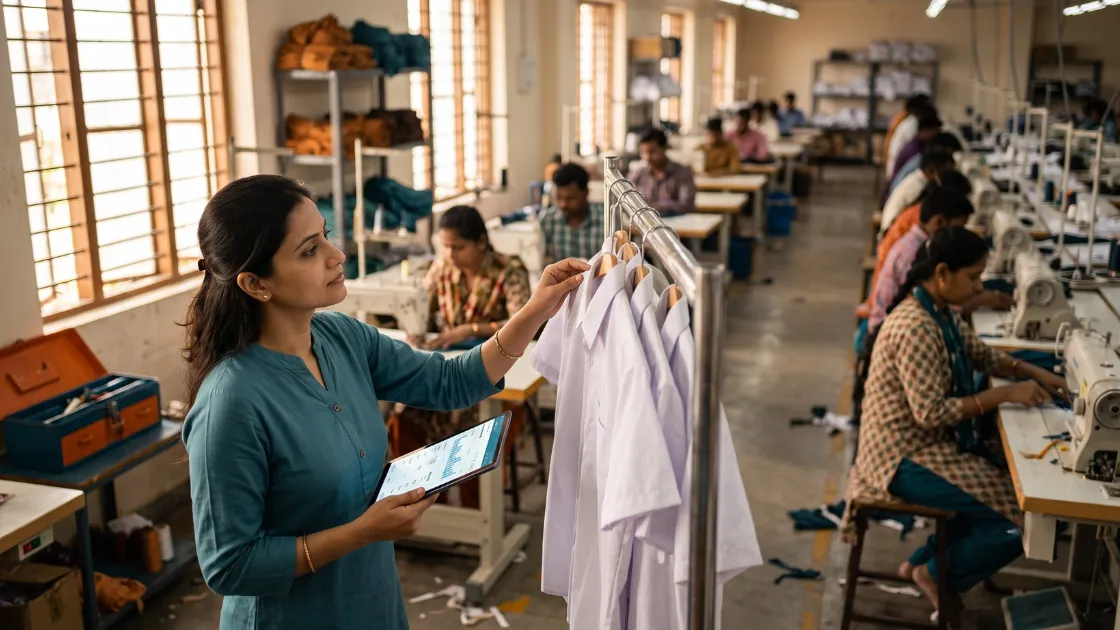
Thirty machines. Four WhatsApp groups. One Excel sheet that only Suresh understands, and Suresh is on leave.
If that is your unit, you have already felt the problem a garment manufacturing ERP exists to solve: nobody can answer "where is order 218?" without walking the floor. This guide strips the jargon and shows what an ERP actually does for a 10–100 machine unit, what it should cost, and how to go live in weeks.
What ERP Means on a Stitching Floor
Forget the textbook definition. On a garment floor, ERP means one system where the whole journey — order, cutting, stitching, finishing, dispatch — lives on one screen.
The cutting master logs 400 pieces cut; the stitching supervisor sees them arrive in his queue; the owner sees the same numbers on his phone at home. One entry, visible to everyone, instead of the same figure written in three registers that never match. That is the entire idea. Everything else is modules.
The 7 Modules a Small Unit Actually Needs
- 1. Order Management: Style, quantity, size breakup, rate, delivery date. Every order gets a number the whole unit uses.
- 2. Cutting and Fabric Consumption: Fabric issued vs pieces cut vs balance returned. This is where fabric silently leaks.
- 3. Production and Job Tracking: Job cards per batch or line, live WIP counts, who is stitching what.
- 4. Inventory — Fabric and Trims: Metre-level fabric stock, plus reorder points for buttons, threads, labels and zips. A Rs. 3 button shortage can idle a Rs. 3 lakh order.
- 5. Dispatch and GST Invoicing: Delivery challans and GST invoices from the same order data — no retyping, no mismatch.
- 6. Payroll and Attendance: Piece-rate wages calculated from production entries, so payday is arithmetic, not argument.
- 7. Reports: Daily production vs target, pending orders, rejection %, and profit per style.
Rule of Thumb for Module Selection
If a system pushes showroom POS, loyalty points or shade-card modules at you, you are shopping in the wrong aisle. Buy only what the floor uses.
Signs Registers and Excel Are Costing You
- • Fabric Guesswork: You buy fabric on guesswork, and dead stock piles up in the loft.
- • Invisible WIP: Nobody knows today's WIP without a floor walk and three phone calls.
- • Slipping Deadlines: Dispatch dates slip silently until the customer calls, angry.
- • Payday Disputes: Piece-rate payday brings the same count disputes every month.
- • Key-Man Dependency: One person holds all the numbers; his leave stops your unit.
- • Profitability Blindspot: You cannot say which style made money last quarter — only that "overall it was okay".
Put a number on it: an unnoticed 2% rejection on 10,000 pieces a month is 200 garments of fabric and labour gone — Rs. 30,000–40,000 a month for many units. That is an ERP subscription paid many times over.
Implementation in Weeks, Not Months
Big-company ERP horror stories come from big-company rollouts. A small unit on cloud garment manufacturing software can follow a four-week plan:
- Week 1: Enter masters — styles, rates, customers, karigars — and opening fabric stock.
- Week 2: Book all new orders in the system; let old orders finish on paper.
- Week 3: Start daily cutting and production entries; the WIP screen comes alive.
- Week 4: Raise invoices and run payroll from the system. Retire the registers.
Two rules make it stick:
- 1. Single Ownership: One person owns data entry per shift — everyone entering means no one entering.
- 2. Owner Routine: The owner checks the dashboard at a fixed time daily; what the boss looks at, the floor maintains.
Cloud systems need no server room — a browser and the phones your supervisors already carry.
What It Should Cost
Traditional manufacturing ERPs are priced for exporters: implementation fees, per-user licences, annual maintenance — several lakhs before the first report. A small unit does not need that.
Cloud tailoring and garment software is subscription-priced; Juvee, for example, is Rs. 10,190/year flat with a free Basic plan, and covers orders, job tracking, GST billing, inventory and payroll. If you make uniforms, see our dedicated page on ERP for uniform manufacturers. And before you sign up for a generic accounting-style ERP, read Juvee vs generic ERP — stitching workflows are the difference.
Cost Benchmark
Simple benchmark: if the system costs more than one month's wastage it is saving you, negotiate or move on.
Frequently Asked Questions (FAQ)
What does ERP mean in garment manufacturing?
It is one software system where orders, cutting, stitching, finishing, dispatch, stock and wages are tracked together on one screen — so the owner sees live numbers instead of chasing registers across the floor.
How much does a garment manufacturing ERP cost in India?
Legacy ERPs run into lakhs with per-user licences and consultants. Cloud garment software built for small units is subscription-based — Juvee is Rs. 10,190/year with a free Basic plan. Watch for per-user charges and implementation fees when comparing.
Is ERP worth it for a 20-machine unit?
Yes, if delivery dates slip or fabric and piece counts leak. A 20-machine unit loses more to unnoticed rejection and payday disputes than a year's software costs. Start with orders, cutting and job tracking; add payroll once the floor is used to it.
Try This With Juvee
Juvee runs order-to-dispatch for small garment units — cutting entries, live WIP, GST invoices and piece-rate payroll on one dashboard, from your phone or computer.
Start free on the Basic plan at juvee.in/free-trial, or book a walkthrough at juvee.in/book-demo if you would rather see it first. It is Rs. 10,190/year, and the Juvee tailor app on Google Play keeps the floor updated from anywhere.
Related reading