Stage-by-Stage Production Control, WIP Tracking, and Floor Bottleneck Management for Small Units
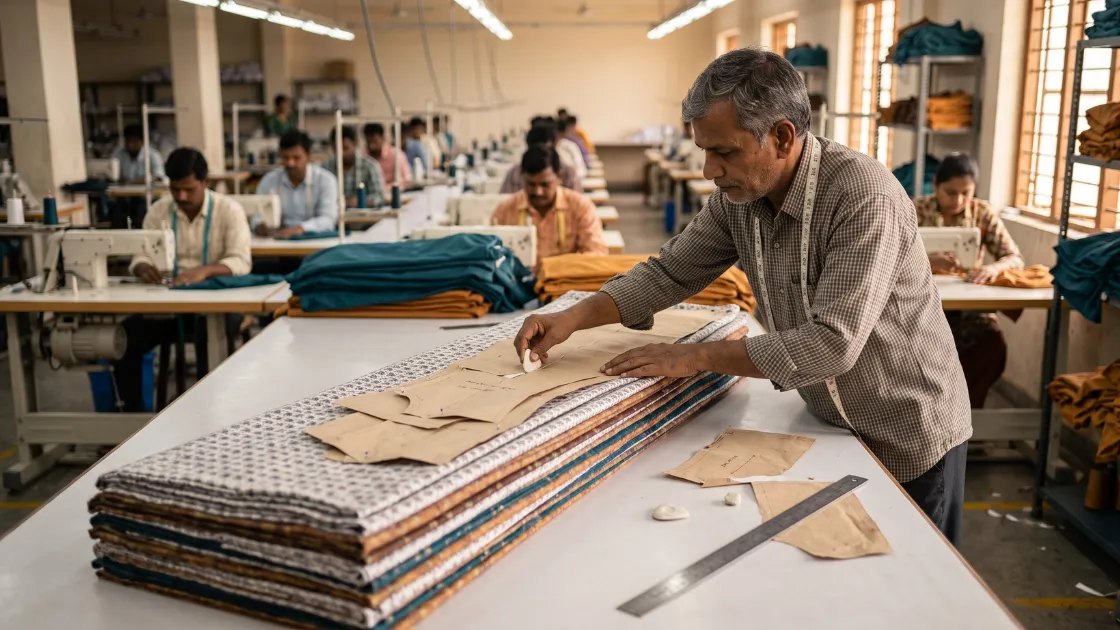
Ask anyone in your unit where order 218 is. If the answer begins with "let me check with the cutting master", production is managing you, not the other way around.
Garment production management does not need consultants or heavy systems. It needs five stages watched with one number each, a ten-minute morning meeting, and job cards that travel with the work. Here is the whole method.
Five Stages, One Number Each
Most small units drown in data or track nothing. The cure is one KPI per stage:
| Stage | Watch this number | Healthy sign |
|---|
| Cutting | Fabric utilisation | 80–85%+ of lay used |
| Stitching | Pieces per machine per day | Steady or rising |
| Checking | Rejection % | Under 2–3% |
| Finishing and packing | Packed vs stitched gap | Cleared daily |
| Dispatch | On-time orders | 95%+ |
Cutting decides your fabric cost forever — a lazy lay plan wastes 5% of every metre you bought. Stitching output per machine tells you about training and machine health before anyone complains.
Rejection % turns vague "quality issues" into a number: on a 2,000-piece order, 1.2% rejection is 24 garments — know whether they are re-workable or lost. Packing gap exposes the pieces that got stitched and then vanished into a corner sack. On-time dispatch is the number your buyers repeat to other buyers.
System Rule #1
Write the five numbers on one board, every evening. That board is your production management system, version one.
The 10-Minute Morning Meeting
Same time, same place, standing at the cutting table, 9:05 am. Fixed agenda:
- 1. Yesterday's Three Counts: Cut, stitched, packed — against target.
- 2. Today's Target: Per line or per karigar.
- 3. Risk Check: Orders at risk this week, by name and date.
- 4. Shortage Warning: Material shortages coming — thread, buttons, labels, zips.
- 5. Quality Insight: One quality issue from the checking table, shown physically.
No chairs, no chai, no blame. Numbers and decisions. Ten minutes here replaces fifty phone calls across the day, because everyone heard the same plan at the same time.
Find the Bottleneck by Following the Piles
Work-in-progress piles up in front of your slowest stage — the floor literally shows you the problem. If bundles tower beside the overlock machines while singer machines wait, overlock is your constraint, and speeding up anything else just grows the pile.
Fix the constraint, cheapest option first: shift a multi-skilled karigar to it for two hours a day; move simple operations off it to a helper; only then buy. Even then, do the maths — a second-hand overlock at around Rs. 25,000 can beat two hours of daily overtime within a single festival season. And re-walk the floor weekly, because the moment you fix one bottleneck, it moves somewhere else.
Batch Flow Beats "Cut Everything First"
Big factories run assembly lines. A small unit's best friend is the small batch: bundles of 20–30 pieces, tied by size, moving through all stages together.
Compare that with cutting all 2,000 pieces before stitching starts: a collar mistake is discovered at piece 800, not piece 25; nothing is dispatchable until almost everything is done; and half-finished stock swallows your working capital as WIP.
With batches, faults surface early, sizes can dispatch as they finish, and counting is easy — a bundle ticket carries its number through the floor. For a 10–40-machine unit, batch flow is the practical middle path between one-tailor piece work and factory line balancing.
Job Cards: The Cheapest Management System Ever Built
Each batch gets a card: order number, style, size, quantity, operations, karigar, date in, date out. The card travels with the bundle. At any moment, the cards tell you your WIP without a single phone call.
Paper cards work to a point. Past ten machines or two simultaneous orders, they fall behind — cards get lost, and totalling them for wages eats an evening.
Digital job cards update WIP the moment a supervisor taps "done", feed piece-rate payroll automatically, and drive order tracking so delivery risks show up days early, on your phone. If you want the full software picture, start with our plain-English garment ERP guide.
Frequently Asked Questions (FAQ)
What is a good rejection rate in garment production?
Small units should aim under 2–3% at final checking, with most of that re-workable. Track it per karigar and per operation — one loose overlock tension setting often explains half the month's rejections.
How do you track WIP in a small garment factory?
Move work in numbered bundles of 20–30 pieces with a job card on each. Count cards at each stage daily, or use digital job cards so the WIP count updates itself as work is marked done.
Which numbers should a garment unit review daily?
Five are enough to manage garment production well: pieces cut, stitched and packed against target, rejection %, and orders at risk of missing dispatch. Ten minutes every morning on these beats any monthly report.
Try This With Juvee
Juvee gives your unit digital job cards, live WIP and dispatch tracking without an ERP-sized project — most floors are running inside a week.
Start free on the Basic plan at juvee.in/free-trial, no card required, then Rs. 10,190/year. Supervisors can update batches straight from the Juvee tailor app on Google Play, or book a demo at juvee.in/book-demo to see a sample floor first.
Related reading