Fabric is the biggest cost in every order. Here is how much cloth each garment takes, what changes it, and where the extra metre quietly disappears.
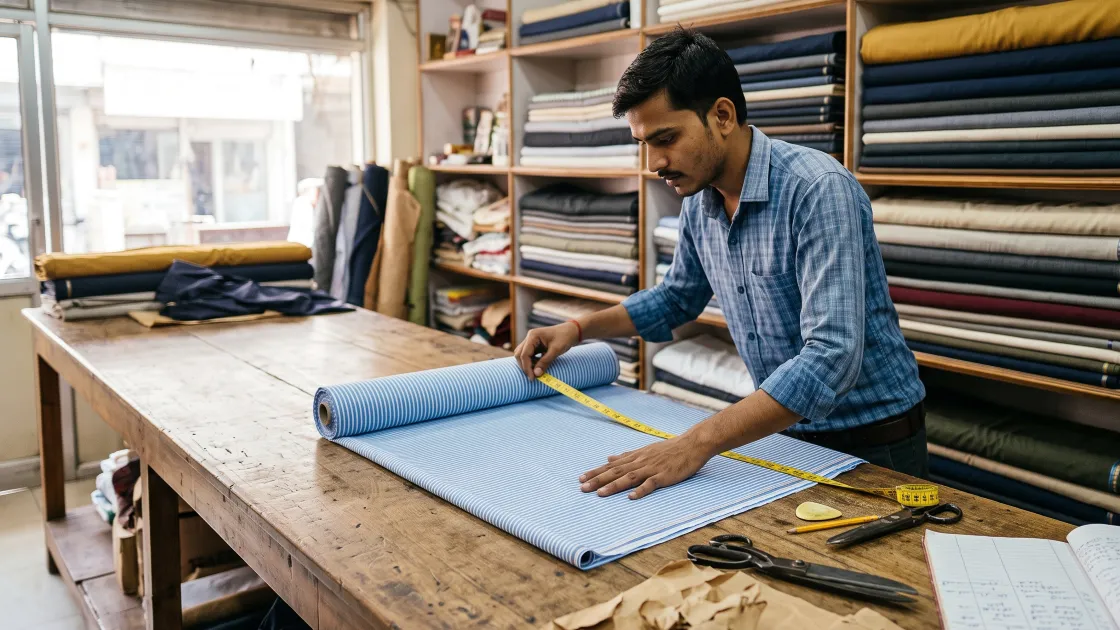
The Number Nobody Writes Down
Every shop knows roughly how much cloth a shirt takes. Very few write it down. So the figure lives in one person, changes with mood, and gets quoted differently to two customers in the same week.
It matters more than it looks. Cloth is usually the largest single cost in an order, and the difference between a good estimate and a lazy one is a quarter of a metre on every garment. On two hundred uniform shirts that is fifty metres you either did not buy or cannot use.
A quantity without a width is not a quantity. The same shirt is 2.5 metres at 36 inches and 1.6 metres at 58.
Starting Quantities
These are the quantities to start a quote from, for an average adult size, at the width shown. They are not cutting instructions. Your own marker on your own table is the real number, and a shop that cuts economically will beat these by a little.
| Garment | Width | Cloth | Notes |
|---|
Shirt, full sleeve | 36 in | 2.25 - 2.5 m | Add for a big size or a long body |
Shirt, full sleeve | 58 in | 1.6 - 1.75 m | Most shirting sold today is this width |
Shirt, half sleeve | 58 in | 1.4 - 1.5 m | |
Trouser | 58 in | 1.25 - 1.4 m | Add for pleats, cuffs or a large waist |
Kurta, mens | 36 in | 2.5 m | Longer kurta needs more, ask the length first |
Saree blouse | 36 in | 0.8 - 1 m | Add lining separately, do not count it in |
Salwar kameez set | 36 in | 6 - 6.5 m total | Kameez 2.5, salwar 2.25, dupatta 2.25 |
Churidar bottom | 36 in | 2.5 m | Churidar takes more than a plain salwar |
Lehenga skirt | 44 in | 3 - 5 m | Flare decides this, agree it before quoting |
Child uniform shirt | 58 in | 1 - 1.5 m | By age, see the uniform chart |
Child shorts | 58 in | 0.7 - 1 m | |
What Moves the Number
Five things change a quantity, and four of them can be asked about before the cloth is bought.
- Width. The first question, every time. Never accept a quantity without one
- Size and height. A tall customer or a large size adds a quarter to half a metre
- Print direction. A one-way print or a border cannot be turned round, so pieces do not nest and you lose cloth
- Checks and stripes. Matching across a seam costs cloth. On a checked shirt allow a quarter metre more, and say so when quoting
- Shrinkage. Cotton and linen move on the first wash. If the cloth is not pre-shrunk, allow for it or wash first
Where the Extra Metre Goes
When a shop runs out of cloth mid-order it is almost never the chart that was wrong.
- The width was assumed. The cloth came in narrower than the quote was based on
- The customer changed the length after the cloth was bought
- The print had a direction nobody checked at the counter
- A piece was cut wrong and there was no allowance left to recut it
- The leftover from the last order was never recorded, so it was bought again
The fifth one is the quiet one. Most shops have usable cut lengths sitting on a shelf that nobody can find, because nothing wrote down what was left over from which order.
Keeping the leftovers findable is what fabric inventory is for.
Quote the Cloth Separately
If the customer brings the cloth, the quantity is advice and should be given before they buy, not after. If the shop supplies it, the cloth and the stitching are two different lines on the bill, with the metres and the rate per metre written out.
A bill that shows only one total invites an argument later about what the cloth cost. A bill that shows the metres does not.
What a tailoring bill should carry is set out in the tailor bill format.
Frequently Asked Questions
How much cloth is needed for a mens shirt?
About 2.25 to 2.5 metres at 36 inch width, or 1.6 to 1.75 metres at 58 inch. Most shirting sold now is 58 inch. Add a quarter metre for a large size, a long body, or a checked cloth that has to be matched at the seams.
How much fabric for a saree blouse?
Roughly 0.8 to 1 metre at 36 inch for a standard blouse. Lining is extra and should be counted and quoted separately. A blouse with long sleeves, a deep back or a princess cut needs more.
How much cloth for a full salwar kameez set?
About 6 to 6.5 metres at 36 inch for the three pieces together: kameez 2.5, salwar 2.25, dupatta 2.25. A churidar bottom instead of a plain salwar takes more, around 2.5.
Why do two shops quote different quantities for the same garment?
Usually width, sometimes cutting. One shop may be quoting at 36 inch and the other at 58, which is a completely different number for the same shirt. Ask the width before comparing.
Does the chart work for children?
Only as a rough guide. Children vary far more than adults, and uniform work is quoted by age band rather than by a single figure. Measure a sample set from the school itself and quote from that.
For bulk uniform work, see school uniform manufacturers software.
Write Your Own Numbers Down
The chart above is a starting point. Within a month of writing down what each garment actually took in your shop, at your widths, with your cutting, you will have something better than any chart on the internet.
Keep it beside the measurements rather than in a separate notebook, because the two are asked for at the same moment: the customer wants to know the cloth and the price in the same breath.
For measurements, see measurement management.
For what is left over, see fabric inventory management.
On the phone at the counter, see the Juvee tailor app.
Plans and what each includes are on the pricing page.
Try It on One Real Week
Take one week of orders and write the actual cloth used against each one. Compare it with the chart. Wherever your number is lower, that is your shop cutting well, and it is worth quoting from.
You can start free on the Basic plan - ten customers, twenty orders a month, no card.
Note: the quantities above are starting figures at the widths stated, for an average adult size. Cloth width, print direction, size and cutting method all change them. Always check against your own cutting before quoting a large order.