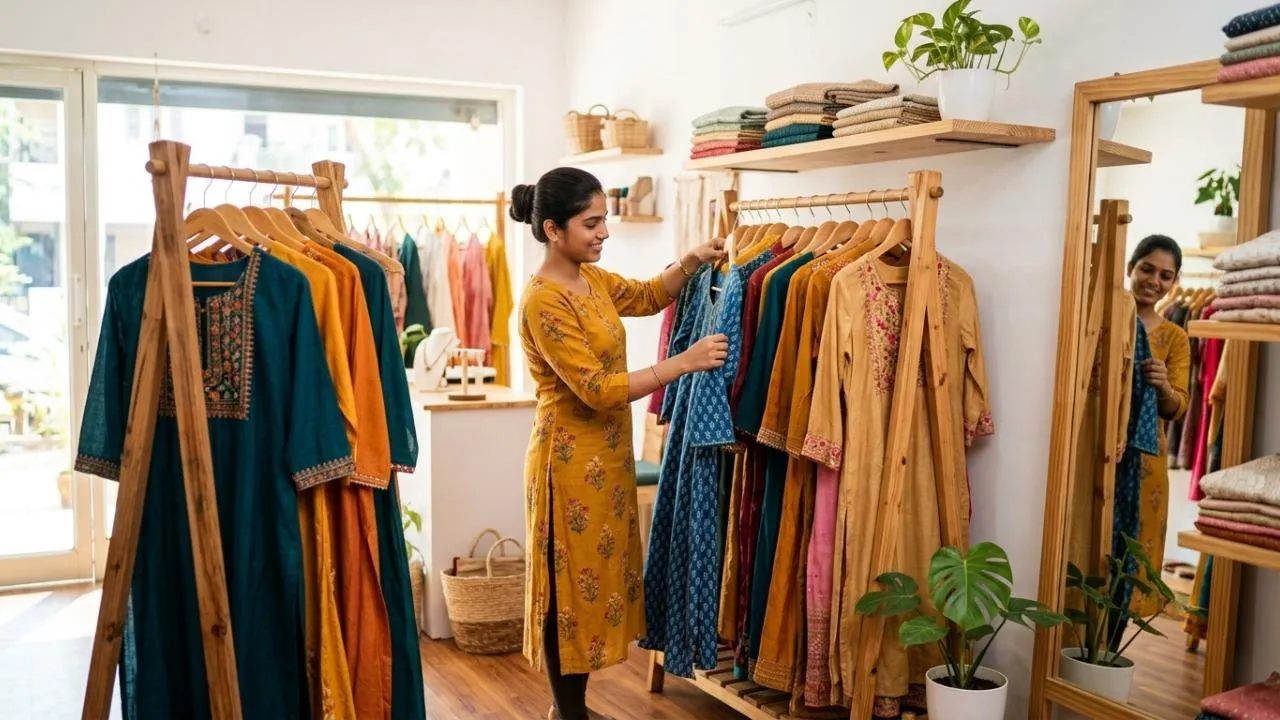
Choose Your Model First: Home, Rented or Online-First
Most advice on how to start a boutique in India jumps straight to interiors and Instagram. The model decision comes first, because everything else — cost, licences, stock — depends on it.
• A home boutique is the cheapest start: one room, two machines, orders through WhatsApp and word of mouth. Low risk, slower walk-in growth.
• A rented shop in a residential market gives you walk-ins and trust, but rent starts the clock on your savings from day one.
• Online-first means you stitch from home and sell through Instagram and WhatsApp, shipping by courier — lowest fixed cost, but you compete on photos and delivery discipline.
Many successful boutiques start at home, prove Rs. 25,000–40,000 of monthly orders, and only then sign a rent agreement. There is no shame in that sequence. It protects your capital.
What It Really Costs in 2026 (Tier-2 City Numbers)
| Item | Home Boutique | Rented Shop |
|---|
| Machines (2 stitching + 1 interlock) | Rs. 45,000–60,000 | Rs. 60,000–90,000 |
| Deposit + first 2 months' rent | — | Rs. 60,000–1,20,000 |
| Interiors, racks, mirror, trial room | Rs. 10,000–25,000 | Rs. 80,000–1,50,000 |
| Opening fabric and materials stock | Rs. 25,000–50,000 | Rs. 75,000–1,50,000 |
| Signage, packaging, misc. | Rs. 5,000–10,000 | Rs. 20,000–40,000 |
Add three months of working capital for thread, lining, karigar payments and electricity. Realistic totals: about Rs. 1–1.5 lakh for a home start, Rs. 3.5–6 lakh for a rented shop in a tier-2 city. Metro rents can double the second column.
If you are stitching-led rather than resale-led, keep fabric stock small — customers bring their own material for most stitching orders, and dead stock is the classic first-year money leak.
Licences and Registrations, Without the Confusion
You need less paperwork than you fear, but get these right:
- GST registration — mandatory only after aggregate annual turnover crosses ₹20 lakh for services or ₹40 lakh for goods in most normal category states (₹10L/₹20L in special category states). Small businesses can also consider the Composition Scheme (up to ₹1.5 crore turnover limit). Many boutiques register early anyway because wholesale suppliers, corporate clients, or school uniforms require a GSTIN.
- Shops & Establishment registration — required for commercial premises under your state's Labour Department rules. Filing is done online via your state's portal, usually within 30 days of starting, with nominal fees based on employee count.
- Udyam (MSME) registration — free, online, and very useful for opening bank accounts, getting priority lending, and qualifying for government loans.
- Current bank account & UPI QR — a dedicated business current account in the boutique's name, plus a counter QR code from day one. Mixing boutique money with household accounts hides your real profit.
When you do start billing with GST, our guide to GST billing for tailors covers rates and invoice rules in detail.
Source Fabric Like a Professional, Not a Shopper
Buy your opening stock in person, in small lots. Surat is the classic base for synthetics, sarees and dress materials; Erode and Tirupur for cottons and knits; every city has a wholesale cloth market where 5–10 metre lots are possible.
Rule of thumb: never put more than a third of your opening stock into any single style, and reorder only what sells twice. Your first three months of sales data is worth more than any supplier's opinion.
Price for Profit From Day One
Cost-plus is the boutique's friend. For a designer kurti set: fabric Rs. 450, lining Rs. 90, thread and finishing Rs. 40, karigar piece-rate Rs. 250, overhead share Rs. 70 — total cost Rs. 900. At a 60–80% margin your price is Rs. 1,450–1,650, and that margin is what funds rent, remakes and slow weeks.
Put stitching rates on a printed rate card at the counter. Underpricing to "build customers" builds only exhaustion; compete on fitting and finish instead.
Your First 90 Days, Month by Month
Days 1–30: Set up and soft-launch. Machines in, rate card printed, registrations filed, 15–20 sample pieces ready. Open quietly and tell your existing customers first.
Days 31–60: Make noise locally. Create a Google Business Profile, post daily WhatsApp statuses, offer a launch stitching offer to two or three housing society groups. Target: 30+ orders in the month and every customer's measurements recorded properly.
Days 61–90: Systemise and review. Look at the numbers — orders, average bill, repeat customers, pending balances. Fix your bestseller list, drop what did not move, and book capacity for the coming festival season. This is also when you plan growth deliberately; the ideas in how to grow a tailoring business apply to boutiques exactly.
Put Systems In Before You Are Busy
The best time to organise a boutique is when it has ten orders, not a hundred. From the first week, record every order with a delivery date, every customer's measurements, every advance and balance.
A notebook works for a month; after that, orders start slipping. This is why researching how to start a boutique in India should include software, not just machines — cloud-based boutique management software keeps orders, measurements and billing in one place from day one, and it costs less than one kurti order a month.
Frequently Asked Questions
Q: How much money do I need to start a boutique in India?
Around Rs. 1–1.5 lakh for a home boutique and Rs. 3.5–6 lakh for a rented shop in a tier-2 city, including machines, interiors, opening stock and three months of working capital.
Q: Do I need GST registration to open a boutique?
Not on day one if you are below the turnover threshold (₹20L services / ₹40L goods), but register early if you want wholesale supplier billing, school or corporate orders, or online marketplace sales.
Q: What is the first step in how to start a boutique in India?
Choose your model — home, rented or online-first — before spending anything. That single decision sets your budget, licences and marketing plan, and starting from home first is a proven low-risk path.
Try This With Juvee
Start your boutique organised instead of organising it later. Juvee gives you orders, measurements, GST billing and customer records in one app that 5,000+ shops and boutiques already use. Start free on the Basic plan at juvee.in/free-trial, download the Juvee tailor app on Google Play, and if it fits your counter, it is Rs. 10,190/year — about the margin on six kurti sets.
Related reading