Most new hands leave in the first month, and it is usually not about money. Here is a plan that makes them useful and makes them stay.
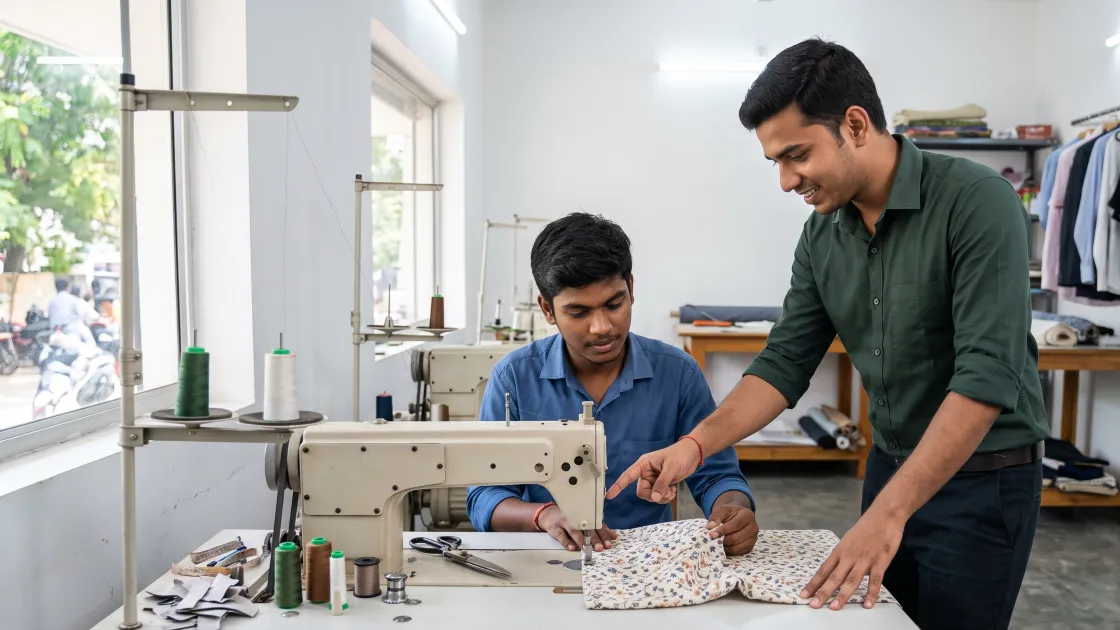
Why the First Month Decides It
A new person walks in able to stitch. What they cannot do is stitch the way your shop stitches, for your customers, to your finish. That gap is the whole job, and how you handle it in thirty days decides whether they are still there in a year.
The usual mistake is to put them straight onto real customer orders on day one, then be annoyed when the work comes back. The second mistake is the opposite - giving them nothing but cutting scraps for a month until they are bored and gone.
Nobody leaves a job where they can feel themselves getting better. They leave one where nobody has time for them.
Week One — Watch and Practise
No customer garment touches their machine this week.
- Have them sit with you or the senior karigar and watch two full garments from cutting to finishing
- Give them offcuts and one instruction: straight seams, even width, no puckering. All week if needed
- Show them how your shop finishes a seam, and why it is done that way here
- Teach the machine - threading, bobbin, tension, needle change, what a skipped stitch means
The last one is skipped in most shops and it is the one that saves you being called over ten times a day for the next year.
Week Two — Simple Real Work, Checked
Now they work on real orders, but only the parts where a mistake is recoverable.
- Side seams, hems, straight runs on simple garments
- You or the senior checks every piece before it moves on. Every piece, this week
- When something is wrong, show the correction on the cloth rather than describing it
Do the checking where they can see you doing it. Being checked openly is normal; being checked secretly and criticised later is not.
Week Three — One Garment, End to End
Give them one whole simple garment - a plain kurta, a straight nightie, a school shirt. Their own, start to finish, with you available but not hovering.
When it is done, go through it with them piece by piece. Say what is good first, and mean it. Then the two things to fix. Two, not ten.
- If it is good enough to deliver, deliver it and tell them so
- If it is not, they redo it. This is normal and should be said as normal
Week Four — Speed, and the Shop Rules
By now the work is acceptable. This week is about pace and about the things that are not stitching.
- How orders are tagged, where finished work goes, how a garment is passed on
- What to do when they are unsure - and that asking is always better than guessing
- What never leaves the shop: a customer's measurements, another shop's design, a complaint they overheard
Also tell them plainly what "finished" means in your shop. Threads cut, pressed, tagged, on the rack. If that is never said out loud, it never happens consistently.
On order stages and handover, see tailor job management.
The Order to Teach Skills In
| Stage | Teach | Why this order |
|---|
Week 1 | Machine control, straight seams | Everything else sits on this |
Week 2 | Hems, side seams, finishing | Recoverable if wrong |
Week 3 | One full simple garment | Shows what they can actually do |
Week 4 | Speed, shop routine, tagging | Now they are part of the flow |
Month 2-3 | Sleeves, collars, plackets, zips | The fitted parts, once basics are steady |
Later | Measuring and cutting | The most expensive place to make a mistake |
Cutting comes last, always. A stitching mistake costs an hour. A cutting mistake costs the cloth, and if it is the customer's cloth it costs the customer too.
Pay Them From Day One
Somebody learning in your shop is doing work in your shop. Pay them from the first day, agree the figure before they start, and pay on the same day every week.
Two things not to do, whatever anybody tells you: do not hold back wages to stop somebody leaving, and do not call a working person an unpaid trainee. Neither keeps anybody, and the first is not lawful.
Whether an apprentice arrangement has particular rules in your state, and what records you must keep, is a question for a local accountant. It is one appointment and it is cheaper than getting it wrong.
On pay methods once they are trained, see the karigar management guide.
The Real Reason to Do This
A shop where only one person can cut is a shop that stops when that person is ill, on leave, or gone. Training somebody behind your best hand is not generosity - it is the only way the shop stops depending on one memory.
On what that dependence costs, see when your master cutter leaves.
Frequently Asked Questions
How do I train a new karigar?
Week one, machine control and straight seams on offcuts with no customer work. Week two, simple real work with every piece checked. Week three, one whole simple garment on their own. Week four, speed and the shop routine. Cutting comes months later.
How long does it take to train someone?
It depends entirely on what they arrive knowing, and no honest article can give you a number. Judge by whether their work needs checking, not by weeks on the calendar.
Should I pay a trainee?
Yes, from the first day, at a figure agreed before they start. Somebody working in your shop is being paid for work, whatever else they are also learning.
My new karigar keeps making the same mistake. What now?
Show the correction on the cloth instead of describing it, and check whether the problem is actually the machine - wrong needle, wrong tension, a worn feed dog. Repeated identical mistakes are more often a setup fault than a person fault.
When should I teach cutting?
Months in, after stitching is steady and needs no checking. Cutting is where mistakes cost the cloth, and on a customer's own material there is no recovery.
On managing the team day to day, see the karigar management guide.
On attendance and wage records, see staff attendance for tailor shops.
And tailor payroll software.
Plans and what each includes are on the pricing page.
Start With One Week
The next person who joins: give them week one exactly as written above, with no customer garment on their machine. One week of your patience buys years of somebody who stitches the way your shop stitches.
You can start free on the Basic plan - ten customers, twenty orders a month, no card.