A perfect fit that comes back two sizes small after one wash is not a stitching fault. Here is how to find out before you cut.
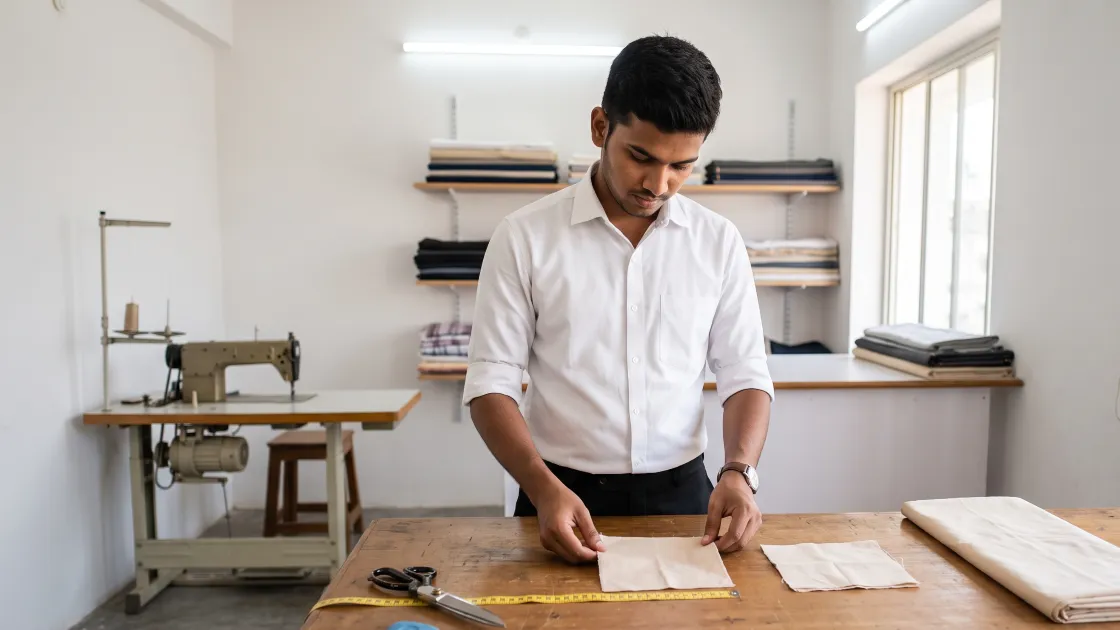
The Complaint Nobody Can Win
She collected it, it fitted, she was happy. Three weeks later she is back and the kurta is tight at the chest and short at the sleeve. You measured correctly. You cut correctly. You stitched correctly.
The cloth moved. And because nobody said anything about it at the counter, it is your fault as far as the customer is concerned.
Cloth shrinks on its own schedule. The only question is whether it does it before you cut or after she wears it.
What Actually Happens
Woven cloth is stretched on the loom and again during finishing. The first hot wash lets it relax back. Length usually moves more than width, because the warp took the most tension.
- Cotton moves the most, and pure cotton more than a cotton blend
- Rayon and viscose can move a surprising amount and also lose body
- Linen shrinks and keeps shrinking a little for the first two or three washes
- Polyester and most blends barely move at all
- Anything starched or heavily finished looks crisp on the roll and relaxes in the bucket
The Test — One Afternoon, Then You Know Forever
Do this once for each cloth your shop buys regularly. After that you have your own table and you never guess again.
- Cut a square from the same roll, roughly 50 cm by 50 cm
- Mark exactly 40 cm along the length and 40 cm across the width with a tacking thread or a fabric marker
- Wash it the way the customer will wash it - normal water, normal soap, not gentle
- Dry it fully, then press it the way it will be pressed
- Measure the two marks again
If the 40 cm length mark reads 38, that is 5 percent. On a 44-inch kurta that is over two inches of length gone. Now you know, and you knew before you cut.
Working the number into the cutting
Two ways, and the second is better.
- Add the shrinkage to the length and width before cutting. Simple, but the garment is slightly loose until the first wash
- Pre-wash the cloth before cutting. It shrinks in your shop, not on her body, and the fit stays as stitched
Pre-washing costs a day and it is the honest answer for anything fitted, anything expensive, and anything for a function. For a loose nightie in a stable blend, adding the allowance is enough.
Starting Points, Not Rules
These are working ranges to plan around until you have measured your own cloth. Mill, weave and finish all change them, so measure before you rely on them.
| Cloth | Usual move | Note |
|---|
Pure cotton, unwashed | 3 to 7 percent | Length moves more than width |
Cotton blend | 1 to 3 percent | Depends how much polyester |
Rayon / viscose | 3 to 8 percent | Also softens and loses body |
Linen | 4 to 8 percent | Keeps moving for two or three washes |
Polyester, most synthetics | Close to nothing | Safe to cut as it comes |
Denim | 2 to 5 percent | Mostly in the length |
Silk | Varies, often little | Dry clean cloth should not be wash-tested |
If a customer brings cloth you have never handled, treat it as unknown and say so. That is not weakness, it is the sentence that protects both of you.
Say It at the Counter
One line at the order, and the whole problem changes shape.
"This cotton will shrink a little on the first wash. Shall I pre-wash it, or should I add the allowance?" Now she has chosen, she knows why, and if it moves later it was a decision, not a mistake.
- Write on the bill which one she chose
- For customer-supplied cloth, note that it was not pre-washed if she declines
- For anything for a function, recommend pre-washing and say why
On what a bill should record, see the tailor bill format.
Buying With Shrinkage in Mind
If you buy cloth for the shop rather than the customer bringing it, the arithmetic changes at purchase, not at cutting.
- Ask the supplier whether the cloth is pre-shrunk. Some is, and it is worth the extra
- Buy the extra metres for shrinkage in the same lot, not later. Dye lots differ
- Test one new roll before committing to a bulk order, especially for uniforms
For a school uniform order this is not optional. Two hundred shirts that shrink after the first wash is not a complaint, it is a returned order.
On uniform runs, see school uniform manufacturing.
On how much cloth each garment takes, see cloth needed per garment.
Frequently Asked Questions
How much does cotton shrink after washing?
Usually somewhere between three and seven percent for unwashed pure cotton, with the length moving more than the width. That is a planning range, not a rule - the only figure you can trust is the one you measure from your own roll.
Should I pre-wash fabric before stitching?
For anything fitted, expensive or for a function, yes. It shrinks in your shop instead of on the customer, and the fit stays as stitched. For loose garments in a stable blend, adding an allowance is enough.
How do I test fabric shrinkage?
Cut a 50 cm square, mark 40 cm along the length and across the width, wash and dry it the way the customer will, then measure the marks again. The difference is your shrinkage.
The garment fitted at trial but shrank later. Who pays?
That depends on what was said at the order, which is exactly why it should be said. If the customer declined pre-washing and it is written on the bill, the alteration is chargeable. If nobody mentioned it, take the loss and start writing it down.
Does washing before stitching spoil the cloth?
Not usually for cotton, linen and denim. Do not wash-test anything meant for dry cleaning, silk included, and do not pre-wash cloth a customer has brought unless she has agreed.
For fabric stock and dead stock, see fabric inventory management.
And the fabric inventory guide.
On fit complaints in general, see when a customer says it does not fit.
Plans and what each includes are on the pricing page.
Test One Cloth This Week
Take the cotton you sell most of, cut one square, and run the test. One afternoon buys you a number you will use on every order for years, and it ends an argument you cannot otherwise win.
You can start free on the Basic plan - ten customers, twenty orders a month, no card.
Note: the ranges above are planning figures used in the trade, not measured data or a standard. Weave, finish, mill and wash all change them. Measure your own cloth before relying on any number.