Stitching for another business pays reliably and builds nothing. Making your own garments builds something and pays badly at first. What job work really earns a tailoring unit, and when to stop taking it.
Two Businesses That Look Identical
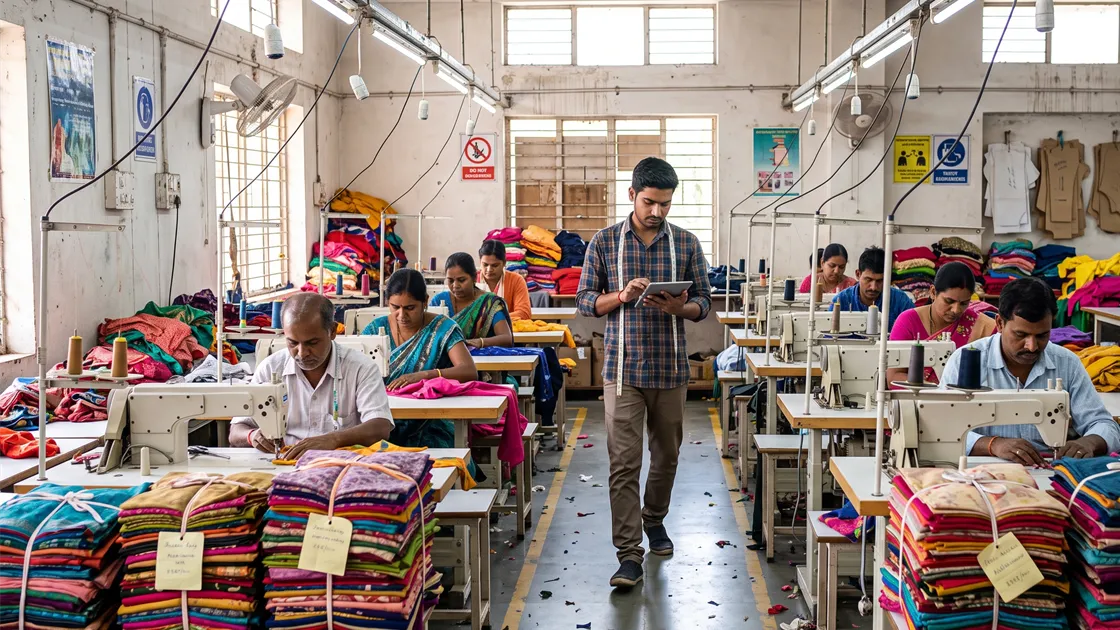
Walk into two units with twelve machines each and you cannot tell them apart. The cloth, the hands, the hum are the same. But one of them is a supplier and the other is a manufacturer, and almost nothing about how they make money is alike.
The supplier takes job work. Cut pieces arrive from a boutique, an exporter or a brand; his unit stitches them; they leave. He never owns the cloth, never meets the customer who wears the garment, and never decides what gets made. He is paid a rate per piece.
The manufacturer buys cloth, makes garments and sells them. He owns everything from the roll to the rack, including the pieces nobody buys.
Most units are some mixture, and the mixture is the decision that actually matters. It is rarely made deliberately — it drifts, usually towards job work, because job work is what walks in the door.
What Job Work Is Genuinely Good At
The money arrives
Invoice on delivery, paid on terms. No unsold stock, no returns, no customer who changed her mind. For a unit paying twelve people every Saturday, predictability is worth a great deal.
No cloth money is tied up
The single largest cost in garment making is not yours. You are selling machine hours and skill, and your working capital goes on wages rather than on rolls.
It teaches you properly
Stitching to an exporter’s tolerances is an education a unit cannot buy. Finishing standards, inspection, packing, consistency across two thousand pieces — you learn it because you will be rejected if you do not.
You can start on Monday
No brand, no designs, no showroom. One buyer and your machines, and the unit is working.
What It Costs You, Quietly
Nothing in that list is untrue, and a unit can run on job work for a decade. What it cannot do is grow out of it, and the reasons are structural rather than a matter of effort.
The rate only goes down
Job work prices are set by whoever will stitch it cheapest. You can be better, faster and more reliable, and the rate will still be compared to a unit in a cheaper town. Nothing you build raises it.
You are one phone call wide
Two buyers giving you eighty per cent of your work is not a business, it is an arrangement. When one changes supplier — and they do, for reasons that have nothing to do with you — half the unit stops.
Nothing accumulates
After five years of job work you have no brand, no customers of your own, no designs and nothing anybody would buy. You have the machines, which you had at the start.
The buyer learns your cost
He knows what the cloth cost because he bought it, and he can see your unit. There is nowhere to hide margin, and in a bad year his cost reduction is your rate.
The Arithmetic Nobody Does
The question is not which business is better in principle. It is what an hour of machine time earns on each, and almost no unit has measured it.
Take one machine for one day. On job work, count the pieces it completes and multiply by the rate — that is the day’s earning, and the cloth was never your cost. On your own production, count what the same machine completes, multiply by your selling price, subtract the cloth, and then subtract the share that does not sell. That last number is the one units leave out, and it decides the comparison.
Own production usually wins on margin and loses on certainty. A unit that sells everything it makes earns far more per machine hour than any job-work rate. A unit that sells seventy per cent of what it makes often earns less, because the thirty per cent took machine time and cloth and returned nothing.
Work out your own figure before deciding anything. A unit that cannot say what a machine hour earns on each side is choosing by instinct.
The Shape That Works
Very few successful units are purely one thing, and the ones that moved across mostly did it the same way.
They kept job work as the floor. Enough to cover wages, rent and power — the costs that arrive whether or not anything sells. That is usually half to two-thirds of capacity, and it is what lets the owner sleep.
The rest of the capacity went on their own production, starting small. A few dozen pieces of one garment, made in the gaps, sold locally or to two or three shops. The point was not the money; it was finding out whether anyone wanted what they would make, at a cost of a few thousand rupees rather than a season.
Then the proportion moved, slowly, and only as its own sales justified it. The units that failed at this almost all failed by moving fast — refusing job work to free up machines for their own line before that line had buyers, and running out of cash in the gap.
One warning worth taking seriously: do not compete with the buyer who feeds you. A unit that makes its own version of the garment it stitches for a brand loses the job work, usually without being told why.
When to Stop Taking Job Work
There is a point at which job work stops being the floor and starts being the ceiling, and three signs mark it.
Your own line sells out reliably, more than once, without a discount. Not one good month — a pattern. You are turning away your own orders because the machines are committed to job work. And the margin on your own production, after the unsold share, has beaten the job-work rate for two consecutive quarters.
When all three are true, reduce job work deliberately rather than refusing the next order. Tell the buyer you are reducing capacity, give him notice, and keep the relationship — you may want it back. Units that burn the job-work bridge and then have a slow season have nothing to fall back on.
Frequently Asked Questions
Is job work profitable for a tailoring unit?
Reliably, yes — the money arrives, no cloth is tied up and there is no unsold stock. What it does not do is grow: the rate is set by the cheapest unit available, so nothing you build raises what you are paid.
Should a unit do job work and its own production together?
That is the shape that usually works. Keep enough job work to cover wages, rent and power, and use the remaining capacity for your own line. Move the proportion only as your own sales justify it.
How do I compare job work with making my own garments?
Work out what one machine earns in a day on each. For your own production, subtract the cloth and then subtract the share that does not sell — that last figure is the one units leave out, and it decides the answer.
When should a unit stop taking job work?
When its own line sells out reliably more than once, when it is turning away its own orders because machines are committed, and when its margin after unsold stock has beaten the job-work rate for two quarters. Reduce with notice rather than refusing the next order.
Where Juvee Helps
Job work and your own production need the same thing counted — what each machine and each hand actually produced, and what it earned. Juvee tracks garment production by job and by worker, which is how the comparison above stops being a guess. The Basic plan is free with no time limit, and paid plans start at ₹10,190 a year including GST; see the pricing page. For the production floor itself, read managing garment production.