Most puckered seams and skipped stitches are a wrong needle, not a bad machine. This is the size to use on each fabric, and the thread to put with it.
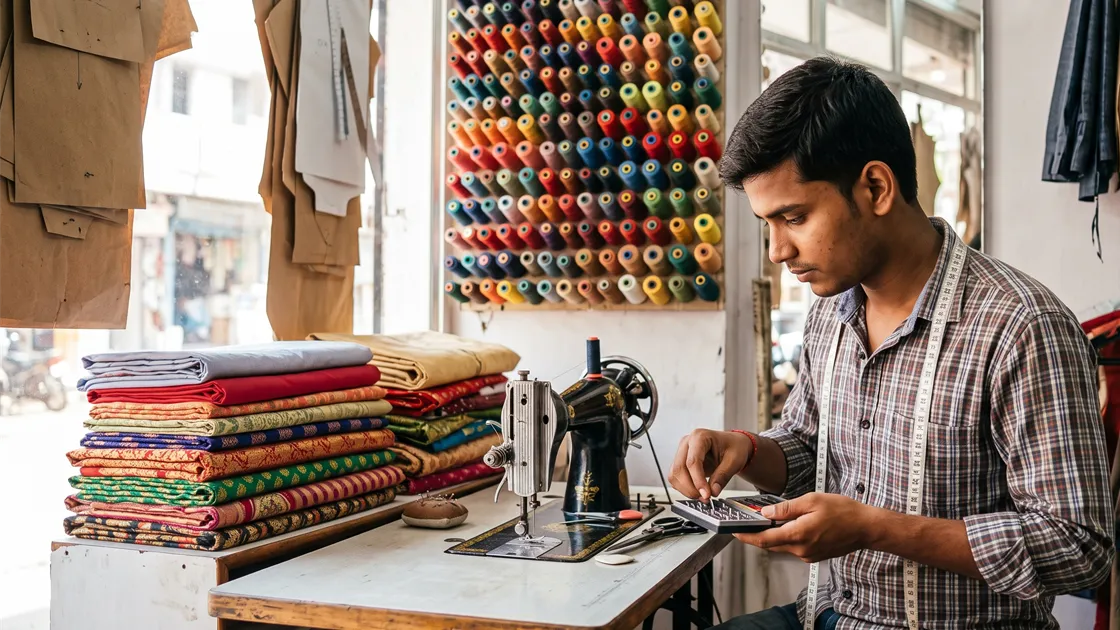
The Fault Is Almost Never the Machine
A karigar says the machine is skipping stitches. The seam on the georgette is puckering. The denim hem broke three needles this morning. In a shop with reasonable machines, all three of those are usually the same problem: the needle in the machine is not the needle for the cloth on the table.
It is the cheapest thing in the shop and the one nobody changes often enough. A needle costs a few rupees and a remade blouse costs a day. A blunt needle does not look blunt — it looks exactly like a new one, right up until it starts pulling threads in the fabric.
The two numbers on every packet are the whole system, and once you know what they mean the rest of this is a lookup.
Reading the Numbers on the Packet
Needles carry two sizes because two systems are in use. A packet marked 80/12 is the same needle in both: 80 in the European system, 12 in the American one. Use whichever your supplier prints.
- 60/8 — the finest. Chiffon, fine silk, net
- 70/10 — georgette, crepe, voile, fine cotton lining
- 80/12 — the everyday size. Cotton, poplin, rayon, most shirting
- 90/14 — heavier cotton, linen, light denim, twill, most trousering
- 100/16 — denim, canvas, upholstery, heavy coat cloth
- 110/18 — thick denim, multiple layers, leather-backed material
The rule behind the list: a lighter fabric needs a finer needle. A thick needle in thin cloth punches holes you cannot close. A fine needle in thick cloth bends, then breaks, and usually takes a stitch line with it.
The Point Matters as Much as the Size
This is the part most shops skip, and it is where the skipped stitches on knits come from.
- Sharp / universal — a slightly rounded point for general use. Cotton, silk, polyester, most woven cloth. This is what is in your machine now.
- Ballpoint or jersey — a rounded tip that pushes between the loops instead of cutting them. Any knit — t-shirt cloth, hosiery, interlock, rib. A universal needle in jersey cuts the loops and the seam ladders after two washes.
- Stretch — ballpoint with a deeper scarf, for lycra and swimwear. This is the one that cures skipped stitches on cotton-lycra churidars.
- Microtex or sharp — a very fine acute point. Silk, microfibre, tightly woven synthetics, anything that shows the needle mark.
- Denim / jeans — a reinforced shaft that will not deflect through a thick seam
- Leather — a wedge point that cuts a slit. Never on woven cloth; it will cut the threads.
- Twin needle — two parallel rows in one pass, for hems on knits and decorative topstitch
If you buy only two kinds, buy universal and ballpoint. Between them they cover nearly everything a general tailoring shop takes in.
A Lookup by Fabric
Pin this near the machines. The thread weight is the second number, where a higher number means a finer thread.
- Chiffon, net, fine silk — 60/8 or 70/10 microtex, 100–120 polyester thread, stitch length 1.5–2 mm
- Georgette, crepe — 70/10 universal or microtex, 100 thread, stitch 2 mm
- Cotton shirting, poplin — 80/12 universal, 40–50 thread, stitch 2.5 mm
- Rayon, viscose — 70/10 or 80/12 universal, 100 thread, stitch 2–2.5 mm
- Silk saree, kanjivaram — 70/10 microtex, 100 thread, stitch 2 mm, and a fresh needle
- Blouse lining, cotton satin — 80/12 universal, 50 thread, stitch 2.5 mm
- Knits, hosiery, t-shirt cloth — 80/12 ballpoint, 50 polyester, stitch 2.5 mm or a zigzag
- Cotton-lycra, churidar stretch — 75/11 or 80/12 stretch needle, 50 polyester, narrow zigzag
- Linen, khadi — 90/14 universal, 40–50 thread, stitch 3 mm
- Trousering, suiting — 90/14 universal, 40 thread, stitch 2.5–3 mm
- Denim — 100/16 jeans needle, 30–40 thread, stitch 3 mm
- Canvas, heavy coat cloth — 100/16 or 110/18, 30 thread, stitch 3–3.5 mm
Stitch length follows the same logic as needle size: heavier cloth takes a longer stitch. A 2 mm stitch in denim perforates the seam line; a 3 mm stitch in chiffon gathers it.
Thread: Cotton, Polyester, or Silk
Polyester is the default for a general shop, and rightly so. It is strong, it has slight give, it takes dye consistently and it does not rot. Use it for almost everything, including most cotton garments — the small amount of stretch is what stops seams popping when the customer sits down.
Cotton thread has no stretch and is weaker, but it presses flatter and it will not melt under a hot iron. Worth keeping for heavy pressing work and for anything that will be dyed after stitching.
Silk thread is for silk, and mainly for hand finishing — a hemmed saree fall, a hook on a bridal blouse. It is expensive and it is not a machine thread for daily use.
One rule that saves more garments than any other: the thread should be weaker than the fabric. Under strain, a seam should give before the cloth tears, because a burst seam is twenty minutes and a torn fabric is a new garment. That is the argument against putting heavy denim thread through a fine cotton kurti because it happened to be on the machine.
When to Change the Needle
Sooner than you are changing it now. As a working rule:
- Every 6 to 8 hours of actual stitching, for ordinary cotton work
- Every garment, for silk, chiffon and anything bridal — a fresh needle costs less than one pulled thread
- Immediately, if it has hit a pin, a zip, a hook or the plate
- Immediately, if the machine has started to sound different, or the stitches look uneven
The three signs of a blunt needle, before it does damage: a soft popping noise as it enters the cloth, thread that frays or snaps for no reason, and small pulled loops along the seam line. Any one of those means change it, not adjust the tension.
Interfacing, Which Is Not Optional
Interfacing is the stiffening inside a collar, a cuff, a waistband and a blouse neckline. Left out, the collar rolls, the cuff creases and the neckline goes wavy within a month — and the customer blames the stitching.
- Light fusible — blouse necklines, fine shirt collars, facings on light cotton
- Medium fusible — shirt collars and cuffs, waistbands, most everyday use
- Heavy fusible or canvas — jacket fronts, structured collars, belt loops on trousering
- Sew-in — silk and anything a hot iron would mark. Fusible glue shows through fine cloth.
Match the weight to the fabric, not to the garment. Heavy interfacing in a georgette blouse makes a neckline that stands away from the body, and no amount of pressing will settle it.
Keeping the Right Ones in Stock
Needles run out quietly. Nobody puts in an order for them, and then a bridal blouse is on the table on a Saturday and there is no 70/10 in the shop, so it goes under an 80/12 and the silk shows every hole.
Hold a minimum of each size you actually use, count them once a week, and treat them as stock rather than as consumables that appear by themselves. The same applies to thread in your common colours, to interfacing, and to zips and hooks. A shop that tracks its materials alongside its cloth stops discovering shortages at the worst possible moment. Our note on buying wholesale for a small shop covers ordering in sensible quantities.
Frequently Asked Questions
Which needle size should I use for cotton?
80/12 universal for ordinary cotton shirting and poplin, with 40 to 50 weight polyester thread and a 2.5 mm stitch. Move to 90/14 for heavier cotton, linen and khadi.
Why does my machine skip stitches on knits?
Almost always a universal needle in knit fabric. A universal point cuts the loops instead of passing between them. Fit a ballpoint or jersey needle, or a stretch needle for cotton-lycra, and the skipping usually stops without touching the tension.
How often should a tailoring shop change needles?
Every 6 to 8 hours of stitching for ordinary work, every garment for silk and bridal, and immediately after hitting a pin or zip or if the machine's sound changes. A soft popping noise, fraying thread or pulled loops all mean the needle, not the tension.
Should I use cotton or polyester thread?
Polyester for almost everything, including most cotton garments — its slight stretch stops seams popping. Keep cotton thread for heavy pressing work and garments that will be dyed after stitching, and silk thread for hand finishing on silk.
Where Juvee Helps
Needles, thread, interfacing, zips and hooks are stock, and they run out quietly. Juvee counts them with your cloth so a shortage shows up on a Monday instead of on a Saturday with a bridal blouse waiting. The Basic plan is free with no time limit, and paid plans start at ₹10,190 a year including GST — every plan is on the pricing page. If you are still buying machines, our note on which machines a new shop needs comes first.