Most Indian tailors cut by chalk and memory, and it works until the person who holds the memory leaves. What pattern making gives a small shop, which patterns to make first, and how to store them.
Chalk, Memory, and One Person
The traditional way works. A master cutter lays the cloth, marks it with chalk from the measurements, and cuts. No paper, no templates, nothing written down. Done well it is fast and it is accurate, and plenty of excellent shops have never worked any other way.
It has one weakness, and it is not accuracy. It is that the shape lives in one person’s head. When he is ill, the shop cuts badly. When he leaves, the shop’s house style leaves with him, and the customers who came because the blouses fitted a particular way notice within two months.
A pattern is simply that shape, taken out of his head and put onto card. It does not replace him and it does not make the shop less skilled. It makes the shop’s own work repeatable by somebody else.
What a Pattern Actually Gives You
The same garment twice
A customer who liked last year’s blouse wants the same again. With a pattern that is a certainty; with chalk and memory it is an approximation, and she can tell.
Speed on repeat work
Laying a card template and drawing round it is a fraction of the time of marking out from measurements, and the saving compounds on every order of the same shape.
Less cloth used
Card pieces can be shuffled on the cloth before anything is cut, and shuffled again. Chalk lines cannot be moved, so the first layout is the layout, and it is rarely the tightest one.
Somebody else can cut
A second hand can cut from a pattern after a week of training. Cutting from measurements takes years. This is what lets a shop grow past one cutter.
A house style that survives
Your armhole, your neckline curve, the way your sleeves sit. On card, that is the shop’s property rather than one man’s habit.
Which Patterns to Make First
Not all of them, and not the complicated ones. Start where the volume is, because that is where a pattern pays back fastest.
Count what you actually made last month. In most ladies’ shops the answer is heavily weighted — blouses, then kurtis, then salwars, and a long tail of one-offs. Make patterns for the top three shapes and ignore the tail entirely.
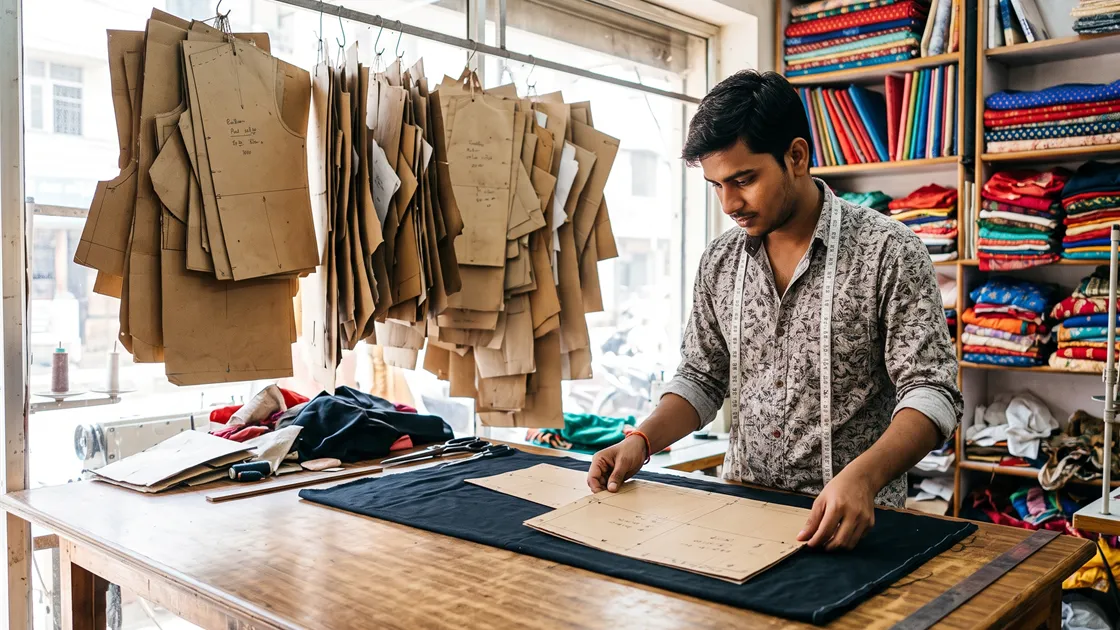
For each shape, make a <b>base pattern</b> in your most common size rather than a pattern per customer. The base is the shape; the customer’s measurements are adjustments to it, and those adjustments are made at the edges when the cloth is laid. A shop with one good base blouse pattern can cut for most of its customers from it.
Then add the two or three variations you are actually asked for — a deeper back neck, a three-quarter sleeve, a princess-cut front. Not every variation you can imagine; the ones on this month’s order book.
Six to eight pieces of card covers most of a small shop’s work. A shop that sets out to pattern everything makes forty, uses five, and concludes that patterns are not worth it.
Making One That Lasts
Use card, not paper
Thin card or a cut-up carton. Paper tears at the edges within a month and a pattern with a worn edge is a pattern that is slowly changing shape.
Write everything on the piece itself
What it is, which size, which piece of the garment, how many to cut, and the date. An unlabelled pattern piece becomes a mystery within six months and gets thrown away.
Mark the grain line
A straight line with an arrow, showing which way it must sit on the cloth. This is what stops a sleeve being cut across the grain and twisting after the first wash.
Include the seam allowance, or do not — but be consistent
Either every pattern includes it or none do. A set where some include it and some do not will produce a garment two sizes apart, and it will happen on a bridal order.
Notch the matching points
Small cuts at the edge showing where a sleeve meets an armhole or a dart closes. These are what let somebody else assemble it correctly without asking.
Make a second copy of the ones you use daily
The base blouse pattern will be used hundreds of times. Keep one as the master, in a drawer, and work from the copy.
Where to Keep Them
Patterns fail on storage more often than on making. A set of good patterns in a pile behind the machine will be bent, torn and lost within the year.
Hang them. Punch a hole in the corner of each piece, put the pieces for one garment on a single large ring or a loop of string, and hang the lot on a nail or a rail. Flat storage means stacking, and stacking means digging through the pile and creasing everything above the one you want.
Label the hanging set on a tag that can be read without lifting it down. "Blouse — base — 36" on the tag is the difference between finding a pattern and searching for one.
Photograph them, once. A photo of each pattern piece with its label, kept with the shop’s records, means a torn or lost pattern can be redrawn rather than re-invented. It takes twenty minutes for the whole set and it is the cheapest insurance in the shop.
And note which customers you have cut from each. A pattern used for a particular customer, with her adjustments written against her record rather than on the card, is how the two halves fit together — the shape on the card, the person in the record.
Frequently Asked Questions
Does a small tailoring shop need paper patterns?
Not to work, but to be repeatable. Cutting from chalk and memory keeps the shop’s shapes in one person’s head; a pattern puts them on card, so the same garment can be made twice and a second hand can be trained in a week rather than years.
Which patterns should I make first?
The three shapes you actually make most — count last month’s orders. Make a base pattern in your commonest size for each, plus the two or three variations you are regularly asked for. Six to eight pieces of card covers most of a small shop.
Should patterns include the seam allowance?
Either way works, but the whole set must be consistent. A set where some pieces include it and some do not will eventually produce a garment two sizes out, and it will happen on an order you cannot afford to get wrong.
How should patterns be stored?
Hung, not stacked. Punch a hole in each piece, put one garment’s pieces on a ring, hang it on a rail with a readable tag. Photograph the set once so a torn pattern can be redrawn instead of re-invented.
Where Juvee Helps
A pattern holds the shape; the customer record holds the person — her measurements, the adjustments made to the base last time, and what she asked for. Keeping the second half properly is what makes the first half usable, and that is measurement records. Juvee’s Basic plan is free with no time limit, and paid plans start at ₹10,190 a year including GST; the pricing page lists every plan. For keeping the shape when the person leaves, read when your master cutter leaves.