Nothing gets a blouse rejected more often than the wrong blouse padding. The difference between padding, cups and lining, which suits which saree, and the two questions to ask before cutting.
Three Different Things, One Word
A customer says she wants padding. The shop hears one thing, she means another, and the blouse comes back. This happens constantly, and it happens because three quite different things are all called padding at the counter.
<b>Lining</b> is a second layer of cloth behind the main fabric. It is about opacity and body — it stops a light cloth being see-through and stops a soft one collapsing. It adds no shape at all.
<b>Padding</b>, properly, is a thin layer of foam or wadding stitched into the bust area. It smooths and gives a little lift. It does not change her size and it is not meant to.
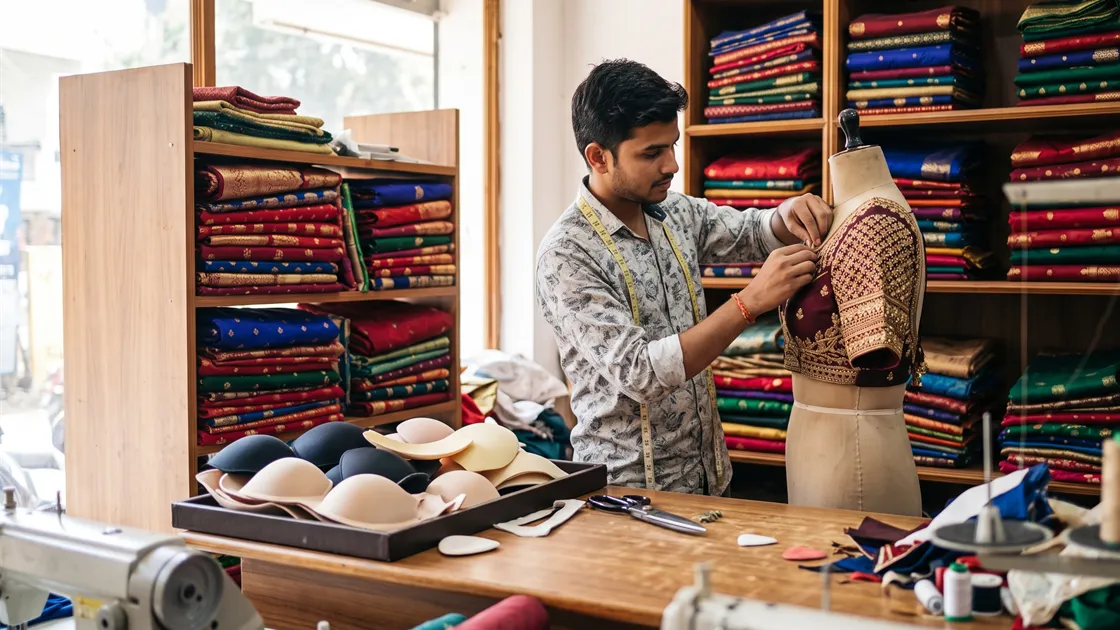
<b>Cups</b> are moulded shapes, the kind used in swimwear and bridal wear. They give structure and definition and make a real difference to the shape of the garment.
A woman who asks for "padding" and means lining gets a blouse that is thicker than she wanted. One who means cups gets one that does nothing. Both come back, and both times the measurements were correct.
Which One for Which Saree
Heavy silk — Kanjivaram, Banarasi
Lining only, in cotton. The saree carries its own weight and structure; the blouse needs body rather than shape, and padding under a heavy silk usually reads as bulk.
Chiffon, georgette, net
Lining is not optional — the cloth is sheer. Light padding is commonly wanted here too, because the saree itself gives no structure and the blouse is doing all the work.
Cotton, daily wear
Usually neither. The cloth is opaque and the garment is meant to be comfortable all day. Adding padding to a daily cotton blouse is the commonest unasked-for addition and the commonest complaint about one.
Bridal and heavy party wear
Cups, almost always, with lining and often boning as well. The garment is structured, it is worn for twelve hours and photographed throughout, and the customer expects it to hold its shape without her thinking about it.
Designer and backless
Cups, stitched in, with no back closure to rely on. This is the case where getting it wrong cannot be fixed afterwards, and it is worth a trial fitting rather than a conversation.
Stitched In or Removable
Both are right, for different customers, and the choice should be hers rather than the shop’s habit.
Stitched in gives a cleaner line — nothing shifts, nothing shows an outline, and the garment looks the same on the hanger as on the body. The cost is washing: padding sewn into a blouse takes a long time to dry and the foam eventually yellows, and after a year the blouse looks older than it is.
Removable, in a small pocket with an opening, lets the blouse be washed properly and the pad replaced when it tires. The cost is that the pocket can show as a faint outline on a thin cloth, and that a pad which is not quite the right size moves.
The working rule: stitched in for bridal and anything worn once or twice; removable for anything she will wear ten times. And if you do make it removable, make the opening wide enough that an ordinary hand can get the pad out, which is a detail shops get wrong surprisingly often.
Fitting It Properly
A pad in roughly the right place is worse than no pad. Four things decide whether it sits.
Place the apex where hers is, not where the pattern says. The highest point of the pad has to sit at the highest point of the bust, and that varies by several centimetres between two women of identical measurements.
Taper the edges. A pad that stops abruptly leaves a visible line through the cloth. The edges should thin out, which on foam means skiving the edge and on wadding means layering.
Stitch it to the lining, never to the outer cloth. Stitches that go through to the face will show, especially on silk, and they will show more after the first press.
And allow for it in the measurement. Padding or cups add to the bust, and a blouse cut to her plain measurement and then padded will be tight. Ask about padding before taking the measurement, not after — it belongs on the order checklist alongside the neckline and the sleeve.
The Two Questions to Ask
Almost every padding complaint is prevented by two questions at the counter, and neither takes thirty seconds.
The first: <b>"Do you want it to change the shape, or just to be smooth?"</b> This is the question that separates the three things. Smooth means lining or light padding. Change the shape means cups. The customer answers it easily even though she could not have used the words.
The second: <b>"Will you be wearing your own bra under it?"</b> If yes, cups are usually wrong and light padding may be unnecessary. If no — which is common with backless and designer blouses — the garment has to provide the support itself, and that changes everything about how it is built.
Write both answers in her words, and keep them with her record. Next time she orders, the answer is already there, and the second blouse is a four-minute order instead of the same conversation again.
What to Keep on the Shelf
Padding is the material most often missing on the day it is needed, because nobody owns the ordering of it and a blouse cannot be finished without it.
A working minimum for a ladies’ shop: thin foam sheet in one or two thicknesses, which can be cut to any shape; moulded cups in three sizes, since most customers fall into a narrow band; cotton lining in white and black, which between them sit under almost every colour; and a soft wadding for the customers who want smoothing rather than shape.
Buy cups by the dozen rather than in pairs. They do not spoil, the price per pair is noticeably lower, and running out of the middle size on a Saturday is how a bridal order slips.
Two habits worth having. Count it on the same day you count thread and zips, because it belongs to the same category of thing that disappears quietly. And keep the foam flat rather than folded — a crease in a foam sheet does not press out, and the piece cut across it will show a line through the cloth.
Frequently Asked Questions
What is the difference between padding, cups and lining in a blouse?
Lining is a second layer of cloth for opacity and body and adds no shape. Padding is thin foam or wadding that smooths and lifts slightly. Cups are moulded shapes that genuinely change the silhouette. Customers call all three "padding".
Should a saree blouse be padded?
It depends on the saree. Heavy silk usually needs lining only. Chiffon and georgette usually want lining and light padding. Daily cotton usually wants neither — adding padding to a daily blouse is the most common unasked-for addition.
Is stitched-in or removable padding better?
Stitched in for bridal and garments worn once or twice, because the line is cleaner. Removable for anything worn often, because the blouse can be washed and dried properly and the pad replaced when it tires.
Does padding change the measurements?
Yes. Padding and cups add to the bust, so a blouse cut to the plain measurement and then padded will be tight. Ask about padding before taking the measurement rather than after.
Where Juvee Helps
Whether she wants padding, which kind, stitched in or removable — three answers that belong with her measurements rather than on a slip that goes in the bin. Juvee keeps preferences against the customer, which is what makes her second blouse a four-minute order; see ladies tailoring software. The Basic plan is free with no time limit, and paid plans start at ₹10,190 a year including GST — the pricing page lists every plan. For the rest of the order, use the blouse order checklist.