Every measurement a gents tailor needs, where exactly the tape goes, and the mistakes that send a shirt back for alteration.
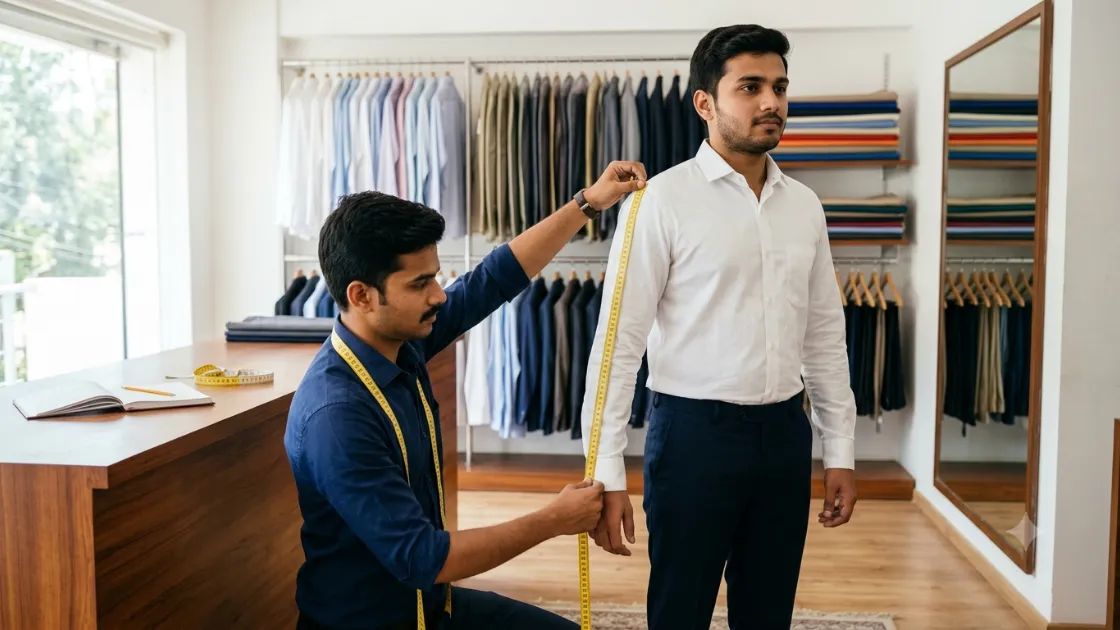
Why Gents Orders Come Back
A shirt rarely comes back because a number was written down wrong. It comes back because the number was right and the fit was never recorded. Two men with the same 40 inch chest want two different shirts, and only one of them told you which.
So this chart has two halves. The measurements, which are the same for everybody. And the fit notes, which are different for everybody and are the part most shops never write down.
Shirt Measurements
Measure over a thin vest or a light shirt, never over a thick one. Keep the tape flat and level all the way round, and snug without pulling. The customer should stand normally, arms down, not holding his breath.
| Measurement | Where the tape goes | What goes wrong |
|---|
Length | Shoulder point at the neck, straight down the front to where the shirt should end | Measured from the collar bone instead, so the shirt runs short |
Chest | Round the fullest part, under both arms, tape level at the back | Tape rides up at the back, so the chest reads small |
Stomach | Round the body at navel level | Skipped entirely, then the shirt pulls at the middle button |
Seat | Round the fullest part of the hip | Only needed for a long or untucked shirt, and forgotten when it is |
Shoulder | Across the back, from one shoulder seam point to the other | Measured across the front, which reads shorter |
Sleeve, full | Shoulder point down the outside of the arm to the wrist bone | Arm bent while measuring, so the sleeve ends up long |
Sleeve, half | Shoulder point down to the middle of the upper arm | No agreed end point, so every half sleeve differs |
Bicep | Round the fullest part of the upper arm | Taken tight, so the sleeve grips |
Cuff | Round the wrist, plus room for a watch | Watch not accounted for |
Collar | Round the base of the neck, with two fingers under the tape | Taken tight, and the top button never closes |
Pant Measurements
One rule decides half of these. Ask him to stand the way he actually stands, and measure the waist where he actually wears the trouser, not where the anatomy textbook puts it. Many men wear it low on the hip.
| Measurement | Where the tape goes | What goes wrong |
|---|
Waist | Round the body at the line where he wears the trouser | Taken at the natural waist, so the trouser sits too high |
Seat | Round the fullest part of the hip, usually about eight inches below the waist | Taken too high, so the seat is tight |
Length | From the waist line down the side of the leg to where the hem should sit on the shoe | Measured barefoot when he will wear formal shoes |
Crotch | Seated, from the waist line at the side down to the seat | Skipped, and this is the single most common cause of discomfort |
Thigh | Round the fullest part, just below the crotch | Taken mid-thigh, which reads small |
Knee | Round the leg at the knee | Left out, so the taper is guessed |
Bottom | Round the leg at the hem opening | Not agreed with the customer, and the shape of the trouser changes completely |
Kurta and Ethnic Wear
A kurta uses the shirt measurements with four changes:
- Length runs from the shoulder neck point to below the knee, and the customer should say where
- Chest and stomach take more ease than a shirt, because a kurta is not meant to sit close
- Sleeve runs to the wrist bone, longer than a formal shirt sleeve
- Side slit height is a measurement in its own right, and should be written down
A Size Band, For Sanity Checking Only
This table is not for cutting. It is for catching a number that has been written down wrong. If a customer looks like a medium and the chest reads 46, measure again before you cut.
| Rough size | Chest, inches | Collar, inches | Waist, inches |
|---|
S | 36 to 38 | 14.5 to 15 | 30 to 32 |
M | 38 to 40 | 15 to 15.5 | 32 to 34 |
L | 40 to 42 | 15.5 to 16 | 34 to 36 |
XL | 42 to 44 | 16 to 16.5 | 36 to 38 |
XXL | 44 to 46 | 17 to 17.5 | 38 to 40 |
Ready-made sizing differs from brand to brand, so treat these as a rough band and nothing more. The tape decides, not the table.
The Fit Notes Nobody Writes Down
These are the notes that stop a repeat customer from being re-measured, and stop the same alteration happening twice.
- Slim, regular or loose, in his words, not yours
- Shirt worn tucked in or left out
- Collar shape he prefers
- Cuff with a button, or a double cuff
- One pocket, two, or none
- Trouser flat front or pleated
- Turn-up at the trouser bottom, or a plain hem
- Anything he complained about last time
Write the date next to every measurement. A body changes, and a two year old chest measurement is a guess wearing the clothes of a fact.
Where Shops Lose the Money
Take a shop doing forty gents orders a month. If three come back for alteration, that is roughly one working day a month spent on work already paid for, plus the fabric on the ones that cannot be saved.
Almost none of that is skill. It is the crotch measurement that was never taken, the fit preference that lived in someone’s head, and the measurement book that was full so a loose slip was used instead.
Frequently Asked Questions
What measurements are needed for a men’s shirt?
Length, chest, stomach, shoulder, sleeve length, bicep, cuff and collar. Add seat if the shirt is long or worn untucked.
What measurements are needed for a pant?
Waist, seat, length, crotch, thigh, knee and bottom. The crotch is the one most often skipped and the one that causes the most complaints.
How much ease should I add to a chest measurement?
It depends on the fit the customer wants, which is why the fit note matters more than a fixed number. Agree slim, regular or loose with him first, then apply the allowance your shop uses for that fit, and keep it consistent for every customer.
Should I measure in inches or centimetres?
Whichever your shop already uses, but use only one. Mixing the two on the same order is a common and expensive mistake.
How do I take measurements for a repeat customer?
You should not have to. If the last set was stored with the date and the fit notes, you confirm rather than re-measure, and the customer notices that you remembered.
Keep Them Where You Can Find Them
A chart is only half the job. The other half is that the measurement is still there in eight months. In Juvee, a measurement is saved against the customer, so:
- The next order pulls the same numbers back, with the date they were taken
- Fit notes sit with the measurements, not in someone’s memory
- The counter phone and the shop computer show the same record
- Templates already exist for shirts, trousers, kurtas, blouses, lehengas and salwars
For the ladies side, see the blouse measurement chart.
And the salwar kameez measurement guide.
For the basics of taking a measurement, see how to take measurements for stitching.
For storing them, see measurement management for tailors.
For the phone app, see the Juvee tailor app.
Try It on One Real Week
Print this chart, or keep it open on the counter phone, and use it on every gents order for one week. The measurements you find yourself guessing at are the ones your shop has been losing money on.
You can explore the free Basic plan.
The Basic plan stays free, so there is no deadline to decide by.
The Other Measurement Charts
One chart per garment, each with the measurements to take, the ease to allow and the points that are easiest to get wrong.