Every measurement a blouse needs, where each one is taken from, and the four that go wrong most often. With a chart you can keep at the counter.
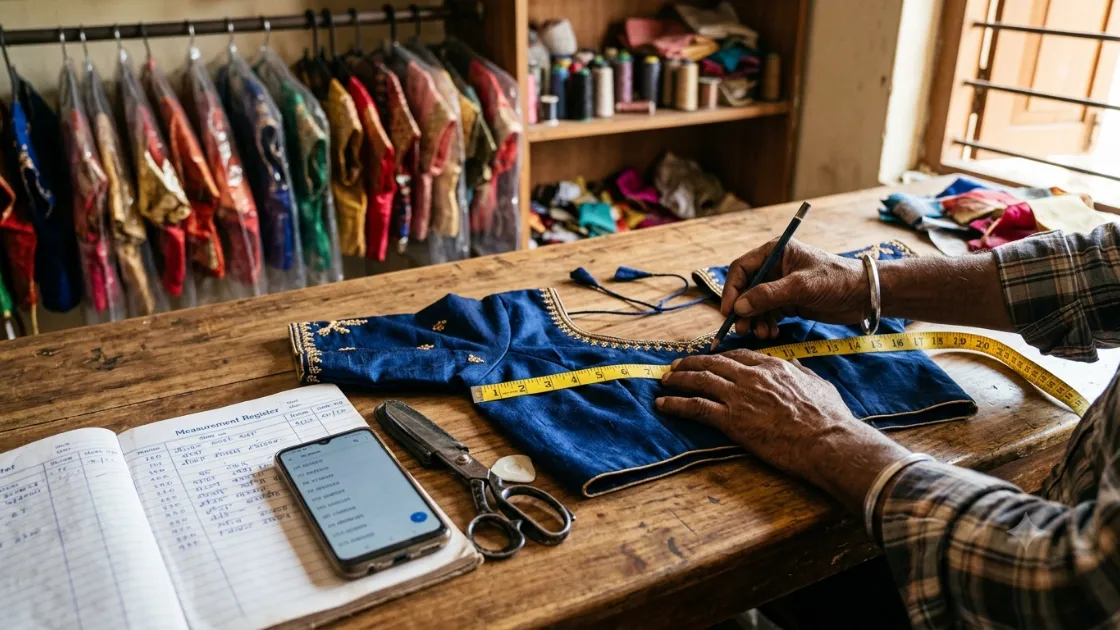
A blouse is the most measured garment in an Indian tailoring shop and the least forgiving. A kurta that runs half an inch wide still wears. A blouse that runs half an inch wide at the armhole comes back.
That is why a blouse needs twelve numbers where a trouser needs four, and why the shop that writes all twelve down is the shop that does not remake.
In this guide:
- The twelve measurements a blouse needs, and where each is taken
- A chart to keep at the counter
- The four that go wrong most often
- How to handle a repeat customer without measuring again
- What to do when the customer brings a fitting blouse instead
Before the Tape Comes Out
Three things decide whether the measurements are usable, and none of them is the measuring itself.
Measure Over a Fitting Blouse, Not Loose Clothing
A customer measured over a loose kurta will get a loose blouse. If she is wearing something fitted, measure over it. If not, it is better to ask her to come back than to guess and add an allowance.
Keep the Tape Level, and Not Too Tight
The tape should sit flat against the body and be snug without pressing in. A tape pulled tight gives a number that produces a blouse she cannot raise her arms in.
Write Each Number Down as You Take It
Not at the end. Twelve numbers held in the head while a customer is talking is how a bust measurement ends up in the waist row.
The Twelve Measurements
Names for these differ between shops and between regions — what one tailor calls "point to point" another calls "apex to apex", and both are right. What matters is that the same shop uses the same name every time, so the person stitching reads what the person measuring meant.
1. Blouse Length
From the shoulder at the base of the neck, straight down the front, to where the blouse should end. Ask rather than assume: the length a customer wants under a saree is a preference, not a formula.
2. Shoulder
Across the back, from the point of one shoulder to the point of the other. Taken at the back, not the front, because the front dips at the neck and gives a short reading.
3. Upper Chest
Around the body just under the armpits, above the bust. This is what stops a blouse gaping at the top even when the bust measurement is correct.
4. Bust
Around the fullest part. Tape level all the way round — check the back, which is where it usually rides up.
5. Waist
Around the body at the point where the blouse will end. Not the natural waist unless that is where the blouse ends.
6. Apex to Apex
The distance between the two bust points, straight across. This is what places the darts. A blouse with the darts in the wrong place looks wrong even when every other number is right.
7. Shoulder to Apex
From the shoulder at the neck, down the front, to the bust point. With the previous measurement this fixes the dart in both directions.
8. Armhole Round
Around the arm where it meets the shoulder, with the tape passing under the armpit. Snug but not tight. This is the single most common remake in a tailoring shop.
9. Sleeve Length
From the shoulder point down the arm to where the sleeve should end. Take it with the arm relaxed at the side.
10. Sleeve Round
Around the arm at the point where the sleeve will end — not at the widest part of the arm unless that is where the sleeve ends.
11. Front Neck Depth
From the shoulder line at the base of the neck, straight down the front, to how low the neckline should sit.
12. Back Neck Depth
The same at the back. Always ask separately. A customer who wants a modest front often wants a deeper back, and assuming they match is how a blouse gets remade.
The Chart
Keep this at the counter. The third column is the part worth reading twice.
| Measurement | Taken from | The mistake to avoid |
|---|
Blouse length | Neck point, straight down the front | Assuming a standard length instead of asking |
Shoulder | Shoulder point to shoulder point, across the back | Taking it at the front, which reads short |
Upper chest | Around, just under the armpits | Skipping it, then wondering why the top gapes |
Bust | Around the fullest part | Tape riding up at the back |
Waist | Around, where the blouse ends | Using the natural waist by habit |
Apex to apex | Bust point to bust point | Guessing it from the bust measurement |
Shoulder to apex | Neck point down to the bust point | Leaving it out, so the dart floats |
Armhole round | Around the arm at the shoulder, under the armpit | Pulling the tape tight |
Sleeve length | Shoulder point down the arm | Measuring with the arm raised |
Sleeve round | Around the arm where the sleeve ends | Measuring at the widest point instead |
Front neck depth | Neck base, straight down the front | Copying the back depth |
Back neck depth | Neck base, straight down the back | Assuming it matches the front |
The Four That Go Wrong Most
In practice, remakes cluster around the same handful of numbers.
Armhole
Too tight and she cannot lift her arm. Too loose and it gapes when she does. It is the one measurement where being half an inch out is visible to everyone in the room, and it is also the one most often taken with the tape pulled.
Apex to Apex
Skipped more often than any other, because it feels like something that can be worked out from the bust. It cannot. Two customers with the same bust measurement can need darts an inch apart.
Neck Depth, Front and Back
Taken once and applied to both. Ask for both, every time, and write both down. This is thirty seconds that prevents a remake nobody will pay for.
Blouse Length
Fashion moves and preference varies. The length a customer asked for two years ago may not be the length she wants now, which is the argument for dating every set of measurements.
The measurement that causes a remake is almost never the one that was measured wrongly. It is the one that was never measured at all.
The Repeat Customer
A regular who comes back for her fourth blouse should not be measured a fourth time. She should be asked one question: has anything changed?
If the answer is no, the previous set is used. If the answer is yes, the affected measurements are retaken and the rest are kept. Either way it takes a minute instead of ten, and she notices.
This only works if the earlier set can be found in seconds and is dated. A measurement register can do it, if the page can be found. What it cannot do is tell you which of three sets is the most recent.
When She Brings a Blouse Instead
A customer who brings a blouse that fits well has given you the easiest job of the day — but measure the garment flat, not on her, and double the width measurements, since a flat garment gives half the round.
Note in the record that these came from a garment rather than the body. If a later blouse comes out tight, that note is the first place to look.
Frequently Asked Questions
How many measurements does a blouse need?
Twelve covers a standard blouse: length, shoulder, upper chest, bust, waist, apex to apex, shoulder to apex, armhole, sleeve length, sleeve round, and front and back neck depth. Some shops add cross front and cross back for particular styles.
Why does the blouse come out tight at the armhole?
Almost always the tape was pulled tight when the armhole was taken, or it was taken with the arm raised. Take it with the arm relaxed and the tape snug rather than tight.
Do I need apex to apex if I have the bust measurement?
Yes. The bust tells you how wide, not where the fullest point sits. Two customers with the same bust can need the darts in different places, and a misplaced dart is visible on the finished blouse.
Should the front and back neck depth be the same?
Not unless the customer says so. Ask for both separately every time. Assuming they match is one of the most common reasons a finished blouse is sent back.
How do I keep measurements for regular customers?
Keep them against the customer rather than against the order, and date every set. When she returns, the question becomes "has anything changed?" instead of ten minutes with a tape.
Measurements That Stay Found
A chart solves how to measure. It does not solve where the numbers go afterwards. Juvee keeps them against the customer:
- A measurement template for each garment type, with the fields that garment needs
- Every set dated, so this year and last year both survive and you can see which is which
- Found by typing two letters of a name, rather than turning pages
- Attached to the order, so the person stitching reads the same numbers you wrote
- On the phone at the counter and the shop computer, on one account
An alteration updates the measurement without overwriting what it used to be, which matters the first time a customer says the last one fitted better.
For how shops set this up, see measurement management for tailors.
For taking measurements at the counter, see the Juvee tailor app.
For shops that mainly stitch blouses and ladies wear, see ladies tailor shop software.
Try It on This Week’s Blouses
Take the next ten customers, enter the twelve measurements properly, and see what happens when the first of them comes back.
You can explore the free Basic plan.
The Basic plan is free permanently for up to 10 customers and 20 orders a month, so a small shop can stay on it without a deadline. Paid plans start at ₹10,190 per year.
The Other Measurement Charts
One chart per garment, each with the measurements to take, the ease to allow and the points that are easiest to get wrong.