A lehenga is three garments, not one. Here is every measurement each part needs, where the tape goes, and the mistakes that cost a wedding fitting.
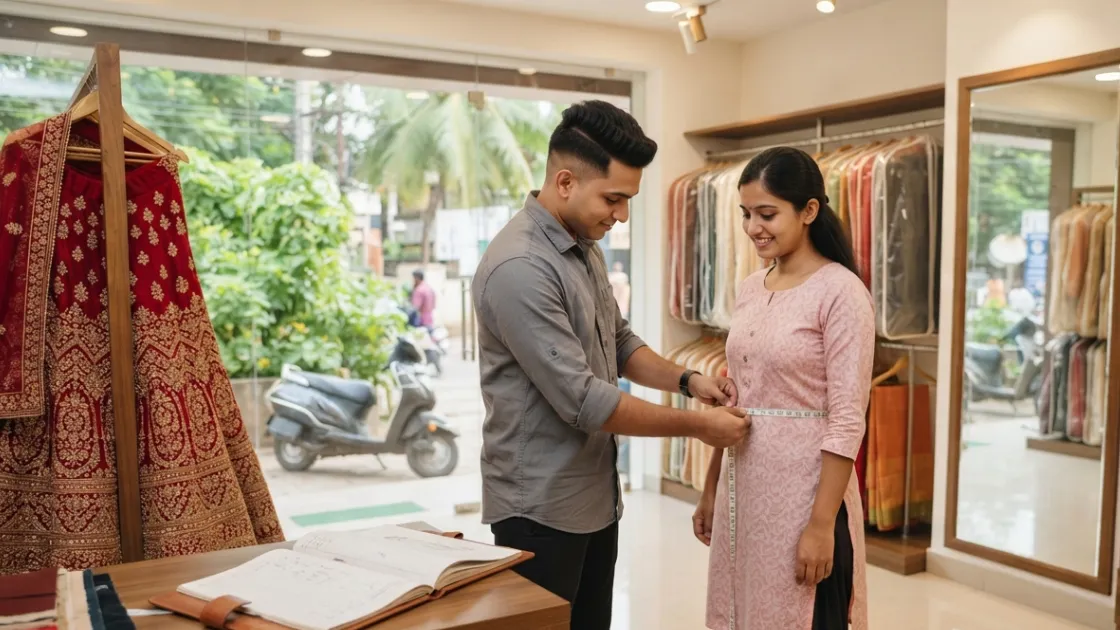
Three Garments, One Order
A blouse is one garment and a salwar suit is two. A lehenga is three, and each part is measured differently: the choli on the body, the skirt from the waist down, and the dupatta by length alone.
Most lehenga alterations come from treating it as one job and taking one set of measurements. The waist that fits the choli is not the waist the skirt sits on, and a shop that records only one of them will be letting out a skirt two days before a wedding.
Part One - The Choli
This is a blouse with two differences: it is worn tighter, and it is usually shorter. Everything else is the blouse chart.
| Measurement | Where the tape goes | What goes wrong |
|---|
Choli length | Shoulder point down the front to where the choli should end | Not agreed with the customer. Ask her to show you with her hand |
Upper chest | Round the body above the bust, under the arms | Skipped, so the neckline gapes |
Bust | Round the fullest part, tape level at the back | Tape rides up behind, so the bust reads small |
Under bust | Round the body directly beneath the bust | The measurement that decides whether the choli stays down |
Waist | Round the natural waist, the narrowest point | Confused with the skirt waist, which sits lower |
Shoulder | Across the back, seam point to seam point | Measured across the front, which reads shorter |
Sleeve length | Shoulder point down to where the sleeve should end | No agreed end point for a short sleeve |
Armhole | Round the arm at the shoulder joint | Taken tight, and she cannot raise her arm |
Front neck depth | Shoulder seam down the front to the neckline | Guessed. Always confirm against a picture she brings |
Back neck depth | Neck bone down the back to the neckline | Guessed, and a deep back is the whole point of a choli |
Cross front | Across the front, armhole to armhole, halfway down | Left out, so the choli pulls across the chest |
Part Two - The Lehenga Skirt
Ask one question before the tape comes out: where will she wear it? On the natural waist, or low on the hip? The answer changes every number below.
| Measurement | Where the tape goes | What goes wrong |
|---|
Skirt waist | Round the body at the line where the skirt will actually sit | Taken at the choli waist. These are two different lines |
Hip | Round the fullest part of the hip | Taken too high, so the skirt will not sit down |
Skirt length | From the skirt waist line straight down to the floor | Measured barefoot when she will wear heels |
Heel height | The heel she will wear on the day, in inches | Not asked. This is the single most common lehenga alteration |
Flare | The finished sweep at the hem, agreed in metres of fabric | Not agreed, and flare is what the customer notices first |
Waistband width | How deep the band itself should be | Left to the karigar, so no two orders match |
Ask for the heel height and write it down. A lehenga cut for flat sandals and worn with three-inch heels drags on the floor, and there is no fixing it the night before.
Part Three - The Dupatta
Only two numbers, and they are usually decided by the fabric rather than the body.
- Length, agreed in metres. Two and a half metres is common; a heavier drape wants more
- Width, which the fabric roll usually decides for you
Record how she wants it draped as well. A dupatta pinned at the shoulder and one carried over the arm are cut to different lengths.
A Size Band, For Sanity Checking Only
This table is not for cutting. It is for catching a number written down wrong. If a customer looks like a medium and the bust reads 44, measure again.
| Rough size | Bust, inches | Waist, inches | Hip, inches |
|---|
XS | 30 to 32 | 24 to 26 | 32 to 34 |
S | 32 to 34 | 26 to 28 | 34 to 36 |
M | 34 to 36 | 28 to 30 | 36 to 38 |
L | 36 to 38 | 30 to 32 | 38 to 40 |
XL | 38 to 40 | 32 to 34 | 40 to 42 |
XXL | 40 to 42 | 34 to 36 | 42 to 44 |
Ready-made sizing differs from brand to brand. Treat these as a rough band and nothing more. The tape decides, not the table.
The Notes That Save the Fitting
A lehenga is worn once, on a day that cannot be moved. These are the notes that decide whether the fitting is a formality or a crisis.
- Heel height on the day
- Padded choli or not
- Lining fabric, and whether she wants it in the skirt too
- Canopy or cancan underneath, which changes the skirt length
- Hook, zip or dori at the back
- The date of the function, not just the delivery date
Write the date beside every measurement. Bridal orders are taken months ahead, and a body changes between the booking and the wedding. A measurement with no date is a guess wearing the clothes of a fact.
Where the Money Goes
A bridal lehenga carries more fabric, more work and more emotion than anything else a shop stitches. It is also the order where a mistake costs the most: the fabric cannot be replaced in two days, and an unhappy bride tells everyone at the function.
Almost none of that risk is skill. It is the heel height nobody asked about, the two waist measurements written as one number, and the trial date that was never fixed.
Frequently Asked Questions
What measurements are needed for a lehenga?
Three sets. The choli takes the blouse measurements, the skirt takes waist, hip, length and flare, and the dupatta takes length and width. The skirt waist and the choli waist are different lines on the body.
How do I measure lehenga length correctly?
From the line where the skirt will sit, straight down to the floor, with the customer standing in the heels she will wear. If she does not have them yet, ask for the height in inches and add it.
How much flare does a lehenga need?
It depends on the look she wants and the fabric. Agree it in metres with the customer before cutting, and write the number down. Flare is what she will notice first and what she cannot describe afterwards.
When should the trial be?
Far enough before the function that an alteration is possible without panic. Fix the trial date at the time of booking and write it next to the delivery date.
How do I keep bridal measurements safe for months?
On paper they are a loose slip in a full register. Stored against the customer with the date and the fitting notes, they are still there at the trial, and the trial becomes a check rather than a rescue.
Keep Them Where You Can Find Them
A chart is half the job. The other half is that the measurement is still there at the trial. In Juvee, a measurement is saved against the customer, so:
- The trial pulls the same numbers back, with the date they were taken
- Fitting notes sit with the measurements, not in someone’s memory
- The counter phone and the shop computer show the same record
- Templates already exist for blouses, lehengas, kurtas, salwars, shirts and trousers
For the blouse side, see the blouse measurement chart.
And the salwar kameez measurement guide.
For bridal work specifically, see bridal boutique software.
For storing measurements, see measurement management for tailors.
For the phone app, see the Juvee tailor app.
Try It on One Real Order
Print this chart, or keep it open on the counter phone, and use it on the next lehenga that comes in. The measurements you find yourself guessing at are the ones your shop has been paying for in alterations.
You can explore the free Basic plan.
The Basic plan stays free, so there is no deadline to decide by.
The Other Measurement Charts
One chart per garment, each with the measurements to take, the ease to allow and the points that are easiest to get wrong.