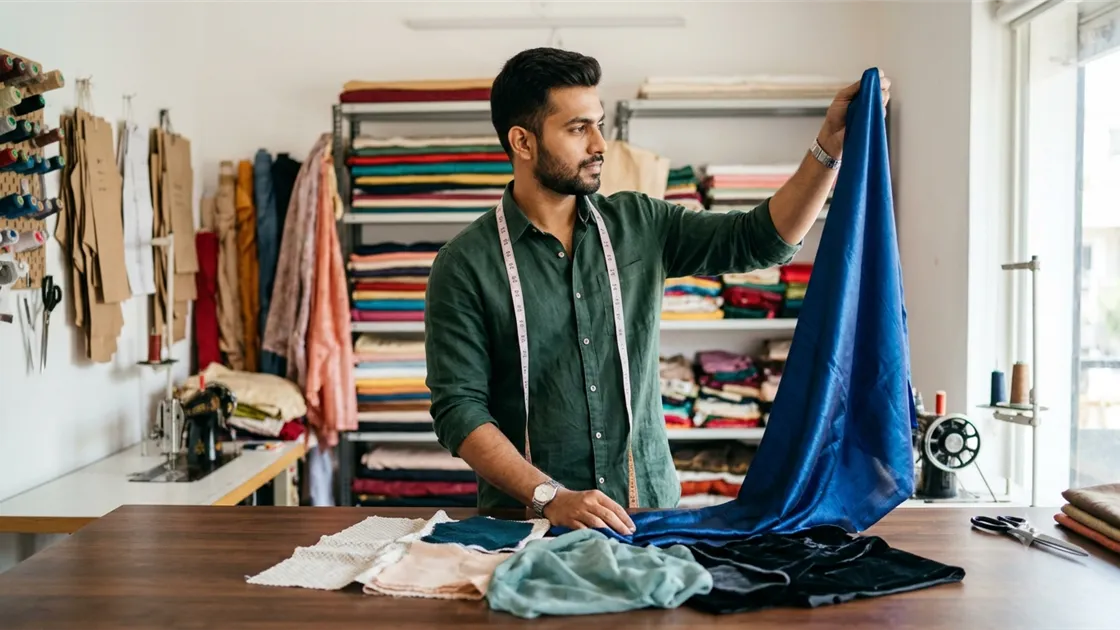
A customer hands over a piece of cloth and asks for a blouse by Friday. Before you agree, you need to know what that cloth will do under the scissors, the machine and the iron. Here are the fabric types every tailor should know, how each one behaves, and what to watch for when stitching it.
Why the Fabric Decides the Job
Two blouses cut from the same pattern, one in cotton and one in georgette, are two different jobs. The cotton stays where you put it, takes a crisp press and forgives a slightly uneven seam. The georgette slides on the table, stretches as you cut, frays at every edge and shows every pucker.
A tailor who knows the fabric quotes the right time, the right price and the right finish. A tailor who does not finds out at the machine, usually the evening before delivery. Knowing the fabric is also how you advise the customer honestly: whether her choice of cloth will hold the design she wants, whether it needs a lining, whether it will shrink.
Natural, Synthetic and Blended
Every fabric falls into one of three groups, and the group tells you most of what you need.
Natural fibres come from plants or animals: cotton, linen, silk, wool. They breathe, take a hot iron and usually shrink when first washed.
Synthetic fibres are made in factories: polyester, nylon. They are strong, cheap and rarely shrink, but they melt under a hot iron and can feel warm to wear.
Regenerated fibres such as rayon, viscose and modal are made from wood pulp. They drape beautifully and feel cool, but they are weak when wet and often shrink.
Most cloth sold today is a blend, such as cotton with polyester or silk with viscose, and behaves somewhere between its parts. When a customer cannot tell you what her cloth is, the label on the shop bill often can. If not, treat it as the most delicate thing it might be.
The Fabrics You Will Meet Most
Fabric | What it is | How it behaves | Watch for |
|---|
Cotton and cambric | Natural, woven | Stable, easy to cut, presses crisp | Shrinks on first wash. Pre-wash or allow for it |
Voile and mulmul | Fine, light cotton | Soft, slightly sheer, frays easily | Needs a lining for most blouses. Finish seams neatly |
Linen | Natural, woven | Crisp, cool, creases heavily | Frays fast. Shrinks. Press while damp |
Rayon and viscose | Regenerated | Soft, drapes well, slides on the table | Shrinks and weakens when wet. Cut on paper if slippery |
Georgette | Usually polyester, crinkled | Light, flowing, slippery, frays | Stretches on cutting. Needs lining. Low iron |
Chiffon | Very light and sheer | Floats, slides, frays badly | The hardest everyday fabric to cut straight. French seams |
Crepe | Crinkled surface, often polyester | Drapes well, hides creases | Stretches in one direction. Test before cutting |
Pure silk | Natural, woven | Rich, holds shape, takes colour well | Marks from pins and wrong pressing. Use a press cloth |
Art silk and satin | Usually polyester or viscose | Shiny, slippery, shows every needle hole | Pin only in the seam allowance. Low iron |
Organza | Stiff, sheer, often silk or polyester | Holds volume, frays | Good for sleeves and overlays, rarely alone |
Net | Open mesh | No give, does not fray much | Scratchy edges need binding or lining |
Velvet | Pile surface | Heavy, rich, the pile shifts | Cut all pieces in one direction. Never press flat |
Brocade | Woven pattern, often with metallic thread | Firm, heavy, frays at the edges | Match the pattern at seams. Overlock edges early |
Khadi | Hand-spun, hand-woven cotton | Textured, breathable, uneven | Shrinks. Check the weave for thin patches |
Denim and twill | Heavy cotton weave | Strong, stiff | Needs a heavier needle and stronger thread |
For the right needle and thread for each of these, see our guide on needles and thread for every fabric.
Woven and Knitted
Most cloth a tailor handles is woven: threads crossing at right angles, so it does not stretch along its length or width, only a little on the diagonal. Shirts, blouses, kurtas and trousers are almost always woven.
Knitted fabric, the kind T-shirts and leggings are made of, is made from loops and stretches in every direction. It needs stretch stitches or an overlock, and a woven pattern sewn in a knit will not fit the same way. If a customer brings stretch cloth for a fitted blouse, the measurements need less ease, and you should say so before cutting.
Grain and Bias: Why It Hangs Wrong
Every woven fabric has a grain: the lengthwise threads, running parallel to the selvedge, the finished edge of the cloth. Garments are normally cut with the grain running down the body, so they hang straight.
Cut off-grain and the garment twists after washing, the side seams creep round to the front, and no alteration really fixes it. Before cutting, fold the cloth with the selvedges together and check that it lies flat. If it does not, the cloth was printed or rolled off-grain, and you should know before you cut, not after.
The bias, at forty-five degrees to the grain, stretches. That is useful for piping and for necklines that need to curve, and a problem when an edge stretches that should not. Stay-stitch curved edges cut near the bias before you handle them.
Before You Cut: Three Tests
Shrinkage
Cotton, linen, rayon and khadi can shrink when first washed. Cut a small piece, measure it, wash and dry it, and measure again. Our guide on testing cloth for shrinkage covers how much to allow.
Colour
Dark and bright cotton prints, and many handloom fabrics, can bleed. Wet a corner and press it against white cloth. If colour comes off, warn the customer and advise dry cleaning or a cold separate wash.
Faults
Open the full length on the table in good light before cutting. Look for weaving faults, holes, stains and colour variation. If you find one, show it to the customer before you start; our guide on when the cloth has a fault covers what to say.
Advising the Customer on Her Choice
Customers often choose cloth for its colour and then a design from a photograph, without knowing whether the two belong together. This is where a tailor who knows fabric earns trust.
A structured design, such as a princess cut, a boat neck or a collar, needs a fabric that holds its shape: cotton, silk, brocade or a lined crepe. A flowing design, such as an anarkali flare or a gathered sleeve, needs a fabric that drapes: georgette, rayon or chiffon. Put a stiff brocade into a full flare and it stands out like a lampshade. Put a soft georgette into a fitted collar and it collapses by lunchtime.
When the cloth and the design do not match, say so at the counter, kindly and with a reason, and offer what would work: a lining, an interfacing, a simpler design, or a different part of the garment for the delicate cloth. Most customers are grateful. The ones who insist have at least been told, and you can note it on the slip.
Pressing Each Fabric
More fabrics are ruined at the iron than at the machine. Cotton and linen take a hot iron and steam. Silk takes a medium heat with a press cloth between the iron and the fabric. Polyester, georgette, satin and art silk take a low heat, tested first on a scrap, because they can shine or melt. Velvet is never pressed flat; steam it from the back. When in doubt, start cool and test on the seam allowance.
Frequently Asked Questions
What are the main types of fabric used in tailoring?
Cotton and cambric, voile, linen, rayon, georgette, chiffon, crepe, pure silk, art silk and satin, organza, net, velvet, brocade, khadi and denim. Most fall into natural, synthetic or regenerated fibres, and many are blends.
Which fabric is easiest to stitch?
Medium-weight cotton. It is stable, easy to cut straight, presses crisp and forgives small errors. It is the right fabric for learning and for testing a new pattern.
Which fabrics need a lining?
Sheer and slippery fabrics such as voile, georgette, chiffon and net usually need a lining for blouses and fitted garments, both for modesty and to hold the shape.
How can a tailor tell what a fabric is made of?
Check the shop bill or label first. Otherwise look at how it creases, drapes and feels, and test a scrap with a low iron. When unsure, treat it as the most delicate fabric it could be.
Where Juvee Helps
Knowing your fabrics matters twice: at the cutting table, and when you buy cloth to sell or stock. Juvee keeps a record of the fabric you hold, what it cost and what was used on which order, so you know what is on the shelf before you promise it to a customer; see fabric inventory management. The Basic plan is free with no time limit, and paid plans start at ₹10,190 a year including GST; the pricing page lists every plan.