The neck is the first thing anyone sees on a salwar kameez, and the part customers change their minds about most. Here are the salwar neck designs most shops are asked for, the three measurements every neck needs, and how to charge for each design so the extra work is paid for.
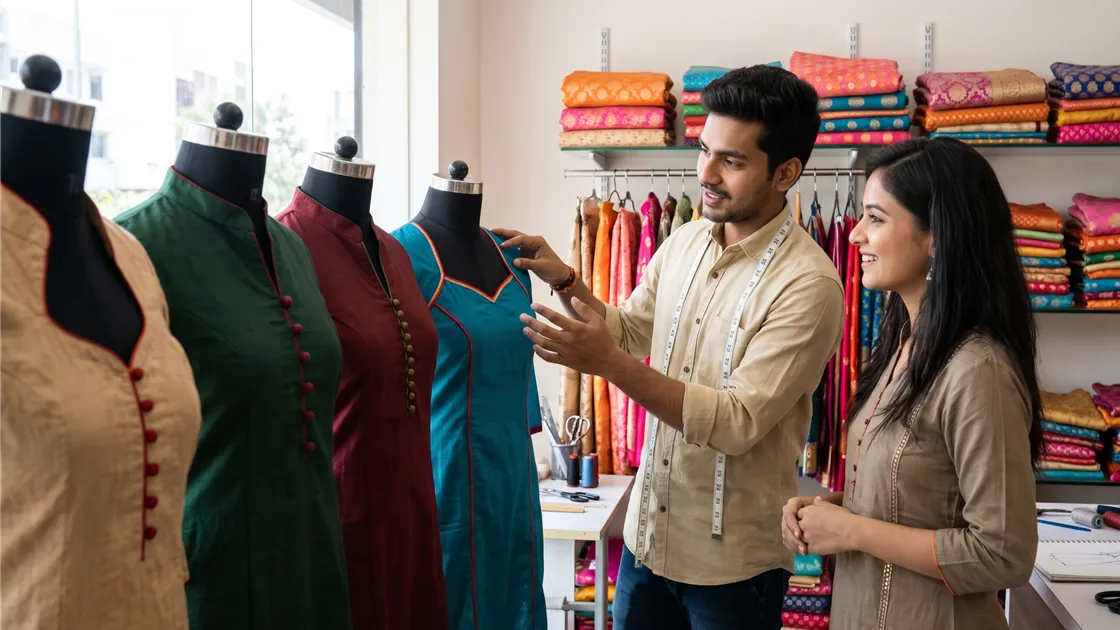
Why the Neck Deserves Its Own Price
Many shops charge one price for a salwar kameez and do whatever neck the customer asks for. A plain round neck and a collar with a placket of potli buttons cost the same at the counter and very different amounts of time at the machine.
That is how a busy shop stays busy and still earns little. The answer is not to charge more for everything. It is to keep a basic neck inside the standard price and add a clear, visible amount for the designs that take longer. Customers accept it readily when they can see the list, and it stops the argument that starts with "but you did it free for my sister".
The Three Measurements Every Neck Needs
Whatever the design, three numbers decide whether it sits right. Take them on the customer, not from a picture.
| Measurement | Where the tape goes | What goes wrong |
|---|
Front neck depth | From the shoulder line, near the neck, straight down the front to where the neckline should end | Agreed in words, "medium", and cut too deep |
Back neck depth | From the shoulder line straight down the back | Forgotten, then guessed from the front |
Neck width | Across the shoulder line, from one side of the neckline to the other | Cut too wide, so the neckline slides and shows the strap |
Show the depth on her with the tape and let her decide by looking in the mirror. A depth agreed on the body is never disputed later. A depth agreed from a photograph on her phone, where the model is a different height, often is.
The rest of the kameez measurements are covered in the salwar kameez measurement guide.
Salwar Neck Designs Customers Ask For
Round neck
The everyday neck and the one most kameez prices assume. Quick to cut and face, comfortable, and suits almost everyone.
U neck
A deeper, softer round. Easy to make, but the depth matters more than on a round neck, so agree it carefully.
V neck
Lengthens the neck and suits most body shapes. The point must be sharp and centred, which takes a little more care in facing and pressing.
Boat neck
Wide and shallow, running towards the shoulders. Elegant, but the width must be exact or the strap shows. Take the neck width twice.
Square neck
Clean and modern. The corners must be clipped and turned precisely, or they pucker. More time than it looks.
Sweetheart neck
A curved, heart-shaped front. Popular for occasion wear and one of the more time-consuming plain necks, because both curves must match.
Collar or Chinese collar
A standing band collar, often with a front placket. It is a separate piece cut, interfaced and attached, and it takes far longer than any open neck.
Keyhole neck
A round or high neck with a small opening at the front or back, often closed with a loop and button. Simple in look, fiddly in making.
Placket with potli buttons
A front opening finished with a placket and a row of small fabric-covered buttons. The buttons themselves are often made by hand, and they are where the time goes.
Neck with piping, lace or patchwork
Any of the shapes above, finished with contrast piping, lace or a fabric patch. The finishing is extra work on top of the shape, and should be priced on top of it.
What to Charge
The bands below are common starting points for the extra charge over a kameez with a plain round neck. Your own rates should come from your time and your costs; our guide to building a tailoring rate card shows how to work them out.
| Neck design | Usual extra charge | Why |
|---|
Round, U or simple V | Included | Quick to cut and face |
Boat or square | Rs 50 - 100 | Exact width or clean corners take time |
Sweetheart or keyhole | Rs 80 - 150 | Matching curves, a loop and button |
Contrast piping | Rs 80 - 200 | Extra cutting and careful stitching |
Collar or Chinese collar | Rs 150 - 300 | A separate piece, interfaced and attached |
Placket with potli buttons | Rs 150 - 350 | Placket plus handmade buttons |
Lace or patchwork neck | Rs 150 - 400 | Depends on the amount of work |
Embroidery, mirror work or hand work around the neck is a different job and should be priced from the hours it takes, not as a neck design; our guide on costing embroidery and hand work shows how.
Put the neck designs and their prices on your rate card, with a small picture or sample of each if you can. Customers choose faster from pictures, and a choice made from a list with prices on it is a choice nobody argues about at collection.
Finishing: Facing, Piping or Lining
How the neck is finished matters as much as its shape.
Facing is a shaped strip of the same fabric stitched to the neckline and turned inside. It is the standard finish, neat and quick, and suits most fabrics.
Piping is a narrow bias strip, often in a contrast colour, that frames the neckline. It adds strength and a finished look, and it is a design feature in its own right.
Lining the whole yoke gives the cleanest inside and holds a deep or wide neck in shape, especially on thin fabrics such as georgette and chiffon.
On a thin or slippery fabric, a deep neck without lining or interfacing will stretch and gape after the first wash. If the customer wants a deep neck on georgette, recommend the lining and price it.
Avoiding the Neck Complaints
Most neck complaints are one of three things: too deep, too wide, or not what she imagined. All three are prevented at the counter.
Agree the depth and width on her body, not from a picture. Write the design name and the numbers on the slip, along with any finishing. For anything unusual, draw a quick sketch on the slip and ask her to look at it. And if she brings a photograph, note the differences out loud: "this model's neck is deeper than what you are showing me, shall I go with yours?" A minute of that saves an alteration.
If she is not sure between a kurti and a full salwar set, the kurti measurement chart covers the neck depth on a kurti, which is usually agreed the same way.
Frequently Asked Questions
What are the most popular salwar neck designs?
Round, U, V, boat and square necks for everyday wear, and sweetheart, collar, keyhole and placket necks with potli buttons for occasion wear. Any of them can be finished with piping, lace or patchwork.
How much extra should a tailor charge for a salwar neck design?
A plain round, U or simple V neck is usually included in the kameez price. More complex designs commonly add from about Rs 50 for a boat or square neck to Rs 150 to 400 for collars, plackets or lace work. Work out your own rates from the time each takes.
What measurements are needed for a salwar neck?
Three: front neck depth, back neck depth and neck width. Take them on the customer with the tape, and agree the depth by looking in the mirror rather than from a photograph.
How do I stop a deep neck from gaping?
Keep the neck width exact, and on thin or slippery fabrics line the yoke or interface the neckline. A deep neck on georgette without support will stretch after the first wash.
Where Juvee Helps
The neck a customer chose, its depth and its finish are exactly the details she will expect you to remember on the next order. Juvee keeps them with her measurements against her name, along with the price you charged, so the next salwar starts from what she liked last time; see Juvee for ladies tailor shops. The Basic plan is free with no time limit, and paid plans start at ₹10,190 a year including GST; the pricing page lists every plan.