Most blouses come back for something that was never a measurement. The blouse order checklist a counter should run through: the fifteen choices to settle before she leaves, and the three worth writing in her words.
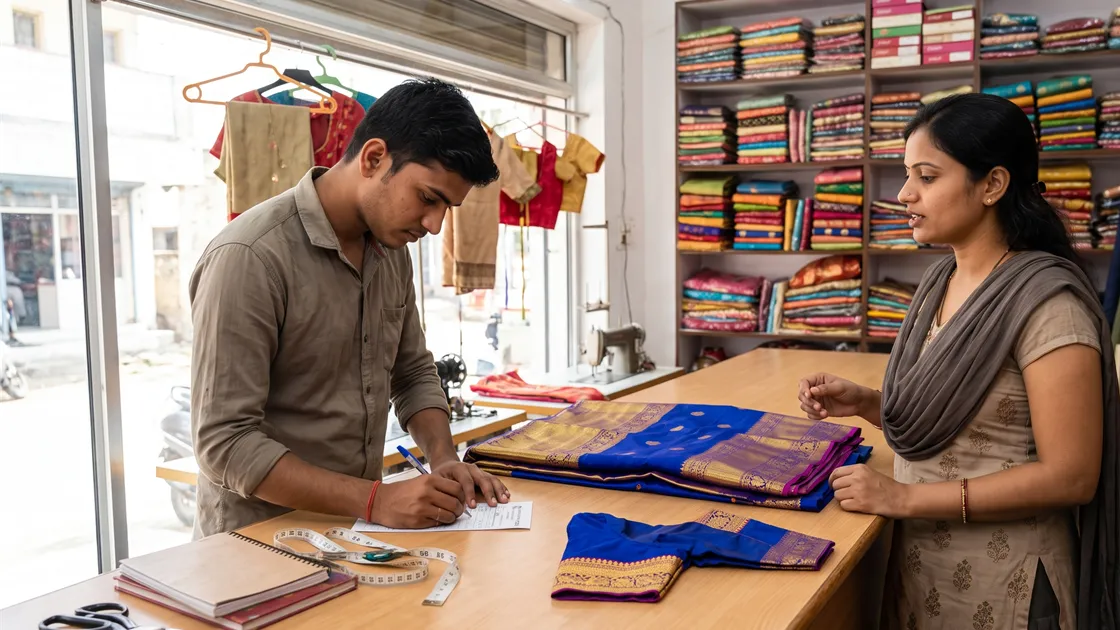
The Measurements Were Never the Problem
A blouse comes back. The shop assumes the measurements were wrong, re-measures, remakes, and the same thing happens again.
Very often the figures were right. What was wrong was a choice nobody made out loud — the sleeve was shorter than she pictured, the neck deeper at the back than she wanted, the hooks were where she did not expect. None of those are measurement errors and none of them are visible on a measurement slip.
A blouse is perhaps fifteen decisions, of which eight are numbers and seven are preferences. Shops take the eight carefully and guess the seven, and then wonder why a well-fitting blouse is rejected.
The fix is a checklist at the counter, run through in the four minutes while she is still there. For the measurements themselves, work from a proper chart; this is about everything else.
The Cloth and What Goes Under It
Is there enough cloth
Measure the piece on the counter, say the figure out loud, and compare it with what the design needs. A blouse with a full sleeve and lining needs noticeably more than a short-sleeved one, and finding that out after cutting is the worst version of this conversation.
Lining, and whose
Lined or unlined, and if lined, are you supplying it. Cotton lining for a silk saree blouse, nothing at all for a cotton daily one. If you supply it, it is a separate line on the bill.
Padding or cups
Padded, lightly padded, or not. Removable or stitched in. This is one of the most common reasons a blouse is rejected and one of the least often asked.
Interfacing at the neck
A wide or deep neckline in a soft cloth will go wavy within a month without it. She will not ask for it; you decide and note it.
The Shape She Has in Her Head
These are the seven that are not numbers, and the ones worth settling while she is in front of you rather than inferring from a photograph.
Front neck — shape and depth
Round, V, square, boat, sweetheart. Depth measured from the shoulder, not described in words. "Normal" means something different to every customer.
Back neck — shape and depth
Usually deeper than the front and the more sensitive of the two. Ask specifically; a back that is deeper than she expected cannot be undone.
Sleeve length and width
Where it ends, measured from the shoulder. Fitted or loose at the opening. Elbow length means four different lengths to four customers.
Closing — hooks, zip, or buttons, and where
Front or back, and how many. A back zip and back hooks sit differently and she will have a preference even if she has never said so.
Length and the waist dart
Where the blouse ends relative to the waist, and whether she wants it fitted at the waist or straight.
Piping, borders, or saree cloth used in the blouse
Whether a border from the saree is being used, and where. If so, you need the saree itself, not just a description.
Who it is being worn with
A heavy Kanjivaram and a chiffon saree want different blouses from the same measurements. If the saree is here, look at it; if not, ask what it is.
The Three to Write in Her Words
Most of the slip is yours. Three lines should be hers, quoted, because they are the ones that get reinterpreted on the way to the cutting table.
Whatever she says about <b>fit</b> — "tight", "not too tight", "like the last one". Those are not the same instruction, and your idea of tight is not hers.
Whatever she says about the <b>back neck</b>. This single item causes more rejections than any other in a ladies’ shop, and it is almost always because somebody translated "little bit deep" into a number.
And anything she mentions about a <b>previous blouse</b> — that the last one was tight under the arm, that the one before rode up. That sentence is worth more than the whole measurement sheet, because it tells you what to change.
Before She Leaves the Counter
Four things in the last minute, and they close most of the gap between what she said and what she gets.
Read the critical measurements back to her — bust, waist, sleeve, length. Not all of them; four. She will correct one about a third of the time.
Show her the neck depth on herself, with a tape or your hand, rather than saying a number. Numbers mean nothing to a customer and everything to a cutter.
Confirm the date with a time, and the balance due. "Friday" means morning to her and evening to you.
And if she brought a photograph, keep it with the order rather than looking at it once. A photograph on the slip is worth three lines of description, and it is the thing the cutter will actually look at.
The Repeat Customer Changes the Job
Everything above is the first blouse. The second one should take four minutes, not twenty, and whether it does is the real measure of a ladies’ shop.
By the second order you already know her measurements, her neck depth, whether she wants padding and which side the hooks go. The only questions left are what has changed and what this one is for. A shop that asks all fifteen again has told her it does not remember her, and she notices.
What makes this work is that the preferences were written down the first time, against her name rather than on a slip that went to the cutting table and then into a bin. The measurements almost always are. The seven choices almost never are, which is why the second blouse so often comes back for the same reason as the first.
One thing to ask every time regardless: whether the last one was right. It takes five seconds, it is the only reliable way to find out that something was slightly wrong and she did not bother to come back, and it is the question that turns one order into ten.
Frequently Asked Questions
What should be on a blouse order slip?
The measurements, plus the choices that are not numbers: neck shape and depth front and back, sleeve length and width, padding, lining, closing type and position, length and waist fit, and what saree it is being worn with.
Why do blouses come back even when the measurements were right?
Because a blouse is about fifteen decisions and only eight of them are numbers. The neckline depth, the sleeve length, the padding and the closing are preferences, and a shop that guesses them will produce a well-fitting blouse the customer does not want.
What is the most common blouse complaint?
The back neck — deeper or shallower than she expected. It is the item most often described in words rather than measured, and words are where it goes wrong. Show her the depth on herself before she leaves.
Should the saree be brought with the blouse order?
If the border is being used in the blouse, yes, and there is no substitute. Otherwise ask what kind of saree it is — a heavy silk and a chiffon want different blouses from identical measurements.
Where Juvee Helps
Fifteen choices per blouse, remembered for the next order and the one after, is more than a slip can carry and exactly what a ladies’ shop needs. Juvee keeps the preferences with the measurements against her name — see ladies tailor shop software. The Basic plan is free with no time limit, and paid plans start at ₹10,190 a year including GST; the pricing page lists every plan. For the eight that are numbers, use the blouse measurement chart.