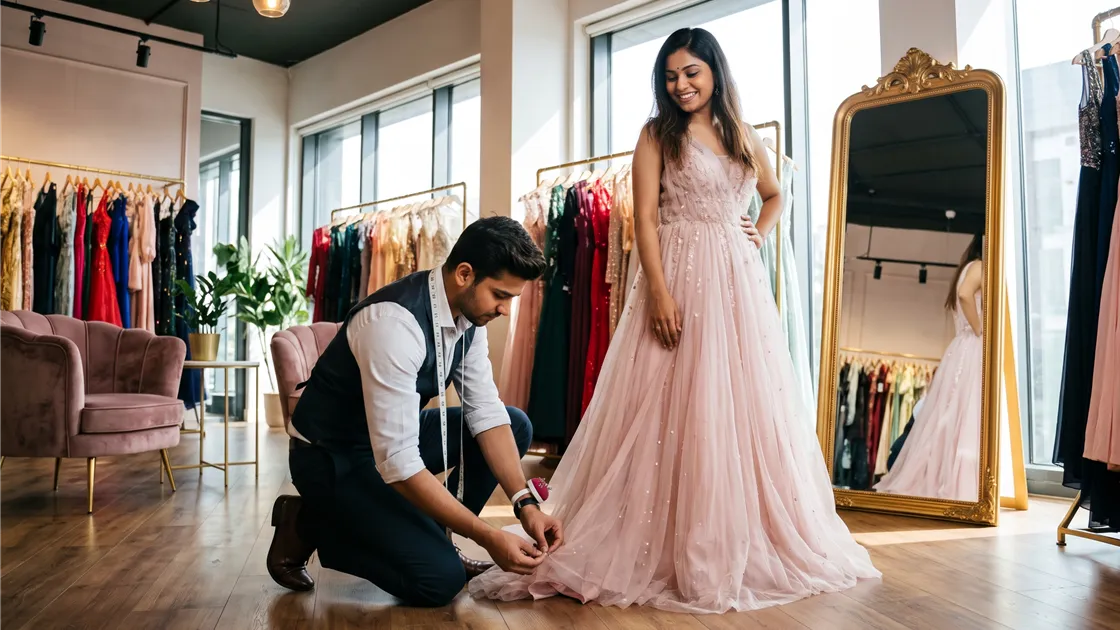
A gown is fitted from the shoulder to the waist and then falls to the floor, so it is measured like a blouse at the top and like a long skirt below. Here is the gown measurement chart, the measurements that decide the fit of the bodice, and how to get the length right when she will be wearing heels.
What Makes a Gown Different
Customers use the word gown for many garments: a long party gown for a reception, a floor-length evening dress, a western-style wedding gown, an Indo-western gown worn with a dupatta. What they share is a fitted bodice, a defined waist and a long skirt that reaches the ankle or the floor.
That combination is demanding. The bodice must fit as closely as a well-made blouse, because there is no saree or dupatta to hide a loose fit. The waist seam, if there is one, must sit exactly at her waist. And the length must be right to the half inch, because a floor-length gown that is too long trips her and one that is too short looks like a mistake.
So a gown needs a fuller set of measurements than a kurti or an anarkali, and two of them, the bust point and the waist-to-floor length, need more care than any others.
The Gown Measurement Chart
Take the measurements standing, over the innerwear she will wear with the gown. If the gown will have built-in cups or padding, measure over a similar garment, because the bust and bust point change.
| Measurement | Where the tape goes | What goes wrong |
|---|
Shoulder | Across the back, shoulder point to shoulder point | Too wide, so straps or sleeves slide off |
Bust | Round the fullest part, tape level | Tape rides up at the back and the bust reads small |
Under-bust | Round the ribcage just below the bust | Skipped, though the bodice is shaped from it |
Waist | Round the natural waist, the narrowest point | Taken where she wears her jeans, which is lower |
Hip | Round the fullest part of the hip | Too tight on a fitted gown, so she cannot sit |
Shoulder to apex | From the shoulder point near the neck down to the bust point | Guessed, so darts or seams miss the bust |
Apex to apex | Straight across between the two bust points | Not taken, so the bodice shaping sits too wide or narrow |
Shoulder to waist | From the shoulder point near the neck, over the bust, to the waist | Measured beside the bust instead of over it |
Back length | From the base of the neck down the spine to the waist | Missed, so the back waist seam sits high |
Waist to floor | From the waist straight down to the floor, in her footwear | Taken barefoot for a gown worn in heels |
Armhole | Round the top of the arm, two fingers loose | Cut exact, so it binds when she lifts her arm |
Sleeve length and round | Shoulder to where the sleeve ends; round the upper arm | Cut tight on net or sequinned sleeves with no give |
Neck depth, front and back | From the shoulder line down to the neckline | Agreed in words; show it on her with the tape |
The shoulder to apex, apex to apex and under-bust are the measurements that decide whether the bodice looks made for her. The blouse measurement chart explains how to take each of them accurately, and the method is the same.
Standard Gown Sizes
When a customer says she wears a medium, she is talking about ready-made sizing. The table below is a common guide in inches. Use it to understand what she means, not to cut.
| Size | Bust | Waist | Hip |
|---|
XS | 32 - 33 | 26 - 27 | 35 - 36 |
S | 34 - 35 | 28 - 29 | 37 - 38 |
M | 36 - 37 | 30 - 31 | 39 - 40 |
L | 38 - 40 | 32 - 34 | 41 - 43 |
XL | 41 - 43 | 35 - 37 | 44 - 46 |
XXL | 44 - 46 | 38 - 40 | 47 - 49 |
Ready-made sizes leave out the length entirely, and length is where a gown is judged. Always measure it.
The Length: Measure in Her Footwear
For any floor-length garment, the length depends on what she has on her feet. A gown measured barefoot and worn with four-inch heels stops well above the floor. One measured in heels and worn in flats drags.
Ask her to bring the footwear she will wear to the function, or at least to tell you the heel height. Measure the waist-to-floor length with the footwear on, and decide with her where the hem should end: just touching the floor, half an inch above, or with a short train at the back. Write the heel height on the order beside the length, so anyone who picks up the order knows how the number was taken.
Leave a generous hem allowance, at least two inches, so the length can be adjusted at the trial. A gown that is slightly long can be taken up. One cut too short cannot be saved.
Ease: Fitted Above, Free Below
The amount of ease depends on the style, so ask her before cutting whether she wants a close fit or a comfortable one.
Bust: add 1 to 2 inches for a fitted bodice. Less on a strapless or corset-style bodice that must hold itself up.
Under-bust and waist: add 1 inch. These seams carry the weight of the skirt and must sit firmly.
Hip: on a fitted mermaid or sheath gown, add at least 2 to 3 inches, and check it with her sitting. On a flared or A-line skirt, the hip is not fitted at all; check only that the skirt is wider than the hip.
Armhole and sleeves: always loose. Net, sequin and embroidered fabrics have no stretch, so add more than you would to cotton.
Skirt Styles and What They Need
Style | How it fits | What to check |
|---|
A-line | Fitted to the waist, flares gently to the hem | Hem width agreed with her |
Ball gown | Fitted bodice, very full skirt with layers or can-can | Layers, cloth and weight |
Mermaid or fishtail | Fitted to the knee, flares below | Hip and thigh ease; she must be able to walk and sit |
Sheath | Close to the body all the way down | A slit or walking pleat at the back |
Trail or train | Extra length at the back | Length of the train, and how it will be carried |
The fuller the skirt, the more cloth it takes, and a ball gown with layered net can use several times the fabric of an A-line. Our guide on how much cloth each garment needs covers the usual quantities. For a bridal lehenga rather than a gown, the lehenga measurement chart shows the differences.
Fabric and Lining Change the Fit
The same measurements give a different gown in a different fabric. Satin and taffeta hold their shape and show every wrinkle of a bad fit. Georgette and chiffon drape softly and forgive a little, but they cannot hold a fitted bodice on their own. Net, sequin and heavily embroidered fabrics are stiff, scratchy against the skin and have no give at all.
So almost every gown needs a lining, and the bodice usually needs more: a firm under-layer or a fused interlining to carry the shape, and boning on a strapless or corset-style bodice so it stays up without being pulled tight. Fit the lining first at the trial. If the lining fits, the outer fabric will follow it.
Tell her at the counter if the fabric she has chosen will not suit the style she wants. A mermaid gown in a soft georgette, or a ball gown in a fabric too light to carry the skirt, is a disappointment you can see coming before you cut, and saying so then is far easier than explaining it at the trial.
Trials: Plan at Least Two
A fitted gown almost always needs two trials. At the first, check the bodice: the bust point, the waist seam, the armholes and the neck. Ask her to sit, raise her arms and walk across the shop. At the second, with the footwear on, check the hem and any final adjustments.
Fix the first trial at least ten days before the function. A gown for a reception or a wedding is not a garment that can be finished the night before.
Frequently Asked Questions
What measurements are needed for a gown?
Shoulder, bust, under-bust, waist, hip, shoulder to apex, apex to apex, shoulder to waist, back length, waist to floor, armhole, sleeve length and round, and front and back neck depth. The waist-to-floor length should be taken in the footwear she will wear.
How do you measure the length of a floor-length gown?
From the natural waist straight down to the floor, with her wearing the footwear she will use at the function. Write the heel height beside the length and leave at least two inches of hem allowance.
How much ease should a gown have?
About 1 to 2 inches at the bust and 1 inch at the under-bust and waist for a fitted bodice. A fitted hip needs at least 2 to 3 inches; a flared skirt is not fitted at the hip at all.
How many trials does a gown need?
Usually two: the first to fit the bodice, the second with her footwear to set the hem. Fix the first at least ten days before the function.
Where Juvee Helps
A gown carries more measurements than almost any other garment, and the ones that matter, the bust point, the heel height and the trial dates, are the ones a paper register loses. Juvee keeps every customer's measurements against her name with the date, the style notes and each trial on the order; see Juvee for bridal boutiques. The Basic plan is free with no time limit, and paid plans start at ₹10,190 a year including GST; the pricing page lists every plan.