Most customers now pay the advance and the balance by scanning a QR code, and most tailoring shops welcome it. The trouble starts at the end of the day, when the bank shows thirty small payments and nobody can say which one was for which order. Here is how to take UPI and QR payments in a tailoring shop without losing track of a single rupee.
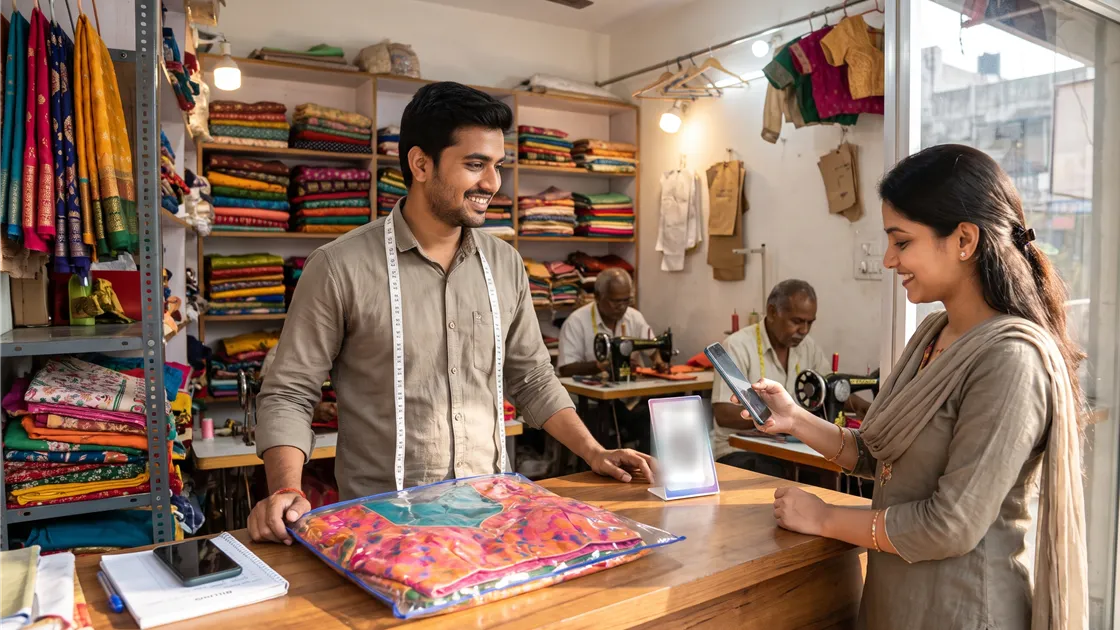
Why UPI Changes the Counter
Cash has one great virtue: it is in the drawer, and you know whose it is because you took it from her hand. UPI payments arrive somewhere else, on a phone or in a bank account, often while you are busy measuring someone else. The money is safer, and the record is weaker.
For a tailoring shop the problem is worse than for a grocer, because almost every order is paid twice: an advance when it is booked and the balance when it is collected, sometimes weeks apart. A grocer only has to know that the money arrived. You have to know which order it belongs to, whether it was the advance or the balance, and how much is still owed.
None of this is a reason to avoid UPI. Customers prefer it, it removes the need for change, and it brings in advances from customers who would otherwise say they will pay later. It just needs a small routine so the records keep up with the money.
Setting Up the QR Code
Use a QR code linked to the shop's own bank account, not to the owner's personal phone number or a relative's account. Business money mixed with personal payments is the commonest reason a shop cannot tell what it earned in a month. Most banks and payment apps offer a merchant or business QR for this purpose; ask your bank what it provides and whether any fees apply to your account.
Put the QR code where the customer can scan it while standing at the counter, at eye level, printed clearly and laminated so it survives. Keep one more at the trial area if customers pay there.
Turn on a payment alert that someone at the counter can hear or see. Many shops use a sound box that announces each payment aloud; others rely on an SMS or app notification. Whichever you use, the person taking the payment must confirm it has actually arrived before the customer leaves. A screenshot on her phone is not a payment until it appears on yours.
Match Every Payment to an Order
This is the habit that matters most. Every UPI payment must be written against an order at the moment it arrives, not at the end of the day from memory.
The simplest way is to tie the payment to the order number. When you book the order, give her the order number and ask her to put it in the payment note, or write the payment straight onto the order when the alert sounds. Record four things every time: the order number, the amount, whether it is an advance or a balance, and that it came by UPI.
| When | What to record | Why |
|---|
Order booked | Advance amount, UPI, date | So the balance due is known from the first day |
Part payment | Amount, UPI, date | Customers often pay in two or three parts for big orders |
Collection | Balance paid, UPI or cash, date | So the order can be closed with nothing outstanding |
Refund or adjustment | Amount, reason, how it was returned | So the account still adds up later |
A payment that arrives without a note, from a name you do not recognise, is the one that causes trouble. Often it is a husband or a son paying for her order from his own phone. Ask at the counter, "who is paying, and from which number?", and note it on the order.
Advances by UPI
UPI makes advances much easier to collect. A customer who has no cash on her can still pay an advance on the spot, and a customer ordering by WhatsApp can pay before you even cut the cloth.
Use that. Ask for an advance on every order, and a larger one on bridal and occasion work, where the cloth and the hours you put in are worth most. An advance paid by UPI is also a written record that the order was placed, which helps if there is ever a dispute about what was agreed.
When a customer sends an advance on WhatsApp for an order taken by phone, send back a short confirmation: the order number, what was ordered, the amount received and the balance. It costs a minute and prevents the conversation three weeks later about how much she already paid. Our guide to WhatsApp for tailor shops has message formats you can adapt.
Collecting the Balance
The balance is where most money is lost, by UPI or cash. The garment goes out, the customer says she will pay tonight, and tonight becomes next month.
Make the balance part of the handover. Tell her the amount before you hand over the garment, show her the QR, and wait for the alert. If someone is delivering the garment to her home, make sure they know the balance and carry a QR code, so the payment happens at the door.
For garments that are finished and not collected, a polite reminder with the balance and the QR code often brings the customer in. Our guide on garments nobody comes to collect covers what to say and when.
Closing the Day
At closing time, check three things. The total of UPI payments recorded on orders today. The total the bank or payment app shows for today. And the cash in the drawer against cash recorded.
If the UPI totals do not match, find out why before you go home, while the day is fresh. It is usually a payment that arrived and was not written on an order, or one written on the wrong order. Found today, it takes two minutes. Found at the end of the month, it can take an afternoon and still not be found. Our guide to the daily closing routine puts this check alongside the rest of the evening's work.
Keep the UPI and cash totals separate in your daily record. At the end of the month you will want to know both, for your own planning and for your accountant, and tailor shop accounts explains how to keep advances, balances and daily cash in one simple book.
Frequently Asked Questions
Should a tailoring shop accept UPI payments?
Yes. Customers prefer it, it makes advances easier to collect and it removes the need for change. Use a QR code linked to the shop's own bank account and record every payment against an order.
How do I match UPI payments to tailoring orders?
Write each payment on the order the moment it arrives: the order number, the amount, whether it is an advance or a balance, and that it came by UPI. Asking the customer to put the order number in the payment note helps.
What if a customer shows a payment screenshot?
Treat it as a payment only once it appears on your own phone or account. A screenshot can be of a failed or pending payment, so wait for your own alert before handing over the garment.
How should UPI payments be checked at the end of the day?
Compare the UPI payments recorded on orders with the total your bank or payment app shows for the day, and count cash separately. Find any difference the same evening.
Where Juvee Helps
The hard part of UPI is not the payment; it is knowing which order it was for and what is still owed. Juvee records every advance and balance on the order, shows the balance due before the garment goes out, and gives you the day's totals by payment type; see tailor billing software. The Basic plan is free with no time limit, and paid plans start at ₹10,190 a year including GST; the pricing page lists every plan.