The sleeve is the part of a blouse customers notice first in a photograph and complain about first at the trial. Here are the common blouse sleeve types, the measurements each one needs, and why most sleeve complaints are really armhole complaints.
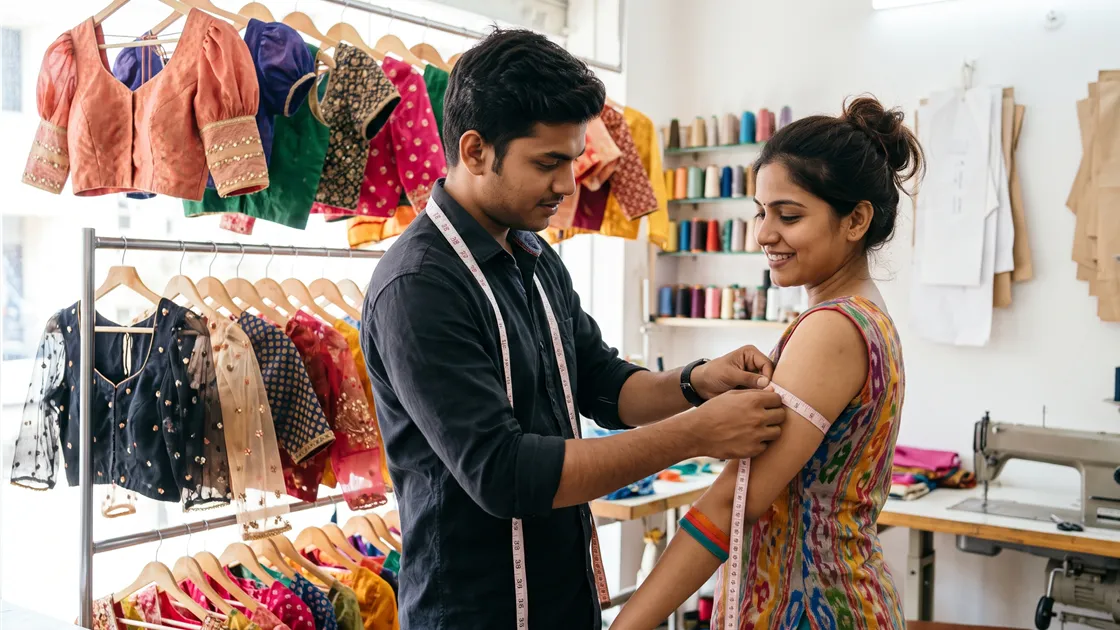
Why the Sleeve Comes Back
A blouse can fit perfectly at the bust and the waist and still come back because of the sleeve. It pinches the arm. It rides up when she lifts her hand to adjust her saree. It sits at a length she did not expect. The puff is flatter or fuller than the one in the photograph.
Most of these come from one of three causes. The sleeve round was taken without enough ease. The armhole and the sleeve cap do not match, so the sleeve pulls. Or the style and length were agreed in words rather than shown, and "elbow length" meant one thing to her and another to the cutter.
All three are avoidable at the counter. The measurements take a minute, and showing the length on her arm takes ten seconds.
The Sleeve Measurements
Take these with her arm hanging naturally by her side, then check the round with the arm bent.
| Measurement | Where the tape goes | What goes wrong |
|---|
Sleeve length | From the shoulder point down the outside of the arm to where the sleeve should end | Agreed in inches instead of shown on her arm |
Sleeve round | Round the arm at the point where the sleeve ends | Taken tight, so it pinches when she bends her arm |
Upper arm round | Round the fullest part of the upper arm | Skipped on short sleeves, so they bind |
Elbow round | Round the elbow with the arm slightly bent | Not taken for elbow and three-quarter sleeves |
Armhole | Round the top of the arm through the armpit, two fingers loose | Cut exact, so the sleeve cannot move |
Wrist round | Round the wrist bone | Needed only for full sleeves, often forgotten |
The armhole is part of the sleeve, even though it is written with the bodice measurements. The blouse measurement chart covers how to take it and the rest of the blouse.
The Common Sleeve Types
| Sleeve | Usual length from shoulder | What to measure and check |
|---|
Sleeveless | None | Armhole depth and how far in from the shoulder it is cut |
Cap sleeve | 2 to 3 inches | Upper arm round; it must not dig in |
Short sleeve | 4 to 6 inches | Upper arm round with ease |
Elbow sleeve | 9 to 11 inches | Elbow round with the arm bent |
Three-quarter sleeve | 12 to 15 inches | Round at the end point, with ease to pass the elbow |
Full sleeve | 20 to 23 inches | Wrist round, and an opening or zip if the wrist is narrow |
Puff sleeve | Short or elbow, with gathers | How full, shown on a sample or photograph |
Bell or flared sleeve | Elbow to full, widening at the end | Hem width at the end, agreed in inches |
Cold shoulder | Varies | Where the cut-out starts and ends on the shoulder |
The lengths are typical starting points for an average arm, not rules. Always measure her arm and show her where the sleeve will end.
Show the Length, Do Not Say It
Customers do not think in inches when they think about sleeves. They think "just above the elbow" or "like the blouse I wore to my cousin's wedding". Ask her to point to where the sleeve should end, put the tape there, and read the number. Then write it down with a short note: "ends 1 inch above elbow".
For a customer who has a blouse she likes, measure the sleeve of that blouse instead. It is the most reliable way to give her exactly what she expects. Note the length, the round at the end and the style.
Ease: The Arm Has to Move
A sleeve that fits exactly at the counter will be too tight at the function, because she will bend her arm, lift it, and hold things all evening.
Upper arm and sleeve round: add 1 to 1.5 inches to the body measurement on cotton and silk. Add more on fabrics with no give at all, such as net, brocade, heavy embroidery and sequin work.
Elbow round: measure with the arm bent and add half an inch. An elbow sleeve that is comfortable with the arm straight is often tight with it bent.
Armhole: two fingers loose at least. A tight armhole is the commonest reason a sleeve feels wrong, even when the sleeve itself is the right size.
Most Sleeve Problems Are Armhole Problems
When a customer says the sleeve pulls, rides up or feels tight, the sleeve is usually not the problem. The armhole is.
The top of the sleeve, the cap, has to be eased into the armhole. If the cap is too short for the armhole, the sleeve pulls up when she lifts her arm. If the armhole is cut too low, the sleeve pulls the whole blouse up with it. If the armhole is cut too small, nothing will move freely, whatever the size of the sleeve.
So when you fit a sleeve at the trial, ask her to lift both arms above her head and then to reach forward, as she would to drape the pallu. If the whole blouse lifts with her arms, check the armhole depth before you touch the sleeve.
Fabric and Lining
Sleeves in net, organza and sheer fabrics are popular, especially on festive and bridal blouses. They look light but they have no stretch, so give them more ease than a cotton sleeve. Line them only if she wants the arm covered; a lined net sleeve loses the effect she chose it for.
Heavy embroidery on a sleeve makes it stiff, and a stiff sleeve needs more ease and a carefully shaped cap. If the embroidery is being done separately, take the sleeve measurements before the work starts and give them to the embroiderer, so the work fits the sleeve rather than the other way round.
Write the sleeve style, the length note and the lining on the order. Our blouse order checklist has a line for each, and our guide to running a ladies tailor shop covers how to price the fancier sleeves as the extra work they are.
Charge for the Fancy Sleeves
A plain short sleeve and a gathered puff sleeve with a lined net layer are not the same work, and they should not be the same price. The fancier sleeves take more cloth, more cutting, more time at the machine and often an extra fitting.
Put the sleeve styles on your rate card as separate lines, or as an extra charge on top of the basic blouse rate: puff, bell, layered, net, cold shoulder, full sleeve with an opening. Decide the extra from the time each one actually takes in your shop, not from what the shop down the road charges.
Quote the sleeve charge when the order is taken, alongside the blouse rate, and write it on the order slip. A customer who chooses a bell sleeve from a photograph is usually happy to pay for it when she is told at the counter. The same amount added at collection, without warning, is the one she argues about.
Frequently Asked Questions
What measurements are needed for blouse sleeves?
Sleeve length, sleeve round at the end point, upper arm round, armhole, and for longer sleeves the elbow and wrist round. Take the length by asking her to point to where the sleeve should end.
What are the common types of blouse sleeves?
Sleeveless, cap, short, elbow, three-quarter, full, puff, bell or flared, and cold shoulder. Each one needs a slightly different set of measurements and a different amount of ease.
How much ease should a blouse sleeve have?
About 1 to 1.5 inches at the upper arm and sleeve end on cotton and silk, more on net, brocade and embroidered fabrics, and at least two fingers in the armhole.
Why does my blouse sleeve feel tight even when the size is right?
Usually because the armhole is too small or cut too low, or because the sleeve cap does not match the armhole. Check the armhole first; it is the commonest cause.
Where Juvee Helps
Sleeves are where "same as last time" saves the most trouble, because the length she liked is a note, not a number. Juvee keeps every customer's blouse measurements against her name with the date, the sleeve style and your notes, so the next blouse starts from the one she was happy with; see Juvee for ladies tailor shops. The Basic plan is free with no time limit, and paid plans start at ₹10,190 a year including GST; the pricing page lists every plan.