A sherwani is worn once, photographed for a lifetime, and judged on the collar, the shoulders and how it sits when he sits down. Here is the sherwani measurement chart, the ease to add, and how to plan the trials so the groom is never fitted the day before the wedding.
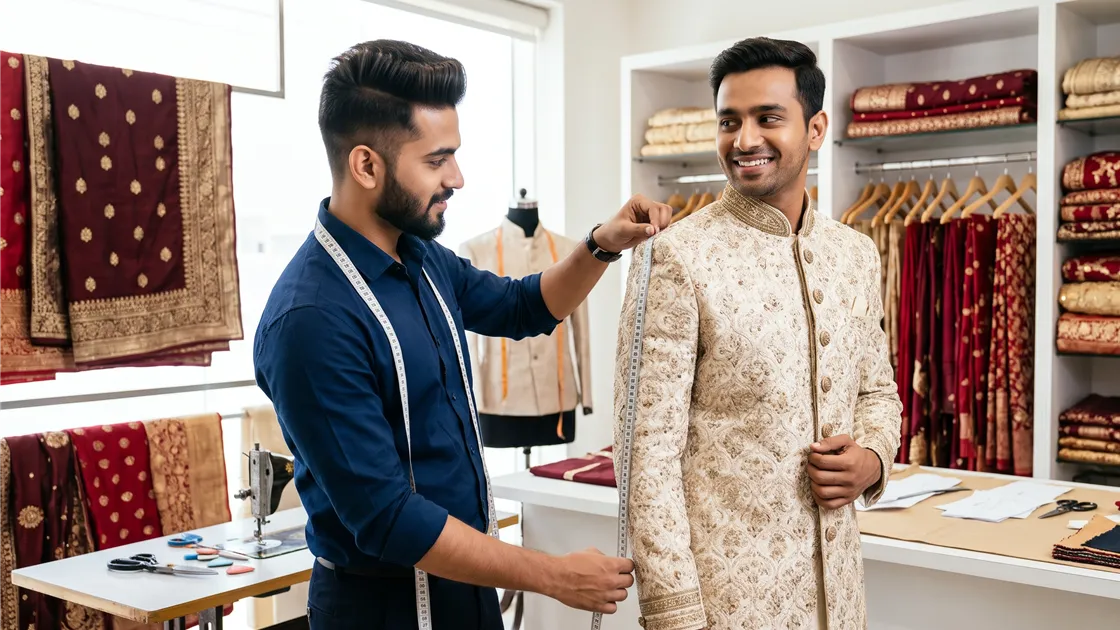
What a Sherwani Asks of the Measurements
A sherwani looks like a long coat, but it is measured more like a fitted shirt down to the waist and more like a kurta below it. It closes high at the neck with a standing collar, it is fitted through the chest and shoulders, and it falls to the knee or below.
Three things decide whether it is a success. The collar must close without pressing on his throat, because he will wear it for eight hours. The shoulders must sit cleanly, because the sherwani is heavy and every photograph shows them. And it must let him sit, bend and garland without the front pulling open, which is where most sherwanis are finally judged.
So the measurements are taken standing, but checked with him sitting. Few customers will ever say a sherwani is too tight across the hips while standing at the counter. Every groom says it on the stage.
The Sherwani Measurement Chart
Take these over the kurta or shirt he will wear underneath, not over a T-shirt. A sherwani taken over thin clothing and worn over a silk kurta is a size too small.
| Measurement | Where the tape goes | What goes wrong |
|---|
Neck | Round the base of the neck where the collar will sit, one finger inside | Taken tight, so the collar presses all evening |
Shoulder | Across the back, shoulder point to shoulder point | Too wide on a heavy fabric, so the shoulders droop |
Chest | Round the fullest part of the chest, under the arms | Taken with the chest puffed out; ask him to breathe normally |
Stomach | Round the fullest part of the stomach | Skipped, then the buttons pull across the middle |
Waist | Round the natural waist | Taken where his trouser sits, which is lower |
Hip | Round the fullest part of the seat | Not taken, so the front opens when he sits |
Sherwani length | From the shoulder point, near the neck, down the front to where it should end | Not agreed. Show him the knee and the calf and ask |
Sleeve length | Shoulder point down to the wrist bone, arm hanging naturally | Measured to the hand, so the cuff covers the watch |
Sleeve round | Round the fullest part of the upper arm | Cut tight on a sherwani with heavy embroidery |
Wrist | Round the wrist bone | Cuff cut too narrow to slide over the hand |
Cross back | Across the back between the armholes, at shoulder-blade height | Too narrow, so the back pulls when he raises his arms |
Front length to waist | Shoulder point near the neck down to the natural waist | Guessed, so a fitted waist sits in the wrong place |
Write down whether he wants it fitted or straight below the waist. A fitted sherwani shaped at the waist and a straight one that falls from the chest use the same numbers but are cut very differently.
Standard Sherwani Sizes
Ready-made sherwanis are sized by chest in inches, like suits. A man who says he wears a 40 means a 40-inch chest. The table is useful at the counter when a customer only knows his size; it is not a cutting size.
| Size | Chest, in | Stomach, in | Shoulder, in | Usual length, in |
|---|
36 | 36 | 32 - 34 | 16.5 - 17 | 40 - 42 |
38 | 38 | 34 - 36 | 17 - 17.5 | 41 - 43 |
40 | 40 | 36 - 38 | 17.5 - 18 | 42 - 44 |
42 | 42 | 38 - 40 | 18 - 18.5 | 43 - 45 |
44 | 44 | 40 - 42 | 18.5 - 19 | 44 - 46 |
46 | 46 | 42 - 44 | 19 - 19.5 | 44 - 46 |
Two men in a size 40 can differ by two inches at the stomach and four at the length. Always measure.
Ease: What to Add
A sherwani is fitted, but it is a coat worn over another garment, and the wearer has to move through a long day in it.
Neck: add half an inch to one inch to the neck measurement for the collar. A collar that closes comfortably over the kurta collar is the first thing he will thank you for.
Chest: add 3 to 4 inches over the chest measurement taken over his kurta, more if the fabric is stiff or heavily embroidered.
Stomach and waist: add 3 inches, so the buttons sit flat without pulling.
Hip: add 4 to 5 inches, and check it with him sitting at the trial. This is the measurement that decides whether the front stays closed on the stage.
Sleeve round: add 2 inches. Embroidered and lined sleeves have no give at all.
The Bottom: Churidar or Pyjama
Most sherwanis are worn over a churidar, sometimes a straight pyjama or a dhoti-style bottom. Take its measurements on the same visit: length, waist, hip, thigh, knee, calf and ankle for a churidar, with the ankle loose enough to pass the foot. The churidar measurement chart covers each one, and the method is the same for men.
Agree the length of the bottom against the sherwani length. A long sherwani over a churidar gathered at the ankle and a shorter one over a straight pyjama are two different looks, and he should choose before you cut either.
Plan the Trials Backwards From the Wedding
The sherwani is the garment you cannot be late with. Plan it from the wedding date backwards, not from the order date forwards.
Take the order at least three to four weeks before the function if the fabric is plain, longer if there is embroidery to be done. Fix the first trial for at least ten days before the wedding, so there is time for a second one. Fix the final collection two or three days before, never the day itself; something always needs pressing, and the groom has other places to be.
At the first trial, ask him to sit, bend forward and raise both arms, as he will when garlanding. Check the collar with the kurta underneath. Check the length with the footwear he will actually wear, especially if it is a mojari with a raised heel.
For group orders, where the groom's brothers or friends order matching sherwanis or kurtas, measure everyone on the same day and give them a single trial day. Our guide to running a gents tailoring shop covers how to handle wedding party orders without six separate trials.
How Much Cloth a Sherwani Takes
For a knee-length sherwani in a 44-inch fabric, plan roughly 3 to 3.5 metres, a little less in a 58-inch suiting width, plus lining of about the same length. A longer sherwani or a fuller cut needs more. The churidar is separate, usually 2.5 to 3 metres. If he brings his own fabric, check the length before you agree the style; a long fitted sherwani from 2.5 metres is not possible, and it is better to say so at the counter than at the trial.
Many of the measurements are shared with a suit, and the suit and blazer measurement chart explains the shoulder and cross back measurements in more detail.
Frequently Asked Questions
What measurements are needed for a sherwani?
Twelve: neck, shoulder, chest, stomach, waist, hip, sherwani length, sleeve length, sleeve round, wrist, cross back and front length to waist, all taken over the kurta he will wear underneath. The churidar or pyjama is measured separately.
How much ease should a sherwani have?
About 3 to 4 inches at the chest, 3 inches at the stomach and waist, 4 to 5 inches at the hip and half an inch to an inch at the collar. Check the hip with him sitting at the trial.
How long before the wedding should a sherwani be ordered?
At least three to four weeks for a plain sherwani and longer for embroidered work, with the first trial ten days before the wedding and collection two or three days before.
How many metres of cloth are needed for a sherwani?
Roughly 3 to 3.5 metres of 44-inch fabric for a knee-length sherwani, plus about the same length of lining, and 2.5 to 3 metres for the churidar.
Where Juvee Helps
A sherwani is often the most expensive garment a gents shop makes all year, and the measurements are worth keeping long after the wedding, because the same man comes back for his brother's. Juvee keeps every customer's measurements against his name with the date and your notes on the fit, the collar and the trial; see measurement management. The Basic plan is free with no time limit, and paid plans start at ₹10,190 a year including GST; the pricing page lists every plan.