A gents tailoring shop earns from fewer garments per customer than a ladies shop, and keeps him for longer. Here is how a gents tailoring shop actually makes its money, what to charge, and the habits that bring the same man back for twenty years.
How a Gents Shop Is Different
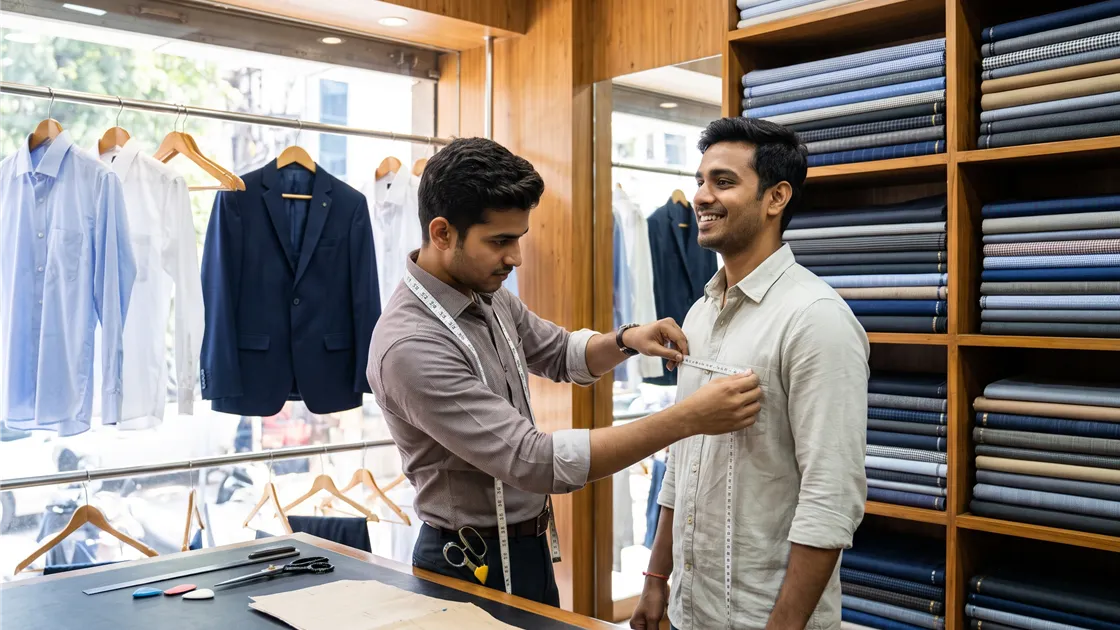
A ladies tailor sees a customer every few weeks: a blouse, a fall, a salwar, another blouse. A gents tailor may see a man three or four times a year. He orders less often, he orders in twos and threes, and when he finds a tailor whose shirts fit him he does not look for another one.
That changes what the shop has to be good at. A ladies shop survives on volume and speed. A gents shop survives on remembering exactly how each man likes his shirt, because the fit he was happy with two years ago is the only thing he will judge you on.
It also has a competitor a ladies shop barely has: the ready-made shirt. Almost every man can buy a shirt that nearly fits for less than you charge to stitch one. The gents shop that does well stops competing with that shirt on price and starts earning from it instead.
The Four Ways a Gents Shop Earns
Shirts and trousers: the base
Regular office shirts and trousers are the steady work that pays the rent. Each one is small, but a man who is happy orders two shirts and a trouser together, and orders again before every new job, promotion or season.
Alterations of ready-mades: the daily cash
This is where the ready-made shirt becomes your customer. Trouser hems, waist adjustments, shirt side seams and sleeve shortening walk in every day, take minutes, and are paid in cash on collection. They are also how a man who has never stitched a garment first trusts you with his clothes.
Occasion wear: the profit
Suits, blazers, sherwanis, bandhgalas and kurta sets for weddings and functions. Fewer orders, much higher bills, and the work that builds a shop's name. One wedding party can bring the groom, his father and four friends in the same week.
Uniforms: the bulk
School, office, hotel and security uniforms. Lower rate per piece, but a whole order at once, and repeat every year. A gents shop is usually better placed for this than a ladies shop, because shirts and trousers are already its daily work.
What to Charge
Rates depend on your city, your rent and your speed, so take the bands below as a starting point and build your own card from your costs; our guide to building a tailoring rate card shows the method.
| Garment | Common band, stitching only | What moves you up the band |
|---|
Formal shirt | Rs 400 - 900 | Collar and cuff style, double stitching, fabric difficulty |
Trouser | Rs 500 - 1,000 | Pleats, lining, extra pockets, belt loops |
Kurta | Rs 500 - 1,000 | Placket work, length, lining |
Safari suit | Rs 1,500 - 3,000 | Pockets, lining, finishing |
Blazer or coat | Rs 3,500 - 8,000 | Canvas, lining, hand finishing, number of trials |
Price alterations from the time they take, not from habit. A trouser hem and a waist that needs the band opened are different jobs, and the alteration charges guide sets out the usual bands for each.
Write Down How He Likes It
Two men with a 40-inch chest want two different shirts. One wants it close at the waist, one wants room to sit through a long day at a desk. One wears his trouser on the waist, one wears it low on the hip. The measurement is the same; the shirt is not.
So record the fit, not just the numbers. A short line on every order does it: slim or regular, collar size and style, cuff type, pocket or no pocket, trouser rise and where he wears it, pleats or flat front. The next time he comes in, "same as last time?" is a question you can actually answer.
Take the measurements the same way every time. The shirt and pant measurement chart shows where each one goes, and the suit and blazer measurement chart covers the extra ones a coat needs.
Make the Ready-Made Shirt Your Customer
Most men will buy ready-mades whatever you do. The shop that accepts this and becomes the place that makes them fit earns far more than the one that complains about it.
Put a small board at the counter listing the common alterations and their prices: hem, waist, sleeve, side seams, tapering. Men do not like to ask what something costs. A visible price list turns a man walking past into a man walking in.
Promise them fast. Most trouser hems can be ready the same evening, and a man who drops a trouser in the morning and collects it on the way home tells his colleagues. Once he trusts you with his ready-mades, the first stitched shirt is an easy conversation.
The Wedding Season
In most of India the wedding months are a gents shop's busiest time, and the orders come late. Men decide on a suit or sherwani two weeks before the function, not two months.
Plan for it rather than react to it. Tell your regular customers when you stop taking wedding orders for a given date, and say it early. Keep the first trial for every occasion order at least a week before the function, so there is time for a second one. And price rush work as rush work: an order taken with five days left costs you overtime, and the rate should say so.
Group orders deserve a little extra care. When the groom's party orders together, take every man's measurements on the same visit, agree one fabric and style, and give them one trial day. Six separate trials for six matching kurtas is how a group order loses money.
Cloth: Theirs or Yours
Many men bring their own suiting and shirting, often a gift or a piece bought in a sale. Check it before you agree a date. Measure the length, look for faults, and ask whether it has been washed. Our guide on when the customer brings their own cloth covers what to check and what to say when it is not enough.
Selling cloth as well can raise the bill considerably, but it ties up money in stock. Start small: a few dependable shirting colours and two or three suiting shades in the weights your customers actually buy, and grow only what sells.
Frequently Asked Questions
Is a gents tailoring shop profitable?
Yes, when it earns from more than shirts. The steady profit usually comes from three things together: daily alterations of ready-made clothes, occasion wear such as suits and sherwanis, and bulk uniform orders.
How much does a gents tailor charge for a shirt?
Commonly Rs 400 to 900 for stitching a formal shirt, depending on the city, the collar and cuff style and the fabric. Work out your own rate from your costs rather than copying the shop next door.
How can a gents tailor compete with ready-made shirts?
By altering them. A visible price list for hems, waists and sleeves brings in men who buy ready-mades, and a quick, reliable alteration is how many of them come to stitch their first shirt.
What should a gents tailor record besides measurements?
The fit preferences: slim or regular, collar and cuff style, pocket, trouser rise and where he wears it, pleats or flat front. These are what make the next shirt match the last one.
Where Juvee Helps
A gents shop lives on remembering each man's measurements and preferences for years, and on knowing which of a dozen alterations are ready tonight. Juvee keeps both on the order: measurements and notes against his name, and every garment's stage from cutting to collection; see order tracking. The Basic plan is free with no time limit, and paid plans start at ₹10,190 a year including GST; the pricing page lists every plan.