An anarkali is measured like a kurti down to the bust and like a skirt below it. Here is the anarkali measurement chart, the three measurements a kurti chart leaves out, and how to plan the flare and the cloth.
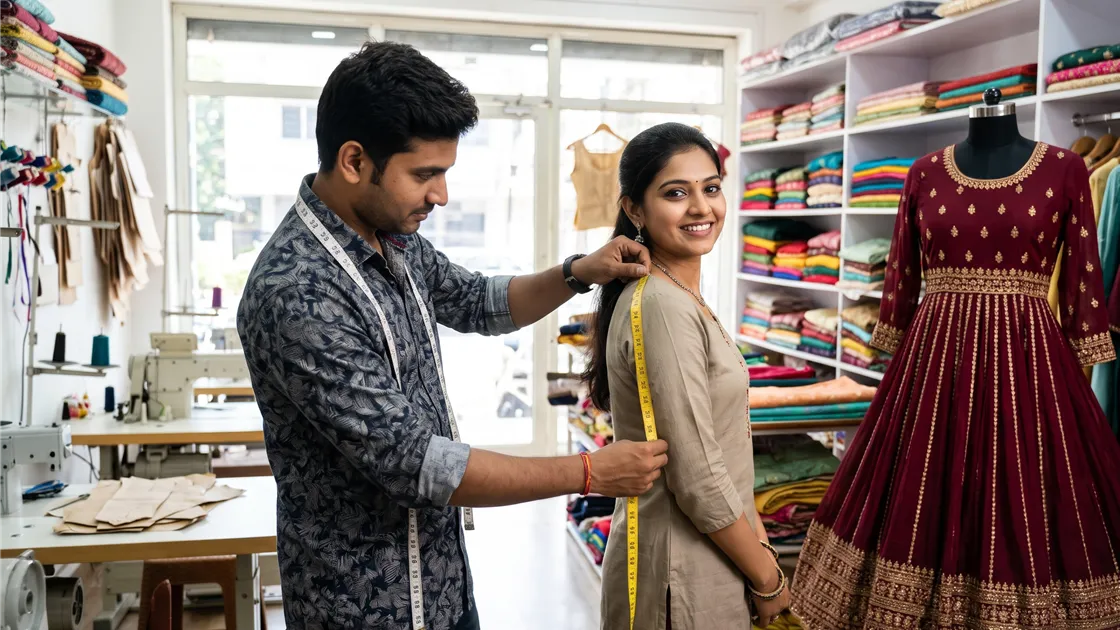
Why a Kurti Chart Is Not Enough
Most shops take anarkali orders on the same eight measurements they use for a kurti. It works for the top half and fails for the bottom, because an anarkali is two garments joined at one seam: a fitted bodice that ends under the bust, and a flared skirt of panels, called kalis, that hangs from it.
Everything that goes wrong with an anarkali goes wrong at that seam. If it sits too low the garment looks heavy and shapeless. If it sits too high it pulls across the bust. If the under-bust is loose the whole skirt drops when she lifts her arms. None of these show up on a kurti chart, because a kurti has no seam there.
So an anarkali needs three extra measurements, and they are the ones that decide whether it fits: the under-bust, the yoke length, and the flare she wants at the hem.
The Anarkali Measurement Chart
Take them in this order, standing, over the innerwear she will wear under the garment. The three marked "extra" are the ones a kurti chart does not have.
| Measurement | Where the tape goes | What goes wrong |
|---|
Shoulder | Across the back, shoulder point to shoulder point | Too wide, so the armhole drops and the bodice gapes |
Bust | Round the fullest part, tape level all the way round | Tape rides up at the back and the bust reads small |
Under-bust (extra) | Round the ribcage, just below the bust | Skipped. This is the seam the whole skirt hangs from |
Yoke length (extra) | Shoulder point down the front to the under-bust line | Guessed from the kurti length. It is a separate number |
Waist | Round the natural waist, the narrowest point | Taken tight, though the skirt flares from above it |
Hip | Round the fullest part of the hip | Not needed for fit, but it sets the smallest flare you can cut |
Full length | Shoulder point straight down to where the hem should fall | Taken barefoot for a garment worn with heels |
Sleeve length | Shoulder point down to where the sleeve ends | Measured with the arm bent |
Sleeve round | Round the fullest part of the upper arm | Cut tight on a net or georgette sleeve that has no give |
Armhole | Round the top of the arm, two fingers loose | Cut exact, so it binds when she raises her arm |
Front and back neck depth | From the shoulder line down to the neckline, front and back | Agreed in words. Show it on her with the tape |
Flare (extra) | Not measured on her. Agreed as the number of kalis or the hem round | Left to the cutter, and she wanted more |
Write the under-bust and yoke length on the order slip even for a regular customer whose kurti measurements you already hold. They are the two numbers that change between a kurti and an anarkali, and they are the ones a busy cutter will otherwise take from memory.
Standard Anarkali Sizes
When a customer says she wears a size 38 anarkali, she means a 38-inch bust, the same way kurti sizes work. The table below is the usual ready-made sizing. It is useful at the counter for a customer who only knows her size, and it is a starting point for conversation, never a cutting size.
| Size | Bust, in | Under-bust, in | Waist, in | Full length, in |
|---|
XS / 34 | 34 | 29 | 28 | 48 - 52 |
S / 36 | 36 | 31 | 30 | 50 - 54 |
M / 38 | 38 | 33 | 32 | 50 - 54 |
L / 40 | 40 | 35 | 34 | 52 - 56 |
XL / 42 | 42 | 37 | 36 | 52 - 56 |
XXL / 44 | 44 | 39 | 38 | 54 - 56 |
Two women who both buy a 38 will not have the same yoke length, and the yoke is where an anarkali is judged. Always measure.
The Yoke Length Decides the Look
The yoke length is taken from the shoulder point down the front to the line just under the bust, where the kalis will begin. On most women it falls between 13 and 15 inches, but it varies more than any other number on the chart, and it is the one customers notice first when it is wrong.
Take it with the tape running over the bust, not beside it, and check it by eye in the mirror with her. Ask her to put a finger where she wants the skirt to start. Some customers want a high empire line that sits right under the bust; others, especially for a long anarkali, want it an inch lower so the bodice looks longer. That inch is a style decision, and it belongs to her.
If you are not sure, cut the bodice with an extra inch of seam allowance at the bottom. A yoke that is too long can be taken up at the trial. A yoke that is too short cannot be let down.
Kalis, Flare and the Hem Round
The flare of an anarkali is decided by how many kalis are joined and how wide each one is at the hem. Customers rarely know the number they want, but they always know the look, so show them a photograph or a finished piece and agree the hem round from that.
| Style | Usual kalis | Usual hem round |
|---|
Knee-length, light flare | 8 - 12 | 2.5 to 3.5 metres |
Calf-length, everyday | 12 - 16 | 3.5 to 5 metres |
Floor-length, occasion | 16 - 24 | 5 to 8 metres |
Bridal or heavy flare | 24 and above | 8 metres and above |
These are typical ranges, not rules. A heavy fabric such as velvet or raw silk carries less flare well than a light georgette does, so a velvet anarkali usually takes fewer kalis for the same look.
Write the agreed hem round on the slip in metres. "Full flare" means one thing to the customer and another to the cutter, and a number ends the argument before it starts.
Ease: What to Add Before Cutting
An anarkali is fitted from the shoulder to the under-bust and free below it. The ease follows the same line.
Bust: add 1.5 to 2 inches. Less than a kurti, because the bodice is meant to sit close.
Under-bust: add 1 inch. This seam must not move, so keep it snug, but she still has to breathe and sit.
Waist and hip: no fitting ease is needed, because the skirt flares out above them. Check only that the hem round is well above the hip measurement.
Armhole: always loose, two fingers at least. A tight armhole is the commonest reason an anarkali comes back.
Sleeve round: add 1.5 inches, more on net or a lined sleeve, which have no stretch at all.
Ask the same question you ask for any fitted garment: does she want it close or comfortable. The answer changes the bust and under-bust ease, and it takes five seconds.
How Much Cloth an Anarkali Takes
Cloth depends on the length, the flare and the width of the fabric. As a rough guide for 44-inch fabric, a knee-length anarkali with a light flare takes 3 to 3.5 metres, a floor-length one 4.5 to 6 metres, and a heavy bridal flare 8 metres or more. Add the churidar and dupatta separately.
When the customer brings her own cloth, measure it before you agree the flare, not after. Promising 24 kalis from 4 metres is a promise you will have to break at the trial. Our guide on how much cloth each garment needs covers the other garments she may order with it.
Length: Ask About Her Footwear
A floor-length anarkali taken while she stands barefoot at the counter, and worn with heels at a wedding, will stop two inches above the floor. Taken in heels and worn in flats, it will sweep the ground. Ask what she will wear on her feet and note it beside the full length.
The bottom matters too. Most anarkalis are worn over a churidar, and the churidar length and ankle gathers are measured separately; the churidar measurement chart covers those. If she is not sure whether she wants an anarkali or a straight cut, the kurti measurement chart shows how the two differ.
Frequently Asked Questions
What measurements are needed for an anarkali?
Eleven taken on the body: shoulder, bust, under-bust, yoke length, waist, hip, full length, sleeve length, sleeve round, armhole and neck depth. The flare is agreed with the customer as a number of kalis or a hem round rather than measured.
What is the yoke length in an anarkali?
The distance from the shoulder point down the front to just under the bust, where the flared panels begin. It usually falls between 13 and 15 inches, and it decides whether the garment looks right more than any other measurement.
How many kalis does an anarkali have?
Anything from 8 for a light knee-length flare to 24 or more for a bridal one. Agree the hem round in metres with the customer, using a photograph, and write it on the order slip.
How many metres of cloth are needed for an anarkali?
For 44-inch fabric, roughly 3 to 3.5 metres for knee-length, 4.5 to 6 metres for floor-length and 8 metres or more for a heavy bridal flare, with the churidar and dupatta extra.
Where Juvee Helps
An anarkali order carries more numbers than any kurti, and the three that matter most are the ones a register has no column for. Juvee keeps every customer's measurements against her name with the date, with room for the yoke length, the agreed flare and a note about her footwear; see measurement management. The Basic plan is free with no time limit, and paid plans start at ₹10,190 a year including GST; the pricing page lists every plan.