The back of a saree blouse is what everyone behind her sees all evening, and it is where customers bring their photographs. Here are the common blouse back neck designs, the measurements each one needs, how much more work each takes, and how to price them so the fancy backs earn more than the plain ones.
Why the Back Neck Deserves Its Own Price
A plain round back neck and a deep U with a dori and tassels may be cut from the same pattern, but they are not the same job. The second needs a facing or piping that lies perfectly flat, a closing that holds the blouse up without straps showing, and finishing that will be photographed at a wedding.
Many shops still charge one blouse rate and absorb the difference. That is how a busy festival month leaves the shop exhausted and no richer: the fancy backs take the time and the plain rate pays for it.
The answer is to price the back neck as a separate line. A base rate for the blouse, and an extra amount for the back design, written on the rate card and quoted when the order is taken. Customers who ask for a design from a photograph expect to pay for it, and most are relieved to hear a clear price.
Two Measurements That Decide Every Back
Whatever the design, two numbers decide whether it works, and both should be written on the order slip, not agreed in words.
Back neck depth: from the shoulder line, near the neck, straight down the centre back to where the neckline should end. Show it on her with the tape and let her decide; never guess from a photograph, because the model in the photograph is not her.
Back neck width: how far apart the neckline sits at the shoulders. A wide back neck with a deep depth can slip off the shoulders, so the two must be balanced.
Ask what she will wear underneath. A back deeper than her innerwear strap line needs a different solution: padding, a built-in support, or a design that covers the strap. Our guide on blouse padding, cups and linings covers those choices. The blouse measurement chart shows where all the other measurements go.
The Common Back Neck Designs
Round and U neck
The everyday back. A round neck at a modest depth, or a U that goes a little deeper. Quick to cut, simple to face, and the base against which every other design is priced.
Deep U and deep V
The same shapes cut much lower. They look simple and are not: the deeper the neck, the more the blouse depends on the fit at the shoulders and the side seams to stay in place. Usually needs padding or a dori to hold it.
Square and boat back
A square back with straight sides and sharp corners, or a wide, shallow boat line across the shoulders. The corners of a square neck must be clipped and turned cleanly, and a boat back has to be cut to the shoulders exactly or it slides.
Keyhole
A small opening, round or teardrop-shaped, cut into a closed or high back, often with a single button or hook at the top. Looks delicate, takes time to face neatly, and is popular with customers who want something special without a deep neck.
Dori or tie-up back
An open back held by cords tied at the neck or the waist, usually finished with tassels or latkans. The cords take the strain, so they must be stitched in firmly. The tassels are often an extra cost of their own.
Potli button back
A row of small fabric-covered buttons with loops down a closed or open back. Each button and loop is handwork, so this design is priced by the number of buttons as much as by the shape. Our guide on zips, hooks and buttons covers how to charge for fastenings.
Window or cut-out back
A closed back with a shape cut out of it: a square, a diamond, a leaf, a heart. The cut-out must be faced from inside and the edges kept from stretching. More shapes, or a shape with sharp points, take longer.
Sheer or net back
The back panel cut in net, often with embroidery or a border, joined to a solid front. Net has no strength, so the seam joining it must be finished carefully and the closing taken by the solid fabric.
High neck and collar back
A closed back up to the neck, sometimes with a collar or a band. Simple to look at, but a high neck shows every mistake in the neck measurement and the fit across the shoulders.
How Much Extra Work Each Takes
The table gives a rough order of extra work over a plain round back, so you can set your own extra charges. It is a guide to time, not a price list; your rate depends on your city and your speed.
Design | Extra work over a plain back | What adds the time |
|---|
Round, U | None | The base design |
Deep U, deep V | A little | Fit at shoulder and side, often padding |
Square, boat | A little | Clean corners, exact shoulder fit |
Keyhole | Moderate | Facing a small curved opening |
Dori or tie-up | Moderate | Cords stitched to take strain, tassels |
Window or cut-out | Moderate to high | Facing the shape, sharp points |
Potli buttons | High | Handmade buttons and loops, one by one |
Sheer or net panel | Moderate to high | Joining and finishing fragile fabric |
Embroidered or bridal back | High | Handwork, priced separately |
Embroidery, mirror work and heavy borders on the back are a separate job altogether and should be priced on their own; our guide on costing embroidery and hand work shows how.
Setting the Extra Charge
Work out the extra the same way you work out any rate: the extra time in hours, multiplied by what an hour of your shop's time costs, plus any extra materials such as tassels, buttons, net or lining. Round it to a figure that is easy to say at the counter. The tailoring rate card guide shows how to find your hourly cost.
Then group the designs into three or four bands rather than pricing each one separately. Plain backs at the base rate. Deep and shaped backs at one extra. Keyhole, dori and cut-out backs at a second. Potli, net and anything with handwork at a third or priced individually. Customers understand bands, and your staff can quote them without asking you.
Write the band on the order slip with the design. A customer who agreed to a potli back at the counter will not argue about the extra at collection if it was written down in front of her.
Show, Do Not Describe
Customers rarely know the names of back neck designs. They know what they saw on a cousin at a wedding, or on Instagram.
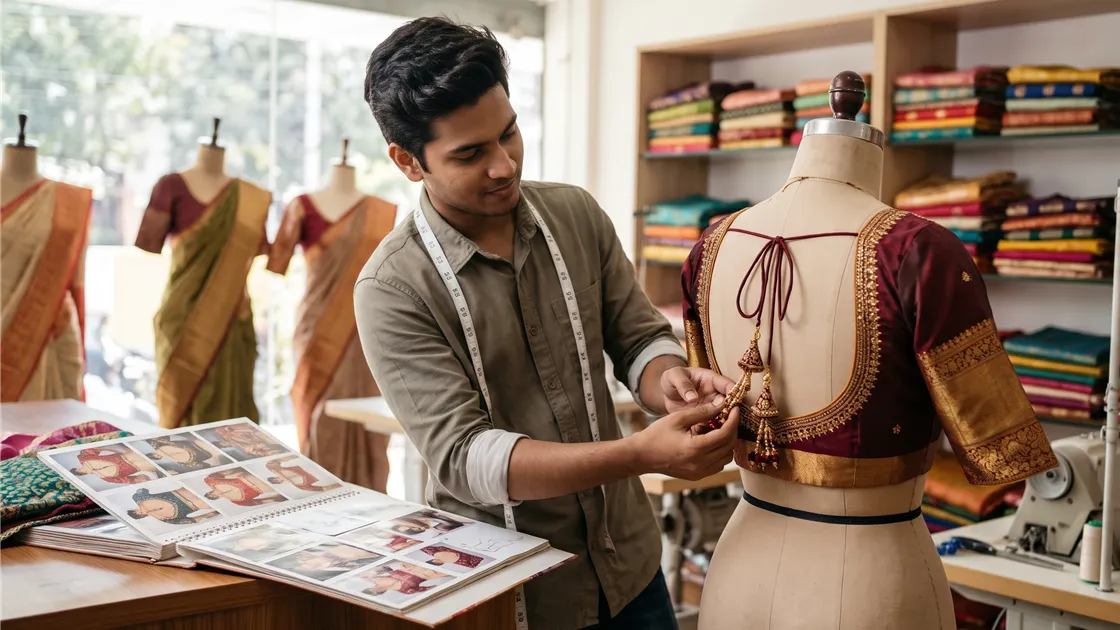
Keep a small album of backs your shop has actually made, photographed against a plain background: the shop's own catalogue. Ask the customer to point. It saves ten minutes of description per order, it shows her that you have done it before, and it lets you show the band price beside each design.
When she brings a photograph, look at it carefully before agreeing. A back made on a model with a fitted, padded, structured blouse may not work in a soft fabric or on her shape. Say so at the counter, and suggest the nearest design that will.
Frequently Asked Questions
What are the most popular blouse back neck designs?
Deep U and V backs, dori or tie-up backs with tassels, potli button backs, keyhole backs, window or cut-out backs and sheer net backs are among the most requested, alongside the everyday round and square backs.
How much extra should a tailor charge for a back neck design?
Work it out from the extra time and materials over a plain back. Most shops group designs into three or four bands, with plain backs at the base rate and potli, net or embroidered backs at the highest band or priced individually.
What measurements are needed for a back neck design?
The back neck depth and the back neck width, written on the order slip and shown on the customer with the tape. Ask what she will wear underneath, because a back deeper than her strap line needs padding or a support.
How do I stop a deep back blouse from slipping?
Fit the shoulders and side seams closely, keep the back neck width balanced against the depth, and use padding, a dori or a built-in support to hold it in place.
Where Juvee Helps
A back neck design is one more detail on an order that already has a dozen, and it is the one most often remembered differently at collection. Juvee keeps the design, the depth, the extra charge and the customer's measurements on the order, so the karigar cuts what was agreed and the bill shows what was quoted; see Juvee for ladies tailor shops. The Basic plan is free with no time limit, and paid plans start at ₹10,190 a year including GST; the pricing page lists every plan.