A kurta looks like the easiest garment a gents shop makes, and it comes back for the same three reasons every time: the length, the armhole and the pyjama. Here is the kurta pyjama measurement chart for men, the ease each style needs, and the questions to ask before you cut.
Why a Kurta Is Not Just a Long Shirt
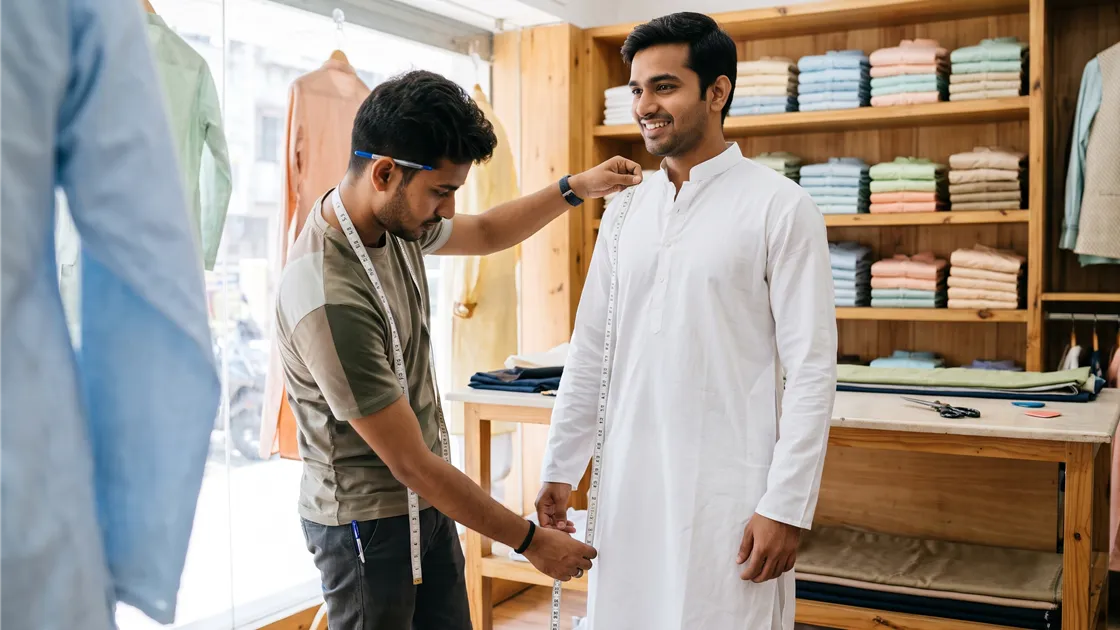
Most tailors measure a kurta the way they measure a shirt and add length. It works for the top, and it misses what a kurta is worn for. A man wears a kurta to sit cross-legged at a function, to bend at a puja, to stand in a wedding photograph and to sit at a long dinner. A shirt is fitted for a desk. A kurta has to be comfortable on the floor.
So the measurements that matter most are not the chest and shoulder, which are taken as for a shirt. They are the hip, which decides whether the side slits pull open when he sits; the length, which decides how the whole outfit looks; and the armhole, which decides whether he can raise his arms. And the pyjama, which is a separate garment with its own measurements, and the one most often taken carelessly.
The Kurta Measurement Chart
Take these standing, over a vest or a thin shirt, with his arms relaxed.
| Measurement | Where the tape goes | What goes wrong |
|---|
Neck | Round the base of the neck, one finger inside | Taken tight, so a collared kurta presses at the throat |
Shoulder | Across the back, shoulder point to shoulder point | Taken wide, so the shoulder seam drops down the arm |
Chest | Round the fullest part of the chest, under the arms | Taken with the chest held out; ask him to breathe normally |
Stomach | Round the fullest part of the stomach | Skipped, then the kurta pulls across the middle |
Hip | Round the fullest part of the seat | Skipped, so the slits gape open when he sits |
Kurta length | From the shoulder point, near the neck, straight down the front | Not agreed. Show him the knee and ask |
Sleeve length | Shoulder point down to the wrist bone, arm hanging naturally | Measured to the hand, so the cuff falls over the knuckles |
Sleeve round | Round the fullest part of the upper arm | Cut close, so the sleeve binds when he folds his arms |
Cuff or wrist | Round the wrist, or the hand if the cuff has no opening | Cuff too narrow to pass over the hand |
Armhole | Round the top of the arm, two fingers loose | Cut to the shirt armhole, so it pulls at a function |
Slit length | From the hem up the side seam to where the slit ends | Not asked. Ask how high he wants it |
Placket length | From the neck down the front opening | Guessed. Short for a collar, longer for a band neck |
Write down the neck style: a band collar, a stand collar, a round neck or a shirt collar. It changes the neck measurement and the placket, and customers rarely mention it unless asked.
The Pyjama Measurement Chart
Take the pyjama measurements on the same visit, not from memory at the cutting table.
| Measurement | Where the tape goes | What goes wrong |
|---|
Waist | Where he actually ties the pyjama, usually a little below the navel | Taken at his trouser waist, which may be lower |
Hip | Round the fullest part of the seat | The most important one; a tight pyjama splits when he sits |
Thigh | Round the fullest part of the thigh | Skipped on a churidar, which then binds |
Knee | Round the knee | Needed for a churidar or a fitted pyjama |
Bottom opening | Round the ankle, or the opening he wants | Cut narrow on a straight pyjama, so it does not drape |
Pyjama length | From the waist down the outside leg to the ankle bone | Taken barefoot for a churidar gathered over footwear |
Seat depth | Sitting on a flat chair, from the waist down to the seat | Not taken, so the crotch sits too low or pulls |
For a churidar, add the extra length that gathers at the ankle, usually 6 to 10 inches more than the leg length, and check that the bottom passes over his foot. The churidar measurement chart explains the gathered length in detail; the method is the same for men.
Standard Kurta Sizes for Men
Ready-made men's kurtas are sized by chest. The table is a counter reference for a customer who knows only his size, not a cutting size.
| Size | Chest, in | Shoulder, in | Usual kurta length, in | Sleeve length, in |
|---|
S / 38 | 38 | 16.5 - 17 | 38 - 40 | 23 - 24 |
M / 40 | 40 | 17 - 17.5 | 39 - 41 | 23.5 - 24.5 |
L / 42 | 42 | 17.5 - 18 | 40 - 42 | 24 - 25 |
XL / 44 | 44 | 18 - 18.5 | 41 - 43 | 24.5 - 25.5 |
XXL / 46 | 46 | 18.5 - 19 | 42 - 44 | 25 - 26 |
Two men in a size 42 may want lengths four inches apart, so always ask.
Ease: What to Add for Each Style
How much room to leave depends on the style he wants. Ask before you cut: fitted, regular or loose.
Regular straight kurta: add 4 to 6 inches at the chest, 4 to 6 at the stomach and 6 at the hip. Leave the armhole loose.
Slim or fitted kurta: add 3 to 4 inches at the chest and stomach and 4 to 5 at the hip. Check the hip with him sitting at the trial.
Pathani or loose kurta: add 6 to 8 inches at the chest and more at the hip; the look is meant to be generous.
Short kurta: worn over jeans or a trouser, ending near the hip. The same ease as a regular kurta, but agree the length carefully; an inch too long and it looks like a mistake.
For the pyjama, add 6 to 10 inches at the hip for a straight pyjama with a drawstring, less for a fitted one, and leave the seat depth generous enough for sitting cross-legged.
The Questions to Ask Before Cutting
Most kurta complaints are not measurement errors. They are decisions nobody asked about. Five questions at the counter prevent most of them.
What is it for? Daily wear, office, a puja, a wedding. It changes the fabric, the fit and the length.
How long? Ask him to show you with his hand, at the knee, above it or below it. Do not say a number.
Which neck? Band, stand collar, round or shirt collar.
What bottom? A straight pyjama, a churidar, a dhoti, or worn over jeans. A kurta for a churidar is usually longer than one worn over jeans.
Pockets? Side pockets in the seam are expected by most men and forgotten by most tailors.
Festival and Family Orders
Kurta pyjamas arrive in waves: before Diwali, Eid, Pongal and the wedding months, and very often as a family order, with a father, two sons and a nephew all wanting matching sets for the same day. The measurements are simple; the planning is not.
Measure everyone on the same visit if you possibly can, and write each man's name on his own slip, not "elder son" and "younger son". Agree one fabric, one neck style and one length rule for the group, then note where any one of them differs. Matching kurtas that arrive with three different collars are a complaint even if every one fits.
Children in a family order grow fast, so measure them fresh every time rather than reusing last year's numbers, and leave a little extra in the hem and side seams so the set lasts another season. Give the whole group one trial day, and fix collection at least two days before the function. Something always needs pressing, and a family that collects the morning of the wedding will remember the rush, not the stitching.
How Much Cloth It Takes
A man's kurta of ordinary length takes about 2.5 metres of 36-inch cloth, more for a long or loose kurta and less in a wider fabric. A straight pyjama takes around 2.25 to 2.5 metres of 44-inch cloth, and a churidar a little more for the gathered leg. Ask the length before you agree the cloth, especially when he has brought his own. Our guide on how much cloth each garment needs covers the rest of a family order, and the shirt and pant measurement chart shows the shared measurements in more detail.
Frequently Asked Questions
What measurements are needed for a men's kurta?
Neck, shoulder, chest, stomach, hip, kurta length, sleeve length, sleeve round, cuff, armhole, slit length and placket length. The hip and the length are the two that most often cause complaints.
What measurements are needed for a pyjama?
Waist where he ties it, hip, thigh, knee, bottom opening, pyjama length and seat depth. For a churidar, add 6 to 10 inches to the length for the gathers at the ankle.
How much loose should a kurta be?
For a regular straight kurta, about 4 to 6 inches over the chest and stomach and 6 inches over the hip. A slim kurta needs less, and a pathani or loose kurta more.
What is the standard length of a men's kurta?
Usually between 38 and 44 inches from the shoulder, depending on his height and the style. Ask him to show the length with his hand rather than quoting a number.
Where Juvee Helps
A kurta pyjama is two garments with nearly twenty measurements, and the man who orders one for Diwali usually orders again for a wedding. Juvee keeps every customer's measurements against his name, with the date, the style and your notes on the length and the neck, so the next order starts where the last one finished; see measurement management. The Basic plan is free with no time limit, and paid plans start at ₹10,190 a year including GST; the pricing page lists every plan.