Aari work turns a plain silk blouse into the one a customer brings for a wedding, and it can earn more per hour than the stitching underneath it. Here is how a tailoring shop can start aari work alongside tailoring: what you need, how to learn it or find someone who knows it, how to price it, and the mistakes that cost shops their first season.
What Aari Work Is
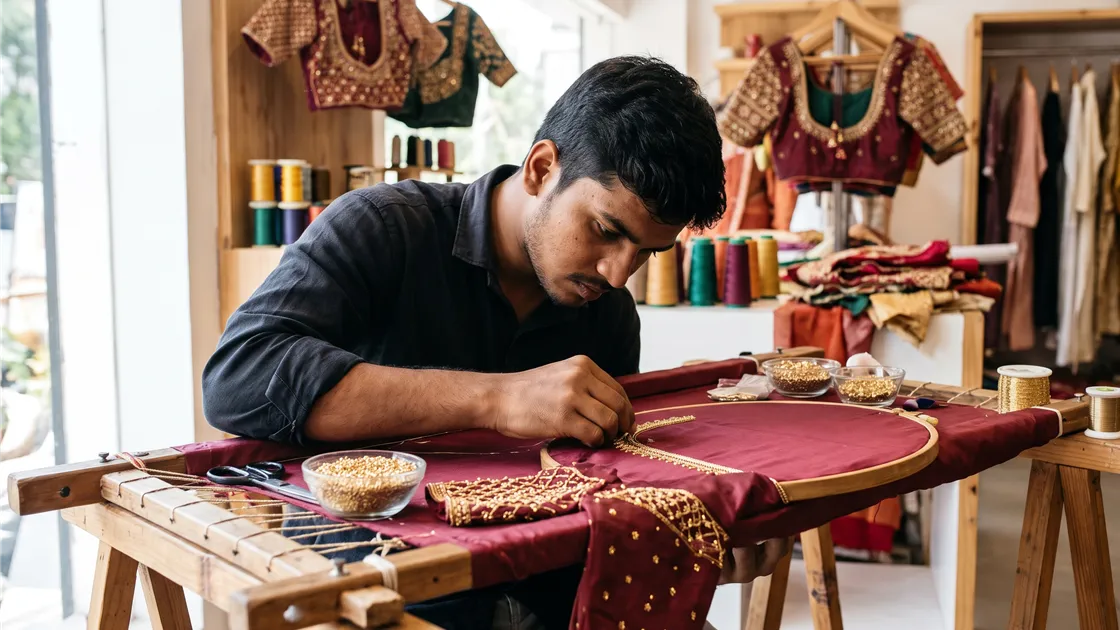
Aari work is embroidery done with a fine hooked needle, the aari, on fabric stretched tight across a wooden frame. The needle pulls the thread up from below to make a fast, even chain stitch, and the same needle is used to lay zari, beads, sequins, stones and cut dana onto the design.
It is quicker than most hand embroidery, which is why it suits blouse work so well. A skilled worker can fill a sleeve or a back neck in a day where needle-and-thread embroidery would take several. And because the finished work is raised, shiny and dense, it photographs beautifully, which is exactly what a customer buying for a wedding wants.
In much of South India, and in Tamil Nadu especially, aari work has become the standard for bridal and occasion blouses. A ladies tailoring shop that sends every aari job out, or cannot offer it at all, watches that work and its margin go to someone else.
Why It Fits a Tailoring Shop
A shop that already stitches blouses has the one thing an aari business needs most: customers who are already standing at the counter with a silk blouse piece in hand.
Adding aari changes the order from a stitching job into a design job. The bill for the same blouse can rise several times over, and the stitching underneath stays the same work it always was. The customer gets one shop to deal with instead of two, and one date to rely on.
It also fills the slow months. Aari orders for weddings are booked weeks ahead, and the embroidery can be done in the quiet spells between stitching orders, rather than everything landing in the festival rush. Our guide to surviving the off season covers why that matters.
What You Need to Start
The equipment is modest. The skill is not.
A frame: a wooden aari frame, adjustable, big enough to stretch a full blouse piece or a sleeve. A basic one costs a few thousand rupees. Start with one.
Needles: aari needles in a few sizes, with a holder. They are cheap, and they wear, so keep spares.
Materials: embroidery threads, zari, beads, sequins, stones and cut dana. Start with a small stock in the colours that sell, gold, silver, maroon, green and the season's favourite, rather than a full range.
Light and space: a well-lit corner where the frame can stay set up. Aari work is close, fine work, and poor light means slow work and bad stitches.
Design tracing: tracing paper, a tracing wheel or powder and pattern transfer materials, and a growing file of designs.
Learning It or Hiring It
There are three ways to bring aari into the shop, and most shops end up using a mix.
Learn it yourself
Short aari courses are widely offered, in person and online, and the basic chain stitch can be learned quickly. Speed and neatness take months of practice. Start on your own pieces and simple designs before you take a customer's silk on the frame.
Hire a skilled worker
The fastest way to start properly. Look for someone who can show you finished work and do a short test piece in front of you, the same way you would test a karigar; our guide to hiring a karigar covers what to ask. Pay can be per piece or by design size; agree it before the first job.
Outsource to a home worker
Many aari workers work from home and take jobs from shops. It costs no space and no fixed wage, but it adds a step you do not control: the blouse leaves the shop, and its date depends on someone else's week. Record exactly what went out, when and to whom.
Pricing Aari Work
Aari work should be priced as embroidery, never folded into the stitching rate. The customer is buying the design, and the design is where the hours are.
Price from the time and the materials, the same way as any hand work: estimate the hours for the design, multiply by what an hour of your shop's time costs or what you pay the worker, and add the materials, which on heavy zari and stone work can be a large part of the bill. Our guide on costing embroidery and hand work shows the method step by step.
Work | What decides the price |
|---|
Simple border or neckline outline | Length of the design and the thread used |
Sleeve or back neck motif | Size and density of the motif, number of colours |
Full sleeve and back neck | Hours on the frame and the materials |
Heavy bridal work with zari and stones | Materials, density and the number of days on the frame |
Matching work on a saree or lehenga | Quoted separately, often by the design size |
Show the price by design, not by the hour. Customers understand "this design is this much" far better than an hourly rate, and a small album of your own finished work with a price beside each piece answers most questions before they are asked.
Taking the Order
An aari order carries more decisions than a plain blouse order, and every one of them should be written down.
The design, chosen from your album or her photograph, with any changes she asked for. The placement: sleeves, back neck, front neck, all over. The colours of thread, zari and stones, ideally with a sample against her fabric. The price, the advance and the date. The blouse order checklist covers the stitching side.
Agree the sequence too. Aari work is done on the cut pieces before the blouse is stitched, so the measurements must be taken and the pieces cut first. A blouse embroidered and then found too small cannot be let out.
Take a larger advance on aari orders than on plain stitching. The materials are bought for her design, and a cancelled order leaves you with zari and stones you may never use.
The Mistakes That Cost Shops Their First Season
Taking too many orders too early
Aari work is slow at first. A shop that takes ten bridal orders in its first month learns the hard way how long a full sleeve takes. Start with small designs and a few orders, and grow as the speed comes.
Folding aari into the stitching rate
"Blouse with work, Rs so much" hides how much the work is worth. Quote the stitching and the embroidery separately.
Embroidering before cutting
Embroidering a whole blouse piece and cutting afterwards wastes work in the seams and can push the design off-centre. Cut first, frame the pieces, then embroider.
Not photographing the work
Every finished piece is your next advertisement. Photograph it against a plain background before it leaves the shop, with the customer's permission if she is wearing it, and use it in your album and on Instagram; our guide to Instagram marketing for boutiques and tailors covers how.
Frequently Asked Questions
Can a tailoring shop start aari work?
Yes, and many do. The shop already has the blouse customers. The equipment is a frame, needles and materials; the skill can be learned, hired or outsourced to a home worker.
What is needed to start aari work?
A wooden aari frame, aari needles, embroidery threads, zari, beads, sequins and stones, good light and a set of designs to trace. Start small, with one frame and the colours that sell.
How should aari work be priced?
As embroidery, separately from the stitching. Estimate the hours for the design and the cost of materials, then quote a price per design rather than an hourly rate.
Should aari work be done before or after stitching the blouse?
Before. Measure, cut the pieces, then embroider them on the frame, and stitch the blouse last, so the design sits in the right place and nothing is wasted in the seams.
Where Juvee Helps
An aari blouse has more stages than a plain one: cutting, embroidery, perhaps a home worker, then stitching and the trial. Juvee shows every order's stage and date, so a blouse that has gone out for aari work is never lost track of, and the customer's message about her wedding blouse can be answered in seconds; see order tracking. The Basic plan is free with no time limit, and paid plans start at ₹10,190 a year including GST; the pricing page lists every plan.